
Per-channel pricing: why one flat price loses money
May 25, 2026
You set the same price everywhere because it feels fair and because it’s easy. One number you copy and paste into Amazon, into MercadoLibre, into your Shopify store. It feels like control. The truth is the opposite: every marketplace charges you differently, costs you differently to fulfill, and competes for different reasons. The price that wins on one channel is the one that bleeds your margin on another. The same number does not mean the same profit.
The problem is you almost never see it. You see it when the month closes, you open three separate dashboards, you export reports that don’t reconcile with each other, and you build a spreadsheet by hand to figure out why you sold well but earned little. By then it’s too late: the negative-margin sales have already cleared, the fees have already been deducted, and you’re setting your next price with data that’s three weeks old.
This article isn’t about raising prices or lowering them. It’s about understanding why a single flat number can’t be optimal across channels that work differently, and how to stop guessing by starting with one real-time source of truth across every channel, instead of gluing fragments into a spreadsheet at every month’s end.
each channel charges you differently
Start with the simplest thing: the fees aren’t equal. On Amazon you pay a category referral fee plus, if you use FBA, the fulfillment and storage fees. On MercadoLibre you pay the commission for the listing type (Clásica or Premium), plus the shipping cost you absorb in many cases when the product qualifies for free shipping, plus the fixed charge on low-ticket items. On your Shopify store you pay the payment gateway, the 3PL cost if you don’t ship yourself, and the advertising you have to switch on for anyone to reach the store at all.
Put numbers on it. A product priced at 600 pesos that nets you about 380 on Amazon after referral and FBA might net 300 on MercadoLibre with a Premium listing and free shipping, and 450 on Shopify after gateway and 3PL. Same sale price, three different margins. If you set the price by looking only at the channel where you sell most, on the other two you’re selling at a margin you never truly calculated.
The trap is that the flat price hides this difference. You see “600 everywhere” and read it as uniformity. The marketplace reads it as three different businesses with three different cost structures. The uniformity lives on the label, not in your pocket.
Dictionary: real net margin is what’s left after ALL channel deductions —referral, fulfillment, shipping, gateway— not the gross margin over product cost.shipping changes the whole equation
In Mexico, shipping isn’t a detail: it’s often the cost that decides whether you win or lose. MercadoLibre pushes free shipping hard through Mercado Envíos, and when your product crosses the price threshold for free shipping, you pay a meaningful part of that cost yourself. That means the same product, depending on which side of the threshold you place it, can have a completely different cost structure.
Raise the price 30 pesos to “earn more” and you sometimes cross the threshold, suddenly absorbing the full shipping cost and losing far more than the 30 you gained. Drop it 30 and you sometimes fall out of free shipping and kill conversion, because the Mexican buyer filters for free shipping almost by reflex. This doesn’t happen the same way on Amazon, and on your Shopify it depends on the 3PL and your shipping policy.
That’s why a flat price is blind to shipping. The number that optimizes your position against the threshold on one channel leaves you in a bad spot on another. You need to think about each channel’s price with that channel’s cost logic, not with an average that represents none of them.
the competition isn’t the same on each side
On Amazon you compete for the Buy Box, where price matters but so do your rating, your fulfillment method and your history. On MercadoLibre you compete for listing position and for reputation (the color of your medal), where an aggressive price lifts you but reputation holds you up. On Shopify you don’t compete in a listing: you compete against the cost of acquiring traffic, against your own brand, against the abandoned cart.
That means “competitive price” is a different idea on each channel. A price that wins the Buy Box on Amazon may, on MercadoLibre, be more expensive than three sellers with better reputation who rank above you. And on your own store, where you control the narrative, you can sometimes hold a higher price because there’s no competitor one click away.
When you put the same number on all three, you’re accepting a loss on the channel where that number isn’t competitive, and you’re leaving money on the table on the channel where you could charge more. The flat price is a draw that loses at both ends.
the real pain: three dashboards and yesterday’s spreadsheet
Here’s the invisible work almost nobody talks about. To know what you truly earn per channel, today you open Amazon Seller Central and pull your fees and settlements report. You open MercadoLibre and pull your sales and charges. You open your 3PL panel and check storage and picking costs. And then, in a spreadsheet, you try to glue all of that together product by product to reach a number that’s already several days old.
That workflow has three flaws. The first is that it’s manual, so it breaks: one mispasted column and your pricing decision comes out crooked. The second is that it’s slow, so you decide with yesterday’s data while the market moved today. The third is that each source defines things differently, so you end up comparing apples to oranges without noticing.
The way out isn’t a prettier spreadsheet. It’s a single source of truth: one place where your sales, your fees and your shipping costs from each channel arrive together, normalized, in real time, so that margin per channel is a figure you look up, not a calculation you rebuild every month. When you stop assembling the report, you start making the decision.
Dictionary: the price calendar is the plan for which price applies on each channel and each date, so changes and promos don’t collide across marketplaces.what “per-channel pricing” means in practice
Per-channel pricing doesn’t mean inventing different prices at random. It means starting from the real net margin of each channel and setting, for each one, a price that respects a profitability floor you decide. On Amazon that floor may force one price; on MercadoLibre, because of shipping and commission, another; on Shopify, where the fee is lower, you can be more flexible.
The difference between channels doesn’t have to be large to matter. Sometimes it’s 20 or 40 pesos. But that difference is exactly what turns a zero-margin sale into a healthy one, or what makes you competitive where that number decides the Buy Box. The point isn’t to charge more: it’s to charge what’s correct for the cost structure on each side.
And here’s where coordination comes in. If you’re going to run different prices per channel, you need to see them together so they don’t contradict each other, so a promo on one doesn’t leave you selling below cost on another, and so changes are scheduled instead of done by hand every time. That’s exactly what an automatic price calendar solves: it lets you plan per channel without losing sight of the whole.
how to start without going crazy
You don’t have to redesign your whole strategy on Monday. Start with your ten highest-volume SKUs, because that’s where most of your profit and most of your leaks live. For each one, calculate the real net margin on each channel with its actual fees and shipping, not the average. You’ll find at least one that’s selling on some channel with almost no margin, and you didn’t know because the flat number hid it.
Then define a profitability floor per channel: the minimum margin below which you don’t want to sell there. With that floor, stop treating sale price as the main figure and start watching the margin it leaves you on each channel. Price becomes the lever; margin becomes the goal.
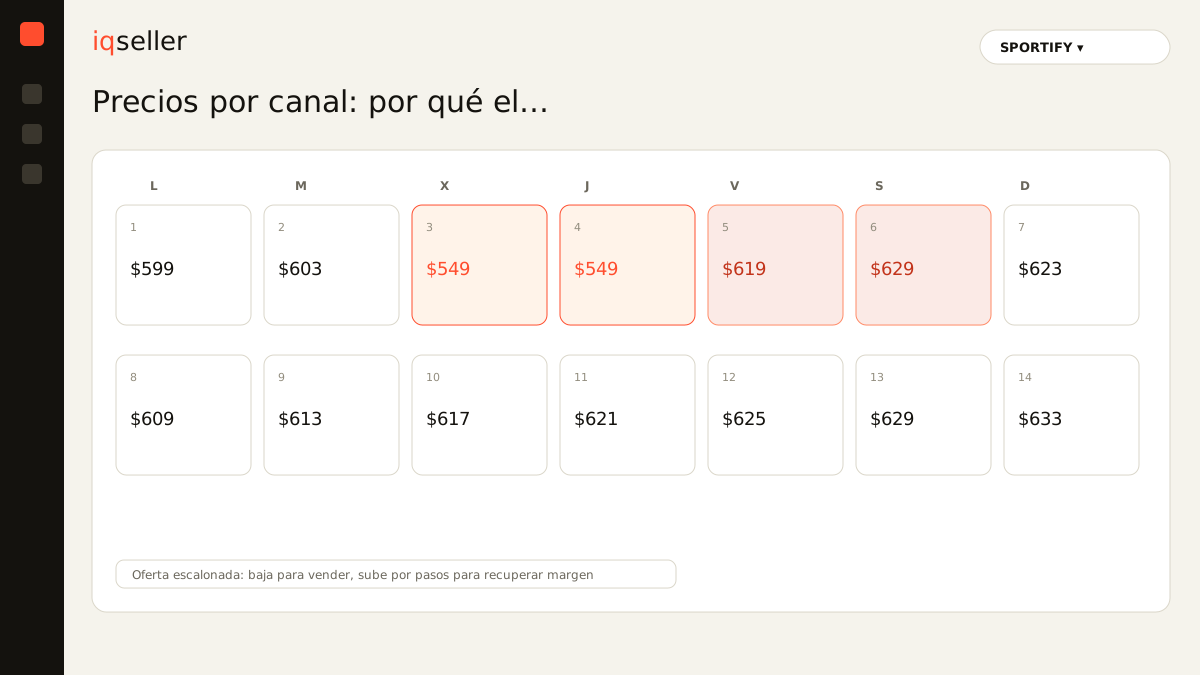
Dictionary: a tiered offer applies discounts by brackets (by quantity or by date) instead of one flat markdown, to protect margin while you push volume.Finally, automate the capture. As long as you keep pasting reports by hand, you’ll decide late and afraid. When your channel data lands in one place and margin per channel updates on its own, per-channel pricing stops being a month-end project and becomes a decision you make with today’s information. SPORTIFY, like any seller running the same catalog on Amazon and MercadoLibre at once, doesn’t need more spreadsheet hours: it needs to see each channel’s real margin before setting the price, not after the sale clears.
The same price everywhere isn’t neutrality: it’s a decision, and almost always the wrong one. Every channel has its own cost, shipping and competition. Treating them alike gifts margin to whoever charges you most and skips revenue where you could earn more. Per-channel pricing, backed by one real-time source of truth, isn’t about charging more: it’s about no longer losing where you don’t even know you’re losing today.