
Report builder: build your view without a spreadsheet
March 17, 2026
Almost every multichannel seller keeps one sacred spreadsheet. It is the file where, every Monday, you paste sales from Amazon Seller Central, sales from MercadoLibre, the inventory your 3PL reports, and an improvised column for fees. That file grew on its own, formula on top of formula, and today it is the only real “view” you have of your business. The catch is that you build that view by hand, it takes hours, and by the time it is finally ready it already reflects yesterday’s cutoff.
The pain is not the spreadsheet itself. The pain is that every new question —“how did each product family do last week?”, “which SKUs are eating margin through advertising?”, “how much real stock do I have left across both channels?”— forces you to rebuild the file, add tabs, copy and paste from three different dashboards, and pray no cell lands in the wrong place. Consolidation became the job, not the tool. And while you consolidate, decisions wait.
A report builder attacks exactly that point: instead of exporting, pasting and fighting with pivot tables, you choose what you want to see and the platform assembles the view on data that is already unified and current. This article explains what problem it actually solves, how to think about it, and where the real difference lies compared to your usual spreadsheet.
why your spreadsheet stops scaling
Your sheet worked because you started with few SKUs and a single channel. Every time you add a marketplace, a warehouse or a metric, the cost of maintaining the file does not grow linearly: it explodes. Adding Amazon plus MercadoLibre plus 3PL by hand is precisely the moment where human error sneaks in, and one mistake in a cost cell contaminates the margin of your entire catalog without you noticing.
There is a silent cost few people measure: time. If you spend two mornings a week consolidating, that is eight mornings a month you are not using to negotiate with suppliers, adjust pricing, or handle a stockout. The spreadsheet is not free; you pay for it in hours you do not bill. And unlike a stockout, that cost shows up in no report, because the report is exactly what you are building.
The second limit is fragility. A formula only you understand is an operational risk: if you go on vacation or hire someone, nobody can touch the file without breaking it. The “view” of the business stays tied to one person. That is not a system, it is a dependency.
what a report builder really is
It is not an exporter on steroids, nor a spreadsheet inside the platform. A report builder starts from a different premise: the data is already clean, unified by the real product (not by the listing) and up to date. The only thing you do is decide the angle from which to look at it.
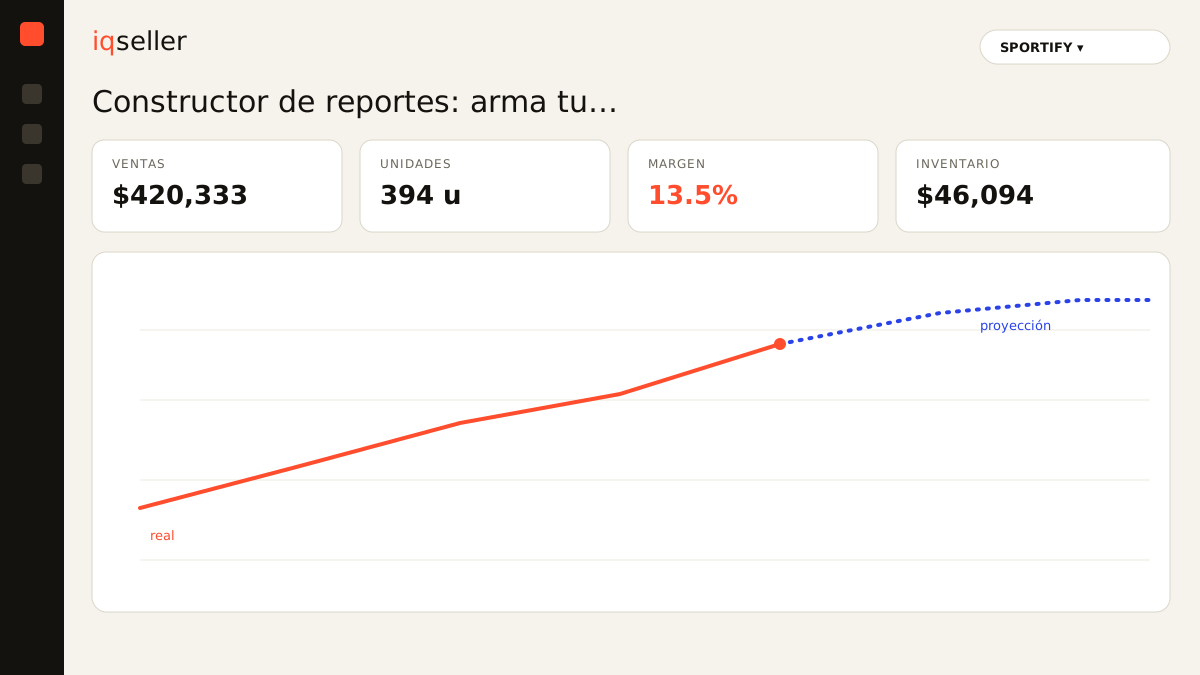
In practice that means choosing three things: which metrics you want (sales, units, net margin, ACoS, days of inventory), how to group them (by channel, by product family, by SKU, by brand) and over what period (this week, month to date, compared against last year). With those three decisions, the platform composes the table or chart instantly, without you touching a single formula.
The deep difference lies in the origin of the data. In a spreadsheet, each number is a snapshot you pasted; in a builder, each number is a live query against a single source of truth.
Dictionary: real-time synchronization is what lets a report reflect what happened minutes ago, not the yesterday cutoff you pasted by hand.from exporting to composing
Change the verb and the work changes. With a spreadsheet, your routine is to export: pull a CSV from Amazon, another from MercadoLibre, the 3PL report, and start pasting. With a builder, your routine is to compose: you no longer fetch data, you look at it from wherever suits you.
This has an effect that goes beyond saving time. When building a view costs hours, you ask few questions and always the same ones. When building a view costs seconds, you dare to ask more: you try grouping by brand, then by season, then you cross margin against advertising. Curiosity stops carrying a prohibitive cost, and that is where the findings your rigid spreadsheet would never surface start to appear. If you want to see this principle applied to pricing, check the automatic price calendar: the same logic of “decide the rule, do not rebuild the file.”
the views you actually use
A good builder does not drown you in options; it lets you save the views you repeat every week. These are the ones almost every multichannel seller ends up needing:
- Sales by channel, side by side. Amazon and MercadoLibre in the same table, no manual addition, to see at a glance where you are growing and where you are stalling.
- Margin by product family. Not the sale price, but what you actually keep after fees, commissions and advertising, grouped by line.
- Days of inventory by SKU. The countdown to a stockout, combining stock across all warehouses into a single number.
- Top and bottom by margin. Which products carry you and which are bleeding you, sorted without you building a pivot table.
- Comparison against the prior period. This week against last, this month against last year, to separate the trend from the noise.
What matters is not that these views exist; it is that you define them once and they come back on their own, already updated, every time you open the platform.
Dictionary: real available stock is what you can truly sell today across channels and warehouses, not the inflated total stock figure.the right data behind every cell
A report is worth as much as its weakest data point. This is where a builder on unified data separates itself from a spreadsheet: the metrics it shows are not approximations, they are consistent calculations drawn from the same catalog and the same cost rules for every channel.
Take margin. In a spreadsheet it is tempting to subtract product cost from price and call it margin. But the real margin of a multichannel seller includes each marketplace’s fees, the category commission, the 3PL logistics cost, and the advertising that SKU consumed. Computing that by hand for every product and every channel is unworkable; that is why almost nobody does it and almost everybody decides with a margin that does not exist.
Dictionary: real net margin subtracts fees, commissions, logistics and advertising, not just product cost, and it is the only one that tells you whether a SKU wins or loses.When the data already comes properly calculated, the report stops being an act of faith. You stop arguing about whether the number is right and start arguing about what to do with it. That shift —from validating data to making decisions— is the real gift of not depending on a spreadsheet. If you are interested in the deep contrast, it is worth reading the pain of five dashboards and a spreadsheet, which dismantles piece by piece why manual consolidation fails.
how to start without breaking your operation
You do not have to throw out your spreadsheet overnight. The healthy transition is in layers. First, replicate in the builder the two or three views you use most and compare them against your file for a couple of weeks; when the numbers match and you see that the platform’s version is fresher, confidence arrives on its own.
Then, add the questions you were not asking before because they cost too much: margin by brand, behavior by season, SKUs with advertising that does not pay back. This is where the builder starts to pay off beyond expectation, not just replacing old work but enabling new analysis.
Finally, let go of the views that no longer add value. Many sellers carry inherited reports nobody looks at because “they were always there.” A builder invites you to curate: keep only the views that move a decision. Fewer tabs, more clarity.
The goal is not to have more reports; it is to have the ones that matter, alive and reliable, without you being the engine that maintains them. That is the point where your view of the business stops being a fragile file and becomes something you can lean on to decide today, with today’s data.