
The pain of five dashboards and a spreadsheet
March 27, 2026
If you sell on more than one marketplace, you know the routine. You open Amazon Seller Central in one tab, MercadoLibre in another, your 3PL panel in a third, maybe the Shopify admin in a fourth, and you end up pasting everything into a spreadsheet you built two years ago that nobody quite remembers how it calculates. Every morning the same ritual: copy sales from here, stock from there, fees from somewhere else, and try to figure out where you actually stand today. The trouble is that by the time you finish gathering the data, it is already noon and the numbers you are looking at are yesterday’s.
That is the real pain of the multichannel seller. It is not that information is missing: there is too much of it. Each platform has its own dashboard, with its own definitions, its own reports, and its own way of counting the same thing. What is missing is a single source of truth that tells you, without you having to assemble it by hand, how much you sold, how much stock you have left, how much it cost you to sell, and how much you actually made. Without that, every decision you make —raising a price, reordering inventory, pausing a listing— rests on stale data and your gut.
This article is not about magic. It is about why the “five tabs and a spreadsheet” model breaks as you grow, what concrete mistakes it causes, and what it means in practice to have everything consolidated in one place and in real time.
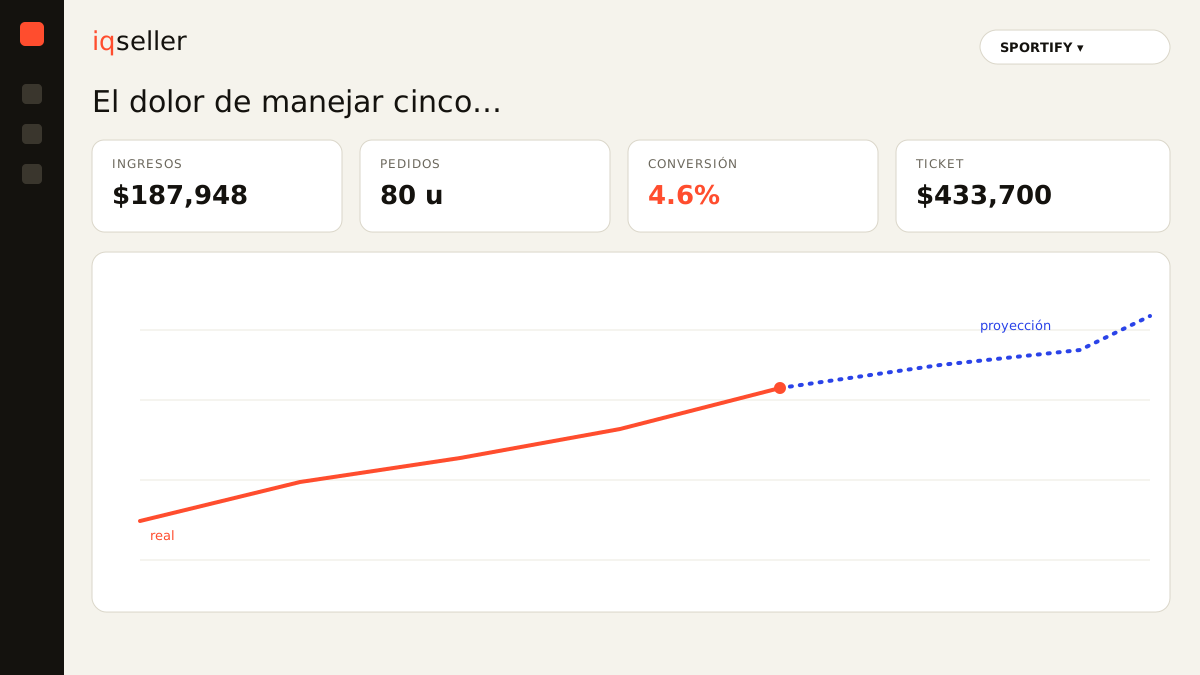
why five dashboards do not add up to one
Intuition says that having five data sources is like having five times the visibility. In practice it is the opposite. Each dashboard shows you a slice of the business, but none shows you the whole. Amazon tells you how much you sold on Amazon. MercadoLibre tells you how much you sold on MercadoLibre. Your 3PL tells you how many units it shipped. None tells you which of your SKUs is truly your star product across all channels, nor which one is costing you money after fees.
The problem gets worse because each platform counts differently. One treats a “sale” as confirmed when payment clears; another when it is invoiced; another when it ships. One bundles shipping into revenue, another splits it out. Some report in one time zone, others in another. When you merge it all into a spreadsheet, you are adding apples and oranges without noticing, and the total that looks “balanced” actually hides inconsistencies that only surface when something breaks.
the spreadsheet that started simple and nobody understands anymore
Almost every multichannel seller has that spreadsheet. It started as an innocent little sheet to track the week’s sales. Then you added a fees column. Then a product cost column. Then an inventory tab, another for returns, a macro someone handed you, a couple of formulas referencing cells that no longer exist. Today that file is the brain of your operation and at the same time its biggest risk.
The spreadsheet has three problems that more columns will not fix. First, it is manual: someone has to update it, and that someone gets sick, takes vacation, or makes a mistake. Second, it is static: it reflects the moment you filled it in, not the moment you read it. Third, it does not scale: what works with 30 SKUs across two channels becomes unmanageable with 300 SKUs across four. If you want to go deeper into when it is worth leaving it behind, we develop that in the automatic price calendar, which shows why pricing decisions cannot depend on a file you update once a day.
Dictionary: real-time synchronization means that when something changes on a channel —a sale, a stock adjustment— it is reflected immediately in your consolidated view, without you copying anything by hand.deciding with yesterday’s data costs money
The cost of the fragmented model is not only the time you lose consolidating. It is the cost of every decision you make on expired information. If you see yesterday’s stock, you can sell units you no longer have and fall into overselling, which on Amazon hits your account health and on MercadoLibre your reputation. If you see yesterday’s sales, you reorder late and run out of product in peak season. If you do not see updated fees, you set a price that looks profitable but, after commissions and taxes, leaves you at zero or in the red.
The classic case is the seller who looks at the spreadsheet, sees that a SKU “sells a lot,” and decides to restock it aggressively, without noticing that the very same SKU has a high return rate and a category fee that eats the margin. The units-sold number looks good; the net result does not. That is why it is also worth reading selling in uncertainty: the cost of not seeing your numbers, which puts figures to what happens when you decide blind.
a single source of truth, in real time
The alternative to the collage of dashboards is not a bigger spreadsheet or a prettier dashboard. It is a layer that connects to all your channels —Amazon, MercadoLibre, Shopify, your 3PL— and normalizes them into a single language. That means a sale is a sale no matter where it happened, that stock is one number even if it lives across several warehouses, and that margin is computed the same way everywhere, subtracting the real fees and costs of each channel.
With that foundation, you stop doing data archaeology every morning. Instead of asking “where is the number?”, you ask “what do I do with the number?”. The time you used to spend consolidating you now spend deciding. And because the view is real time, decisions rest on what is happening now, not on what happened when you filled in the file.
Dictionary: real availability is the stock you can truly sell today, after subtracting what is reserved, in transit, and committed to open orders across all channels.what changes in daily operations
The most visible change is that the morning no longer starts with copy and paste. Instead of opening five tabs, you open one and see the full picture: sales by channel, the SKUs that move the most, the ones running out of stock, the overselling alerts before they happen. Tasks that used to be reactive —“oh no, it sold out”— become preventive, because the system warns you when real availability crosses a threshold.
The second change is that team conversations stop being arguments about which number is right. When everyone looks at the same source, there is no more “my spreadsheet says this and yours says that.” Energy goes into deciding, not reconciling. For a seller like SPORTIFY, moving catalog on Amazon and MercadoLibre at the same time, that means going from operating defensively to operating ahead of time.
the margin you could not see
There is an uncomfortable truth in the multiple-dashboard model: you rarely know how much you truly make. Platforms show gross revenue generously, but fees, commissions, shipping costs, returns, and taxes live in separate reports that almost nobody cross-checks line by line. The result is that many sellers believe they have a healthy margin which, once everything is subtracted, turns out much thinner —or negative on certain SKUs.
Consolidating is not just convenience: it is the only way to see the real net margin by product and by channel. When that number is in plain sight, you decide differently. You raise the price where the fee justifies it, pause the SKU that loses money, double down on the one that truly performs. That is the difference between growing in sales and growing in profit.
Dictionary: real net margin is what you keep per unit after subtracting product cost, marketplace fees, shipping, returns, and taxes —not the gross revenue the channel shows.how to take the first step without breaking anything
You do not have to throw out your spreadsheet on Monday. The sensible path is to start by consolidating what hurts most: usually sales and stock, because those are the two things that cause the most expensive errors. Connect your channels, validate for a week that the consolidated numbers match each platform, and only then start basing decisions on the single view. The spreadsheet can remain a backup while you build confidence.
The important thing is to understand that the goal is not “to have one more dashboard.” It is to have one less: replacing the ritual of five tabs and a spreadsheet with a single source of truth that is always up to date. When you get there, the business becomes easier to read, faster to decide on, and far less dependent on someone remembering to update the right file on time.