
Selling in uncertainty: the cost of not seeing your numbers
March 24, 2026
Every multichannel seller knows this moment by heart. It’s eleven at night, you have three tabs open (Amazon Seller Central, the MercadoLibre panel, and your 3PL portal), and you’re copying figures into a spreadsheet to answer a single question: did you make or lose money this week? The answer never quite arrives. An approximation does. And on that approximation you base tomorrow’s decision.
Selling in uncertainty is not a problem of attitude or lack of experience. It’s structural: your business information lives scattered across systems that don’t talk to each other, each with its own definition of “sale,” of “fee,” and of “available stock.” When you stitch it together by hand, you don’t just lose hours; you introduce errors, you work with yesterday’s data, and you end up deciding based on a blurry photo of a business that actually moves by the minute.
This article isn’t about a magic tool. It’s about the real, measurable cost of operating without seeing your numbers, and about why a single real-time source of truth changes the very nature of the decisions you make as a seller.
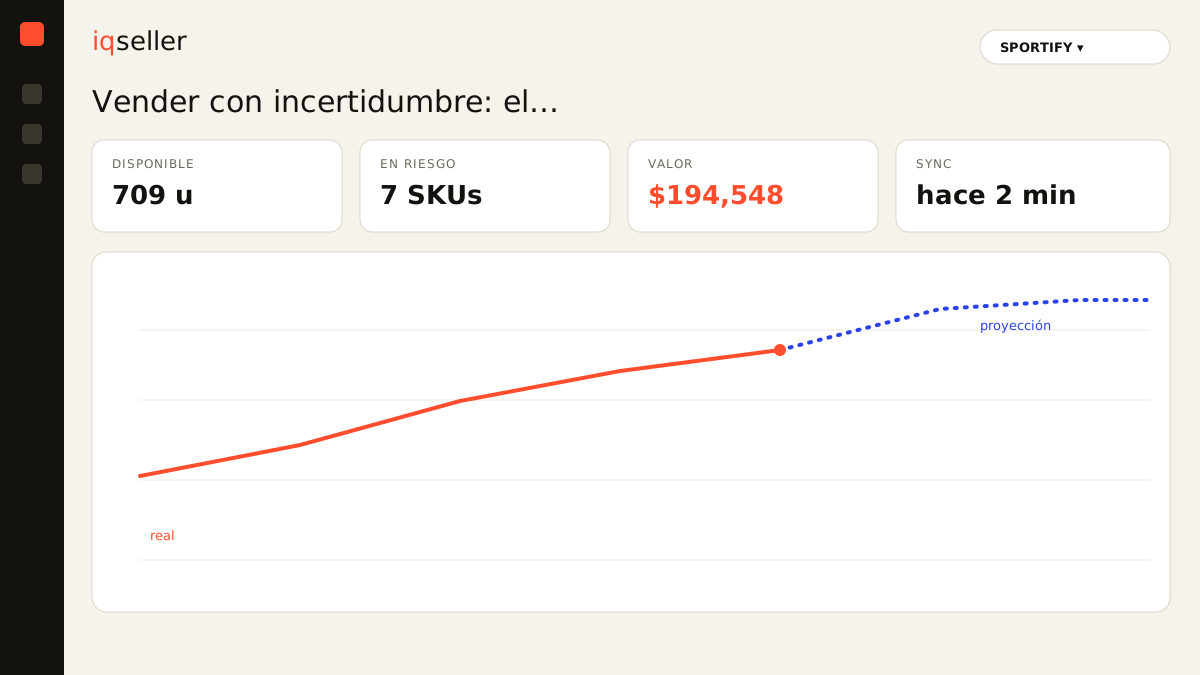
the invisible cost of stitching it together by hand
Let’s start with the most concrete part. When your operation lives across several dashboards, every decision carries a hidden time tax. You export a report from Amazon, another from MercadoLibre, you download inventory from the 3PL, paste it all into Excel, normalize the SKUs (because each marketplace names them differently), subtract fees, add shipping, and only then do you look at a number. By the time that number exists, it’s already old.
But the hours are the least serious cost. The real cost is everything you decide wrong in the meantime. If your spreadsheet says you have 40 units of a product and the 3PL has already shipped 12 that aren’t reflected yet, you’ll oversell or you’ll pause a campaign you could actually sustain. If you calculated a margin on an outdated Amazon fee, you’re cutting price on a profit that doesn’t exist. Every manual sheet is a bet placed on yesterday’s data.
And there’s an even quieter cost: not deciding at all. Many sellers, faced with a lack of clarity, simply wait. They don’t send inventory because they’re unsure of sales velocity. They don’t adjust pricing because they don’t know the real margin. They don’t launch on a new channel because they can’t keep up consolidating the ones they have. Uncertainty doesn’t only produce bad decisions: it produces paralysis.
why yesterday’s data costs you money today
In a marketplace business, the variables that matter move in hours, not days. Stock drops with every sale. The Buy Box shifts with the competition. A MercadoLibre promotion spikes demand for one SKU and leaves another untouched. An Amazon fee updates and alters the margin of an entire category.
When you work from a morning export, you’re flying a plane while staring at an instrument that froze six hours ago. Maybe everything’s fine. Maybe you’re about to run out of fuel and the gauge isn’t telling you. That gap between what’s happening and what you can see is exactly where money leaks out: stockouts you didn’t anticipate, oversells that trigger cancellations and penalties, prices you left too low during a demand spike.
Dictionary: real-time synchronization connects your channels so the number you see is the number that is, not an old copy.The difference between a seller who reacts and one who anticipates is almost never talent. It’s latency. The one who sees their numbers the moment they change can move price ahead of the competition, restock before the stockout, and pause before the oversell. The one who sees them tomorrow reacts to a problem that already cost sales.
the trap of the spreadsheet that feels like control
A spreadsheet gives a reassuring sense of control. It’s yours, you understand it, you built it. But that very feeling is the trap. A spreadsheet is a photo of the past that needs manual work to stay current, and anything manual breaks: a formula someone moved, a SKU renamed on one channel, an exchange rate you forgot to update, a tab still holding last week’s data.
The bigger your operation grows, the more fragile the sheet becomes. What worked with 20 products on one channel collapses with 200 products across three channels plus a 3PL. You reach a point where you spend more time keeping the sheet alive than using it to decide. And worse: you start to distrust it, because it’s failed you before, so you reopen the three dashboards “just to confirm.” The loop closes on itself.
The underlying problem isn’t Excel as a tool. It’s that you’re asking it to be a live, multichannel database, something it was never designed for. What you need isn’t a better spreadsheet; it’s for the numbers to arrive already consolidated, already reconciled, without you being the human integrator between systems that don’t speak to each other.
what changes when there’s a single source of truth
A single source of truth means inventory, sales, fees, and margin from all your channels live in one place, under the same definitions, updating on their own. It’s not a report you generate: it’s a state you consult. The question “how much stock do I really have available to sell?” stops requiring an investigation and starts having an instant answer.
This matters because it changes the unit of measure of your decisions. Instead of “what does this morning’s sheet say?”, the question becomes “what’s happening right now?”. Real availability accounts for what’s committed, in transit, and reserved across every channel, not just what shows up in a static column.
Dictionary: real availability is the stock you can truly sell today, after subtracting what’s committed and in transit across all your channels.On that foundation, the inventory forecast in depth stops being a guessing game. If sales velocity, real stock, and replenishment lead times sit in one place and stay current, projecting when you’ll run out becomes arithmetic, not intuition. Uncertainty doesn’t disappear —selling always carries risk— but it stops being self-inflicted by bad information.
from the number you react to, to the number you anticipate
Seeing your numbers in real time isn’t just operational comfort; it reorders the hierarchy of your decisions. When real net margin is visible instantly, you stop making pricing decisions blind. You know how much you keep after fees, commissions, shipping, and product cost on each channel, and that number tells you how far you can move price without destroying profit.
Dictionary: real net margin is what you actually earn per sale after subtracting all costs and fees, not the gross margin on the list price.Take a concrete example. SPORTIFY sells the same product on Amazon and on MercadoLibre. On Amazon it pays a category fee plus FBA; on MercadoLibre it pays a commission plus free-shipping cost. If SPORTIFY looks only at the selling price, both channels appear equally profitable. But the real net margin can differ by 15 points between them. Without seeing it, SPORTIFY would spend ad budget on the wrong channel, cut price where it shouldn’t, and restock thinking of the lower-margin channel. With the number in front of it, every peso of inventory and advertising goes where it pays off.
That’s the difference between reacting and anticipating. The seller who reacts discovers the problem once it’s already happened: the stockout, the oversell, the margin that evaporated. The one who anticipates sees the trend while it unfolds and moves the piece first. And to anticipate you don’t need to be a fortune teller; you need the right data to be where you can see it in time.
seeing your numbers isn’t a report, it’s a way of operating
There’s a mistaken idea that “seeing the numbers” is something you do at month-end, when you close the books. But the close is only the photo of the result. The real operation happens every day, in hundreds of micro-decisions: send inventory or not, adjust a price or not, pause or sustain a campaign, launch on a new channel or not. Each of those decisions is better or worse depending on the quality of the number in front of you at that moment.
That’s why seeing your numbers matters on the team side too. When several people run different channels, they all need to look at the same reality, not each their own sheet. One panel for the whole team with roles and permissions ensures that the purchasing person, the pricing person, and the operations person decide on the same data, without reconciling different versions of the truth in every meeting.
The cost of not seeing your numbers rarely shows up on an invoice. It shows up scattered: in the hours nobody counts, in the inventory that stocked out, in the price you left too low, in the decision you didn’t make for fear of getting it wrong. Added up over a year, that invisible cost is usually larger than any investment in putting your information in order. Selling will always carry uncertainty. What makes no sense is adding the avoidable uncertainty of not knowing, in real time, how your own business is doing.