
The month-end close you no longer have to suffer
March 23, 2026
The last day of the month rarely ends at a reasonable hour. That night comes around when you open Amazon Seller Central in one tab, MercadoLibre in another, your 3PL portal in a third, and you begin the same ritual as always: download reports, copy columns, paste into a spreadsheet nobody quite remembers building, and hope the totals reconcile. What should be a clear snapshot of how the month went turns into an after-midnight session of manual reconciliation where fatigue counts as much as the numbers.
The real problem isn’t that you’re missing data. It’s that you have too much of it, and each piece lives somewhere different, with its own date logic, its own definition of a “sale,” and its own table of fees. By the time you’ve stitched it all together, you’re already looking at the past with a two- or three-day lag, and any decision you make off that close rests on a version of the month you finished assembling by hand.
This article is about why month-end hurts so much for a multichannel seller, and why the way out isn’t working more hours on the 30th, but changing how the data arrives: stop collecting reports and start reading a single source of truth that comes already reconciled.
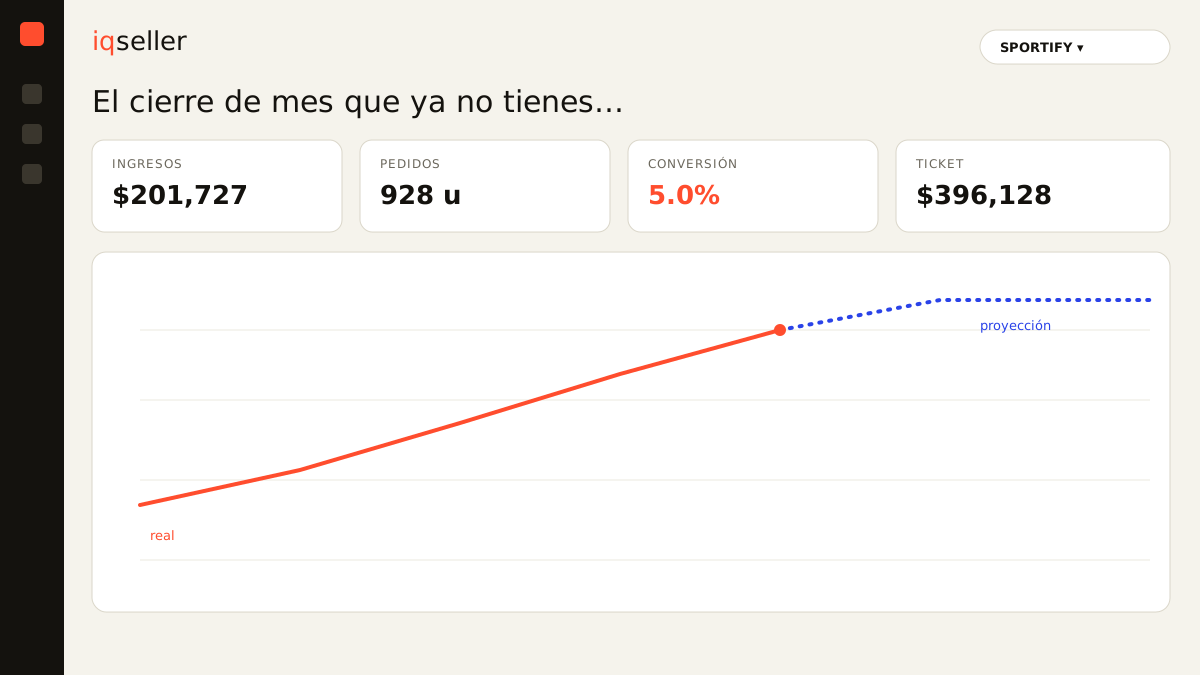
why the month-end close becomes an ordeal
The close isn’t hard for one single reason; it’s hard because of many small frictions adding up. Each marketplace reports its own way. Amazon hands you settlements over periods that don’t line up with the calendar month, mixing sales, refunds, inventory adjustments, and commissions inside one statement. MercadoLibre runs its own settlement dates, shipping charges, and financed promotions. Your 3PL bills storage and handling on yet another cycle.
When you try to assemble the month, you end up fighting questions that shouldn’t exist: does this sale on the 31st at 11:50 p.m. count in this month or the next? Does the refund that landed yesterday belong to an order from three weeks ago? Does the fee shown in the report already include tax, or do you have to break it out yourself? Each of those doubts gets resolved with one more formula in the spreadsheet, and each formula is a fresh chance to get it wrong.
The outcome is predictable: the close gets done late, gets done tired, and gets done with mistrust. And the worst part is that, by the time you finally have the number, several days of the new month have already passed, so you’re operating blind exactly when you’d need clarity most.
the invisible cost of closing by hand
There’s an obvious cost — the hours you pour in — but the expensive one is invisible. When your close lives in a hand-built spreadsheet, nobody else on the team fully understands it. If you get sick or travel, the close stops. If someone touches the wrong cell, the totals shift without anyone noticing. The whole operation depends on a fragile file only you know how to read.
The second cost is decision latency. If finding out your real February margin means waiting until March 4th, then during the first days of March you’re setting prices, buying inventory, and approving ad spend without knowing how the prior month closed. You decide on yesterday’s data, and in a multichannel business where the price calendar and stock move every day, yesterday is too old.
The third cost is trust. When the close is built by hand, there’s always doubt about whether the number is right. That doubt makes you check twice, ask someone else to validate it, and postpone decisions you should already have made. It’s not that you lack information: it’s that you don’t trust the information you have.
Dictionary: real-time synchronization means each channel’s data updates on its own, without you having to download and paste reports by hand.from collecting reports to reading one source
The fundamental shift is to stop treating the close as a project that begins on the 30th. If data from Amazon, MercadoLibre, and your 3PL arrives already connected and reconciled throughout the month, the close stops being an event and becomes a state: at any moment you can see the month in progress exactly as it stands, without building anything.
That’s what changes when you have a single source of truth. It’s not that the dashboard “gathers” your reports for you once a month; it’s that the channels stay permanently connected, so the sale on the 31st is already classified in the right month from the second it happened, the refund is already linked to its original order, and the fee already comes separated from tax. On the first of the following month you have nothing pending to assemble, because you never stopped having an up-to-date close.
To get there, the first step is to connect the channels properly, once. It’s worth doing carefully — that’s exactly the topic of connect your channels in minutes, not weeks — because a clean connection is what spares you every future close.
reconciliation that understands each marketplace
A single source of truth is useless if it dumps everything into the same bucket. The hard part — and the valuable one — is that reconciliation respects each channel’s rules before summing them. An Amazon FBA sale isn’t counted the same way as a MercadoLibre Full sale, and a partial refund isn’t the same as a full cancellation.
This matters especially with dates. What one marketplace records as the “sale date” doesn’t always match the date the money is credited or the date you need for your tax close. Reconciliation that understands these differences can show you the month by order date, by credit date, or by settlement period, depending on what you’re trying to answer, without you redoing the calculation each time.
The other fine detail is fees. Each channel charges a sales commission, shipping cost, advertising charges, and, in the case of the 3PL, storage and handling. If you want to know what you truly earned, you need all those costs deducted and attributed to the correct order. When that happens automatically, the close stops being a subtraction by hand and becomes a reading.
Dictionary: real available stock is the inventory you can actually sell right now, already net of what’s reserved, in transit, or committed on other channels.the number that actually matters: your net margin
Closing the month isn’t just knowing how much you sold. It’s knowing how much you kept. And that gap — between gross sales and what really lands in your pocket — is where the manual close fails most often, because you have to subtract product cost, commissions, shipping, advertising, returns, and 3PL charges, each with its own source.
When all of that is already reconciled, the close can hand you the real net margin per product, per channel, and for the full month, instead of a coarse total that hides the fact that a star SKU actually loses money after fees. That level of detail is what turns the close from an accounting chore into a decision tool: you see immediately what stopped being profitable and where you’re giving away margin without realizing it.
This is where the connected close earns its value. Instead of discovering on the 4th that February was soft, you see it coming from the second week of February, in time to adjust prices or pause a campaign that isn’t performing.
Dictionary: real net margin is what’s left after subtracting all costs — product, fees, shipping, advertising, and returns — not just the sale price.what a close that doesn’t hurt looks like
A good close is noticeable by what no longer happens. There’s no downloading five reports. There are no tabs open across three portals. There’s no spreadsheet only you understand. There’s no all-nighter on the 30th and no waiting until the 4th to learn how you did.
Instead, you open the panel and the month is already there: sales by channel, fees deducted, returns applied, stock reconciled, and net margin up to date. If you want to see February by order date or by credit date, you switch the view and the number recalculates on its own. If someone on your team needs to review it, they see it just as you do, without asking you for the file.
The close stops being a ritual of suffering and becomes something that is simply available when you need it. Not because you work faster on the last day, but because you stopped building by hand what the channels could already give you reconciled every day of the month.