
Sales velocity: the metric that predicts your next stockout
June 4, 2026
Most sellers find out about a stockout the day after it happens. You open Seller Central in the morning, see the listing grayed out, the Buy Box gone, and only then start doing the math on when the restock will land. By that point you’ve already lost sales, lost ranking, and worst of all lost the momentum you worked so hard to build. The problem wasn’t that you ran out of stock. The problem is that nobody warned you it was about to happen.
The signal was there weeks earlier, hidden in a metric almost nobody takes seriously: sales velocity. It isn’t a vanity number or an end-of-month statistic. It’s the real pace at which units leave your warehouse, and when you cross it with your available inventory and your lead time, it tells you with surprising precision the date you’ll run dry. The stockout stops being a surprise and becomes something you can see coming.
The challenge for the multichannel seller is that this velocity doesn’t live in one place. Some of your units go out through Amazon FBA, some through MercadoLibre Full, some shipped from your 3PL. Each channel has its own dashboard, its own way of counting, and its own refresh delay. Stitching all of that together by hand — export, paste into Excel, sum the columns — means that by the time you have the number, it’s already stale. And deciding restocks on yesterday’s data is exactly how you end up with a grayed-out listing.
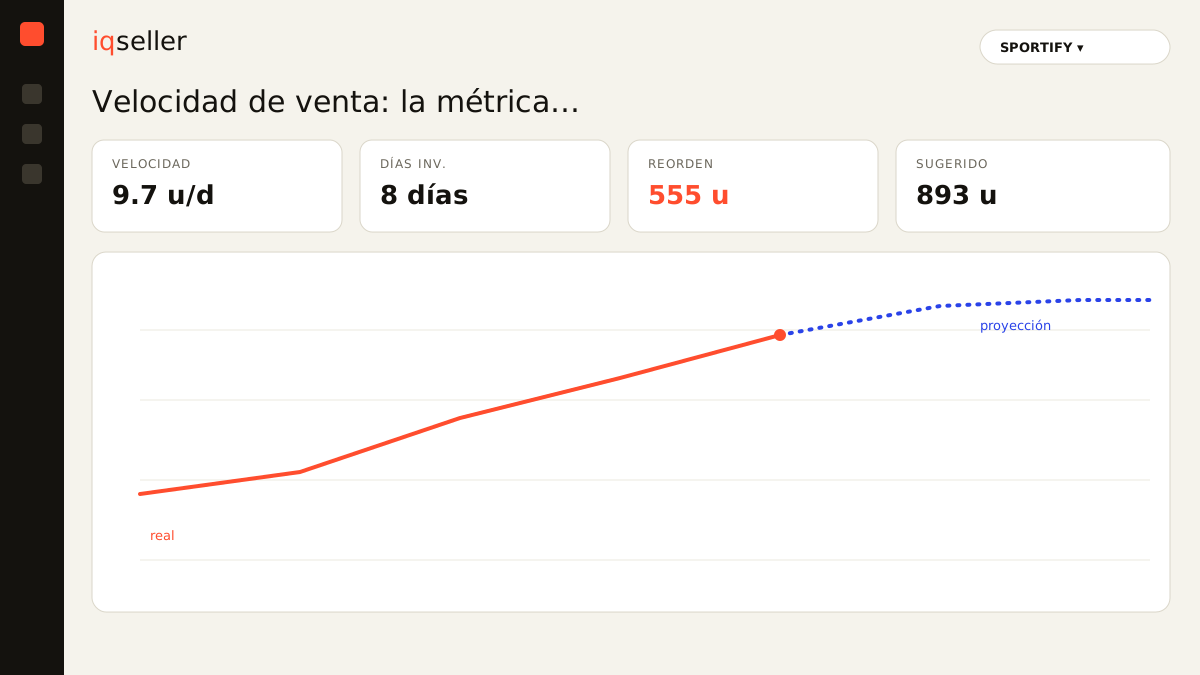
what sales velocity actually is
In its simplest form, sales velocity is units sold per unit of time: per day, per week, per month. It sounds trivial, but the trap is in which period you use. If you average the last twelve months, you smooth the curve so much that you bury today’s reality. A product that sold 3 a day in January and sells 12 a day in June gives you a misleading average that’s useless for restocking.
The velocity that matters is the recent, weighted one: the last 2 to 4 weeks count more than last quarter, because they reflect current demand, current pricing, and your current position in the ranking. That’s the figure that actually predicts when you hit the bottom of your inventory — not the historical average that makes you feel comfortable.
Dictionary: a forecast isn’t guesswork; it’s projecting your recent sales velocity onto your available inventory to anticipate dates.why a single number fails when you sell on several channels
Here’s the concrete pain of the multichannel seller. Your SKU sells 8 a day, but that 8 is the sum of 4 on Amazon, 3 on MercadoLibre, and 1 direct. Look at each channel on its own and none of them scares you. But the inventory feeding them might be shared — the same lot at your 3PL supplying all of them — or split across separate warehouses.
When stock is shared, the velocity that matters is the aggregate one: all three channels eating from the same pool. When it’s split, you need velocity by channel and by location, because you can run out on Amazon while you have plenty on MercadoLibre. Calculating this by hopping between Seller Central, the MELI panel, and your 3PL report, each with its own lag, is where the math falls apart. A single source of truth with channels already synced turns that puzzle into one reliable number — or the several correct numbers, depending on how your inventory is set up.
from velocity to stockout: days of inventory
The bridge between “I sell X a day” and “I run out on day Y” is called days of inventory. The formula is direct: divide your real available stock by your daily sales velocity and you get how many days you have left at the current pace.
Days of inventory = Real available stock ÷ Daily sales velocity
If you have 240 units and sell 8 a day, you have 30 days. But that number moves on its own: if your velocity climbs to 12 because you entered a promo or won the Buy Box, your 30 days become 20 overnight. That’s why days of inventory isn’t a snapshot — it’s a movie you need to watch update in real time.
Dictionary: days of inventory tells you how long your current stock lasts at today’s sales pace; it’s the countdown to the stockout.sales velocity also drives your pricing
There’s a detail many sellers overlook: sales velocity and pricing are tied together. Raise the price and you usually lower velocity; lower velocity and your days of inventory go up, letting you stretch coverage until the restock lands. The reverse works too: if you need to clear a lot before fresh product arrives, you drop the price to speed the sell-through.
That means velocity isn’t only an inventory metric — it’s a lever you can operate. When you see a SKU is going to run out before the restock arrives, instead of simply losing sales you can nudge the price up to slow the pace and hold on. That intersection between velocity and price is exactly what connects the forecast to the automatic price calendar: you don’t set the price in a vacuum, you set it knowing how many days of stock you have left.
reorder point: when to fire the order
Knowing you’re going to run out is useless if you find out too late to order. That’s where the reorder point comes in, folding your lead time into the equation. The reorder point is the inventory level at which you must place the order so the restock arrives just before you hit zero.
Reorder point = (Sales velocity × Lead time) + Safety stock
If you sell 8 a day and your real lead time is 30 days, you needed to have ordered when you had 240 units left, plus a safety cushion for demand swings and delays. The part almost everyone gets wrong is the lead time: it isn’t what the supplier promises, it’s the full time from order to sellable, including channel inbound. That’s why it pays to measure your real lead time instead of trusting the promise.
Dictionary: the reorder point is the stock level that triggers the purchase order so the restock lands before you run out of product.peak season changes everything
Everything above assumes a more or less stable velocity. In Mexico that breaks three times a year: Hot Sale, Buen Fin, and the December season. During those spikes a SKU’s sales velocity can triple or quadruple in a matter of days, and your 30 days of inventory evaporate in a week.
The classic mistake is entering the season with a reorder point calculated on normal velocity. When demand explodes, the low-season reorder point is already too short: you needed to order much earlier and much more. That’s why sales velocity has to be read through a seasonal lens, adjusting the projection to the expected spikes. If you sell on Mexican marketplaces, it pays to plan your peak-season forecasting ahead of time, because there stockouts don’t just cost sales — they cost the best moment of the year.
from metric to decision
Sales velocity is powerful precisely because it chains everything together: it defines your days of inventory, feeds your reorder point, conditions your pricing, and warps during peak season. The problem was never the formula — it’s middle-school math — but having the data fresh, aggregated by channel and net of what’s already in transit, without spending half the morning exporting reports.
When that velocity lives in a single source of truth, synced in real time across Amazon, MercadoLibre, and your 3PL, the stockout stops being an emergency call and becomes an alert you see weeks ahead. That’s what a well-built forecast module does in iqseller: it takes your real velocity, crosses it with your available stock and your lead time, and tells you which SKU will run out and when, before the listing goes gray.