
Forecasting peak season for Mexican marketplaces
June 1, 2026
In Mexico, peak season is not a single spike. It is three linked waves: Hot Sale in late May, Buen Fin in November, and the December run-up through Christmas and Reyes in early January. For a multichannel seller, each wave behaves differently depending on the marketplace, the category, and the type of buyer, which makes forecasting far more delicate than multiplying last month’s sales by a hopeful number.
If you sell on Amazon Mexico and MercadoLibre at the same time, and you also move inventory through a 3PL, you already know the underlying pain. Demand does not arrive evenly. It arrives concentrated into a handful of days, with promotion rules that shift, fees that move, and replenishment lead times that stretch out exactly when you need them most. And the information you need to decide lives scattered across Seller Central, the MercadoLibre panel, and your logistics provider’s report. Stitching it together by hand, pasting it into a spreadsheet, and projecting on yesterday’s data is the recipe for running out of your best seller while drowning in stock nobody wanted.
This article is a practical guide to forecasting peak season when you sell across several channels at once. The goal is not to guess better. It is to look at the right number at the right moment, from a single source of truth that no longer depends on how many tabs you have open.
why peak season breaks ordinary forecasting
For most of the year, a reasonable forecast leans on inertia. You sell roughly the same amount each week, with small variations. During peak season that inertia disappears. Hot Sale can pack into four or five days what you normally sell in a month, and Buen Fin does the same in November. If you project from the average of your recent weeks, you will underestimate the spike dramatically.
The second problem is the distortion the event itself leaves in your data. A Buen Fin’s sales do not transfer cleanly into a December projection, because many buyers pulled their purchase forward. And December’s sales do not transfer cleanly into January, because January is the hangover. Feed those raw spikes into next year’s model and you carry forward distortions that have nothing to do with real underlying demand.
Dictionary: the forecast is the projection of future demand by SKU and channel; during peak season it is built on events, not on averages.That is why peak-season forecasting is done differently. You separate the demand base from the event effect, you adjust per channel, and you review it far more often than the rest of the year. A solid conceptual starting point is inventory forecast in depth, which explains how to build the base on which you later stack the spikes.
the three waves are not the same
Treating Hot Sale, Buen Fin, and December as one undifferentiated “season” is an expensive mistake. Each wave has its own behavior.
Hot Sale, in late May, is a short and highly concentrated event, heavily driven by aggressive discounting and by real-time pricing competition. The risk here is running out of stock halfway through and losing the ranking you fought to earn.
Buen Fin, in November, lasts more days and mixes need-based buying with early gift buying. Demand spreads across more categories and the buyer compares more before deciding. The challenge here is allocating inventory well across channels without cannibalizing yourself.
December is a different beast. Demand does not concentrate in one weekend; it stretches over weeks, with a last-minute surge for urgent deliveries before Christmas and then a second wind for Reyes. Lead time becomes critical because couriers and warehouses saturate.
Building a single flat forecast for all three waves guarantees you miss at least two. The projection has to recognize the shape of each event separately.
the real pain: many panels, no real-time picture
This is where peak season exposes the true bottleneck. In November the data changes by the hour. A Buen Fin promotion can empty your stock of one SKU in a single morning, while on MercadoLibre the same product moves at a different pace. If checking your status means logging into Amazon Seller Central, then the MercadoLibre panel, then the 3PL report, and finally pasting everything into a sheet, by the time the picture is assembled it is already stale.
That lag is exactly what costs money during peak season. You reorder based on yesterday’s inventory, not on right now. You move stock between channels late. You fail to see in time that a product is selling out on one marketplace while it sits idle on the other. The uncertainty does not come from the future being unpredictable; it comes from your present being fragmented.
The way out is not to forecast more, it is to consolidate. A single source of truth that brings together sales, inventory, and sell-through velocity from every channel in one place and in real time completely changes the quality of the decision. You are no longer rebuilding reality by hand every morning; you see it directly and spend your attention deciding, not copying and pasting.
days of inventory: the metric that rules peak season
During spikes, the important question is not how many units you have, but how many days they last at the current sales pace. A stock level that looked comfortable at normal velocity can be dangerously low during Hot Sale, because sell-through multiplied.
Dictionary: days of inventory measure how long your stock lasts at the current sales pace; in peak season they are computed with the event’s velocity, not the year’s.The classic mistake is reading days of inventory with the year’s average sales velocity. During peak season that lies. You have to recompute it with the event’s velocity, which is much higher, and do it per channel, because the same product can have three days of coverage on Amazon and ten on MercadoLibre at the same time. That gap is exactly what tells you where to move inventory and where to ease off.
When you see days of inventory live and per channel, replenishment stops being a hunch. You know which SKU enters the risk zone before it stocks out, and which one carries excess worth pushing with a promotion before December strands it.
reorder point when lead time stretches
During peak season, replenishment lead times stretch. The supplier takes longer, couriers saturate, and warehouses have queues. That means the reorder point you use the rest of the year falls short: fire the order late and the inventory arrives after the spike has already passed.
The correct calculation combines the sales velocity expected during the event with the real peak-season lead time, not the lead time of a quiet month. If you normally replenish in a week but in November your provider takes two, your reorder point has to trigger much earlier. And since each channel sells at a different velocity, the moment to reorder also differs between them.
Dictionary: the reorder point is the stock level that triggers a new purchase; in peak season it is computed with the event’s extended lead time.For the detail of the formula and how to adjust it, see reorder point: the formula that avoids stockouts and overstock. The core idea for peak season is simple: advance the trigger in the same proportion that your lead time stretches, or you will arrive late to your own spike.
building the three-wave forecast, step by step
With the landscape clear, the practical method can be summarized as follows.
First, separate the base from the season. Clean the past event spikes out of your historical series to get an honest base demand, then add the expected effect of each wave on top, separately. Do not project Buen Fin with data contaminated by the previous Buen Fin without adjusting it.
Second, project per channel, not in aggregate. Amazon Mexico and MercadoLibre have different curves, different audiences, and different promotion rules. An aggregate forecast hides exactly the differences you need in order to allocate inventory.
Third, tie the forecast to real logistics. The projection is only useful if you cross it with your peak-season lead time and your 3PL capacity. Forecasting 500 units sold is worthless if your provider cannot replenish in time.
Fourth, review at event frequency. Off-season you might review weekly; during Hot Sale and Buen Fin the review is daily, sometimes more often. This is where a single real-time source of truth stops being a convenience and becomes the difference between reacting in time or reading the disaster the next day.
Fifth, plan the exit from the spike. The excess left after December costs as much as a stockout. Decide in advance which SKUs you will push with a promotion if they run long, so you do not drag dead capital into January.
the role of a single dashboard
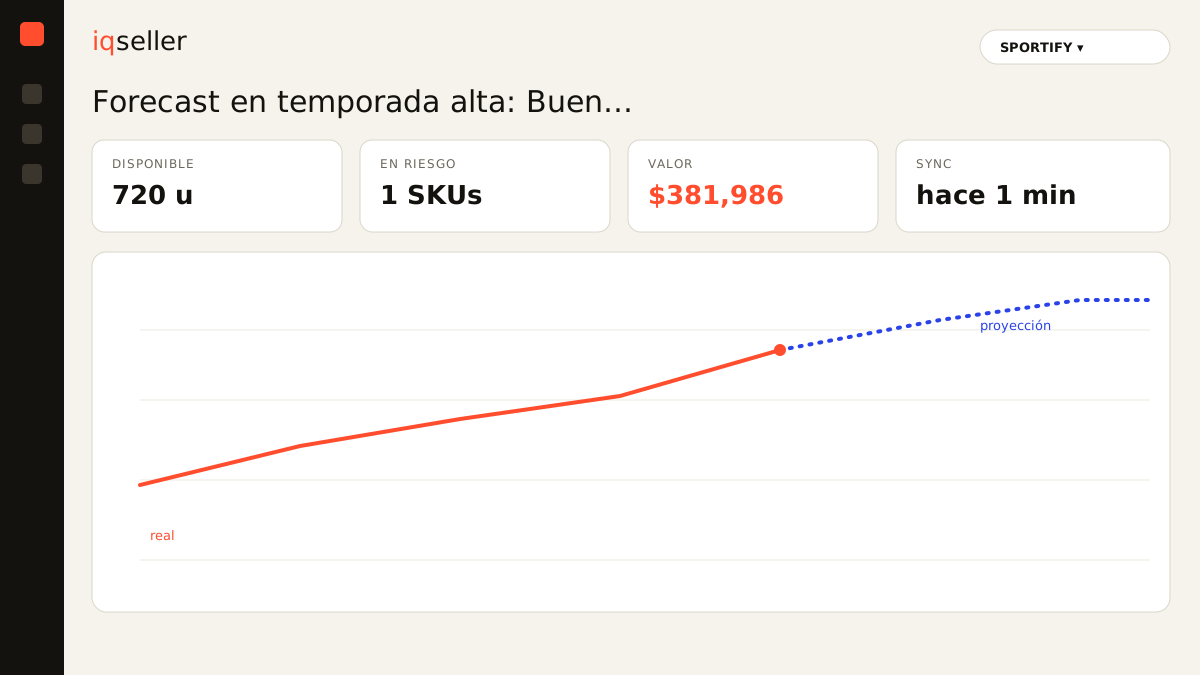
A seller running SPORTIFY on Amazon and MercadoLibre at once does not need a magic forecast; they need to stop assembling the picture by hand every November morning. The value of consolidating everything in one place is that the forecast stops being a static spreadsheet document and becomes a living view: sales, stock, days of inventory, and reorder point across every channel, updated together.
That is what changes peak season. You do not predict the future with more certainty, but you decide on the real present instead of yesterday’s. And during Hot Sale, Buen Fin, and December, deciding a day earlier with the right number is usually worth more than any sophisticated model fed with old information.