
Reorder point: the formula that avoids stockouts and overstock
June 5, 2026
There’s a question that lands in every multichannel seller’s head once a week and almost never has a calm answer: is it time to reorder this product yet? Not “how much do I have left?” — that you can see at a glance — but the exact threshold past which waiting one more day starts to cost you money. Order too early and you freeze capital in merchandise that will take ages to turn over; order too late and you run out of stock exactly when demand peaks. Between those two mistakes runs a thin line, and that line has a name: the reorder point.
The idea isn’t the problem — almost everyone grasps it intuitively. Holding onto it in a real operation is. Your product lives in several places at once: part in Amazon FBA, part in MercadoLibre Full, part in your 3PL. Each marketplace shows you its own number in its own dashboard, on its own delay. To figure out when to reorder, you end up opening three tabs, copying figures into a spreadsheet, and doing a subtraction by hand that’s already stale by the time you finish it. The reorder point stops being a formula and becomes a hunch dressed up as a calculation.
This article takes that hunch apart. We’ll see where the formula comes from, what its three pieces mean, why it fails when you compute it on yesterday’s data, and what changes when it lives in a panel that recalculates itself.
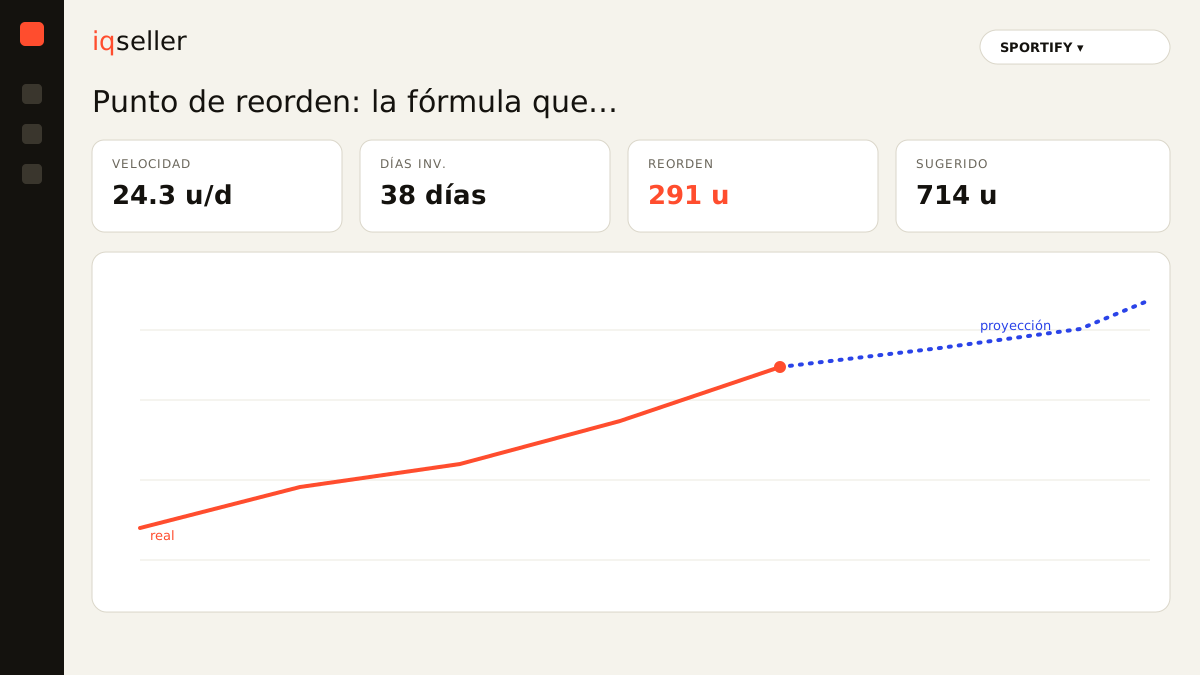
what the reorder point actually is
The reorder point is the level of available inventory at which you must place a new purchase order so that the fresh merchandise arrives just before the old runs out. It isn’t a quantity to order; it’s a trigger. The moment your real available stock crosses that threshold going down, the order has to go out. Not a day earlier — every extra day is frozen capital — and not a day later — every day later is stockout risk.
Framing it this way matters because it separates two decisions people tend to blur: when to order and how much to order. The reorder point answers only the first. The second — order size — is a different calculation that covers the period between orders. Confusing them is the root of half of all restocking mistakes: either you fire the order at the right moment but pick an arbitrary quantity, or you size the quantity well but launch it late.
Dictionary: the reorder point as a threshold that triggers the order, not as a quantity to order →the formula, piece by piece
The formula is deliberately simple, and that simplicity is a feature:
Reorder point = (Sales velocity × Lead time) + Safety stock
The first term, Sales velocity × Lead time, is the demand you’ll consume while you wait for the new order to arrive. If you sell 8 units a day and your lead time is 30 days, 240 units will go out during that wait. That’s the inventory you need on hand at the moment of ordering just to avoid a stockout in the normal case.
The second term, safety stock, is the cushion for what isn’t normal: the week you sell more than expected, the supplier who runs five days late, the customs hold. If you want to cover 5 extra days of selling, that’s 8 × 5 = 40 units of cushion. Adding it up: (8 × 30) + 40 = 280 units. The second your real available stock drops below 280, the order should be going out.
Three numbers, one sum. The trap isn’t the arithmetic — you do that once. It’s that each of the three moves on its own, all the time, across different channels at once.
why sales velocity isn’t a fixed number
Sales velocity is the heart of the formula and also its most treacherous part. Many people calculate it once — “I sell about 8 a day” — and leave it nailed down for months. But real velocity changes every week: it climbs when a product takes off, drops when the season ends, spikes during a Hot Sale and collapses afterward.
Computing it on the wrong history distorts the entire formula. If you average 12 months of a seasonal product, your velocity looks flat and calm exactly when you should be reacting to the peak. The right move is to measure it over your recent history — the last few weeks — and weight it, not over the whole year. Since that number feeds the reorder point directly, an error here multiplies: an underestimated velocity artificially lowers your threshold and guarantees the stockout.
That’s why it pays to treat velocity as a living metric, not a constant. I cover it in depth in inventory forecast in depth, where you can see how this number connects to the rest of the restocking calculation.
Dictionary: how the forecast uses recent velocity, not the annual average, to anticipate the reorder →the real lead time, not the optimistic one
The second factor, lead time, is where sellers lie to themselves the most. The temptation is to use the lead time the supplier promised, or the one you remember from an order that went smoothly. But the lead time that matters for the reorder point isn’t when the box reaches your warehouse: it’s when the product is sellable — when Amazon or MercadoLibre received it, processed it through their fulfillment center, and listed it again.
That final stretch, the marketplace inbound, is invisible in almost every restocking spreadsheet and usually adds days nobody counted. A lead time “of 25 days” that’s really 35 in practice leaves your reorder point 80 units below where it should be — exactly the ones you’ll be missing. A late reorder is almost never the formula’s fault; it’s the fault of an optimistic lead time. If your restocks always arrive at a sprint, it’s worth reading real lead time: why your restock always arrives late, because half of all stockouts live there.
real available stock, not total stock
Here’s the most expensive mistake, and the quietest: comparing your reorder point against total stock instead of real available stock. The total cheerfully adds up everything each channel reports. Real available stock subtracts what’s reserved by unreleased orders, what’s in transit, what’s damaged, and what’s not sellable.
The gap is brutal in multichannel, because the same physical product has its inventory split up. Adding 60 units from Amazon, 40 from MercadoLibre and 50 from the 3PL to say “I have 150” ignores that some is already committed and some isn’t even listed. If your reorder point is 280 and you think you have 150 when your real available stock is actually 110, you’ll order late without knowing it. The threshold only works if you compare it against the honest number. That’s why serious calculation starts from inventory unified by physical product, not by listing.
days of inventory: the reorder point as a countdown
The reorder point gives you a threshold in units; days of inventory give you the same thing in time, which is how a seller actually thinks:
Days of inventory = Real available stock ÷ Sales velocity
If you have 110 units and sell 8 a day, you’ve got about 14 days. And if your real lead time is 30, the reading is crushing: even if you ordered right now, you’d arrive 16 days late. Seeing days of inventory next to the reorder point turns an abstract number into an alarm you understand without thinking. You don’t have to remember that your threshold was 280; just seeing that you have fewer days of inventory than your lead time tells you you’re running late.
Dictionary: days of inventory as the reorder point translated into time remaining →why the reorder point has to live outside the spreadsheet
Here’s the real problem. The formula is trivial; keeping it alive is the hard part. For your reorder point to mean anything you need three current numbers — recent velocity, real lead time, unified real available stock — and all three change with every sale, every order and every receipt, across three different channels.
Keeping 280 current by hand for one SKU is tedious. For 300 SKUs split across Amazon, MercadoLibre and your 3PL it’s simply impossible. What happens in practice is that the seller computes the reorder point once, parks it in a spreadsheet column, and reality quietly drifts away: velocity climbed, lead time stretched, available stock dropped, and the threshold in that column no longer represents anything. The formula didn’t fail; maintenance did.
That’s why the calculation has to live where the data lives, recalculating itself on a single source of truth in real time. When a product crosses its reorder point, you don’t want to discover it on Monday doing subtractions at 11 at night: you want the panel to flag it the same day, with today’s velocity and the real lead time, ready to turn the trigger into a purchase order. That’s what separates restocking on time from finding out when the listing has already gone inactive — with the ranking drop that takes weeks to recover and the fees that keep piling up in the meantime.
The reorder point isn’t a big-company formula. It’s the tool that gives the multichannel seller back control over the most expensive moment in their operation: the exact instant when it’s time to order again.