
Depending on a single supplier: the risk nobody prices until it happens
November 23, 2026
Almost every catalog that grows fast grows leaning on one supplier. It is the natural path: you found someone who fills orders well, gives you a good price, understands the product and tolerates your last-minute changes. Every order strengthens the relationship, every year the volume discount improves, and concentration rises without anybody deciding on it.
The problem is that this concentration does not feel like a risk. It feels like an operational advantage, and for years it is one. Right up to the quarter when the supplier runs out of raw material, changes ownership, decides to sell directly on the marketplace where you sell, or simply stops answering.
That is the day you discover something uncomfortable: the cost of not having a second supplier is not paid at the moment of failure, it is paid across the weeks it takes to replace them. And that stretch is not measured in days. Qualifying a new supplier, sampling, approving quality, producing a first lot and getting it into the channel is a multi-week process, during a month when your listing sits at zero and your competitor’s does not.
What follows is not an argument for diversifying on principle. It is a method for putting a peso figure on the exposure, comparing it against what coverage costs, and deciding with that comparison instead of with intuition. The arithmetic examples are invented and labelled as such.
why a single supplier is so comfortable
Before criticizing it, it is worth naming what a single supplier gives you, because if you do not, you will diversify badly.
It gives you a better price, because you concentrate volume and climb their discount table. It gives you priority, because you are a customer who matters, and in peak season that translates into a place in the queue. It gives you product consistency: one mold, one fabric lot, one quality standard, and therefore fewer returns caused by variation. It gives you operational simplicity: one relationship to maintain, one contact, one order format, one calendar.
And it gives you something almost nobody values: informal room to maneuver. The supplier you have worked with for six years pulls production forward for you, lets a payment slide, accepts a change mid-run. None of that is in any contract, and it is worth a lot.
None of this is false. What is false is the conclusion that because the relationship works, the risk does not exist. The risk does not depend on your supplier being good; it depends on you having no alternative when the good one cannot deliver.
six failure modes, not one
When a seller thinks “what if my supplier fails me?”, they almost always picture one scenario: bankruptcy. It is the least likely. These are the ones that actually happen, and each asks for a different response.
- Capacity failure. The supplier is still there and still wants to sell to you, but their peak-season capacity falls short and they ship half your order. It is not a total failure, it is a cut, and it usually arrives without enough warning.
- Input failure. Their supplier failed them. Same product, same price, but the date slides six weeks.
- Quality failure. The lot arrives different: another shade, another stitch, another weight. You find out when your reviews drop and your return rate climbs, which is late.
- Commercial failure. They raise the price to a level that leaves you no margin, or change payment terms. Technically they did not fail you; economically they did.
- Alignment failure. The supplier decides to sell directly on Amazon or MercadoLibre, with your product and without your acquisition costs. It happens more than people admit.
- Continuity failure. Change of ownership, closure, sale of the plant, or the founder retires and the next generation does not want the business.
There is a seventh that is not about the supplier but behaves identically: route failure. If all your volume enters through the same port and the same inland leg, a disruption there hits you as if it were your supplier. In 2026 the port of Manzanillo went through well-documented congestion episodes: a customs staff work stoppage from 12 to 16 May, reports of weeks of stalled operations by July, an emergency plan activated by Ferromex in late July in response to the backlog, and a January that was the busiest month in the port’s history with more than 354,000 TEU. Maersk, in an August 2026 advisory, estimated that the Manzanillo–Guadalajara leg can go from 3.5 to 4 hours under normal conditions to between 6.5 and 8 hours under heavy congestion. A flawless supplier does not save you from that.
Glossary: stockout, when you run out of product →putting a number on the exposure
Here is the part that turns a worry into a decision. Exposure is calculated in four steps, and all four use data you already have.
Step one: concentration. What percentage of your units sold and, more importantly, what percentage of your contribution margin comes from that supplier’s SKUs. The two figures almost never match, and the one that matters is the second.
Step two: runway. How many days of coverage you have today on those SKUs, counting available inventory plus what is already in transit. Those are the days you have before a failure shows up on the listing.
Step three: replacement time. How many days it would take to have sellable product from an alternate supplier from scratch: identify them, sample, approve quality, produce, ship, receive and send into the channel.
Step four: the gap. Replacement time minus runway. If the result is positive, those are the days without product, and that is your number.
An invented example, with the arithmetic checked. Supplier A accounts for 62% of your units and 71% of your contribution margin. On the SKUs they fill you have 38 days of coverage between available and in-transit stock. Qualifying a new supplier would take 20 days of sampling and approval, 25 of production, 12 of transit and 7 of receiving and inbound: 64 days.
Gap: 64 − 38 = 26 days without product on 71% of your margin.
If those SKUs generate 840,000 pesos of contribution margin a month, 26 days are roughly 728,000 pesos of direct exposure. Plus the cost of recovering listing placement, which is neither immediate nor free.
That figure — 728,000 pesos in this example — is what you compare against the cost of coverage. Not a feeling of vulnerability: a number.
the insurance premium against the volume discount
The legitimate objection to diversifying is economic: if I split the volume, I drop a tier in the discount table and pay more per unit. That is true, and it can be calculated.
Continuing the invented example. You buy 10,000 units a year from supplier A. Their list price is 240 pesos and, for concentrating all your volume, they give you an 8% discount: 220.80 pesos per unit. Annual cost: 2,208,000 pesos.
Now you split 80/20. At 8,000 units you drop a tier and your discount with A becomes 5%: 228 pesos per unit, 1,824,000 pesos. Supplier B, new and without volume, quotes 242 pesos: 2,000 units come to 484,000 pesos. Total: 2,308,000 pesos.
The diversification premium is the difference: 100,000 pesos a year.
Now the honest comparison. If the probability that A fails seriously in a given year is 15% — a figure you have to estimate from your own incident history, not copy from here — the expected loss is 728,000 × 0.15 = 109,200 pesos. More than the premium.
And there are two things that arithmetic does not even include, and that usually tilt the result further:
- With an active supplier B, the gap in case of failure is not 26 days: it is however long B takes to scale production, because they are already qualified. That reduces the exposure itself, not only its probability.
- Holding a live quote from B changes your position when negotiating with A. The discount you lose by splitting volume tends to come back, partly or fully, once A knows an alternative exists.
The point of the exercise is not that diversifying always wins. Sometimes the premium is too high and the right answer is to cover yourself with inventory rather than with a second supplier. The point is that the decision gets made with both numbers in front of you.
how to diversify without losing the price
Diversifying does not mean splitting everything down the middle. There are gradual options, in order of increasing cost:
Qualified but inactive supplier. You identify them, request samples, approve quality, agree price and terms, and buy a small lot once a year to keep the relationship alive. It costs little and cuts the replacement gap from weeks to days, because the slow part — qualifying — is already done.
Asymmetric split by family. Instead of splitting every SKU, you give B entire families of different products. A does not lose a tier in the families where their price is unbeatable, and B gets enough volume for their price to make sense.
An 80/20 split on critical SKUs only. Just on the SKUs that concentrate your margin. That is where exposure is high and where the premium is justified. The rest of the catalog stays with A.
True dual sourcing. Both suppliers routinely produce the same SKU. It is the most expensive level and the most robust, and it almost only makes sense on the two or three SKUs that carry the business.
Route diversification rather than supplier diversification. Sometimes the supplier is fine and what you need is a second way in: another port, another operator, or a share of volume by air when the calendar tightens. It is cheaper than opening a supplier and it solves the route failure mode.
And one rule that saves pain: never qualify a new supplier during peak season. The moment to sample, approve and run a first lot is a quiet month, when a quality error can be fixed without costing you the season.
what to measure to know whether the second supplier works
An alternate supplier you never measure is not coverage, it is an illusion. Four indicators are enough and you can track them by hand:
- Complete and on-time deliveries. For each order, what share arrived complete and within the committed date. A supplier who delivers 70% of volume on time is not a backup.
- Lead time variability. Not the average: the spread between their best and worst delivery. A supplier with a long but stable window is a better backup than a fast, unpredictable one.
- Defect and return rates on B’s lots against A’s. If B generates twice the returns, their lower price is fictional.
- Response time to a change. How many days they take to confirm an urgent order or a quantity change. It is the indicator that predicts how they will behave the day you really need them.
With those four numbers you can have the price conversation from an informed position instead of asking for discounts blind.
Glossary: inventory valuation, how much capital is parked →how this reads in iqseller
The panel does not manage suppliers, and that is worth saying first: there is no purchasing module, no supplier scorecard, no purchase orders. What the panel contributes are the three figures that make the exposure calculable.
Profitability holds net margin per SKU, with the COGS you load, the commissions from Amazon’s settlement and from MercadoLibre orders, FBA and Full fees, shipping, advertising, and the VAT and withholding breakdown. If your COGS distinguishes who you bought each SKU from, you can total margin by supplier and get step one of the calculation: real concentration, measured in margin rather than units.
Inventory shows stock split across FBA, Full, your warehouse and your 3PL, what is in transit with its availability date, and the inventory valuation of each pool. That gives you step two: the runway you have before a failure becomes visible.
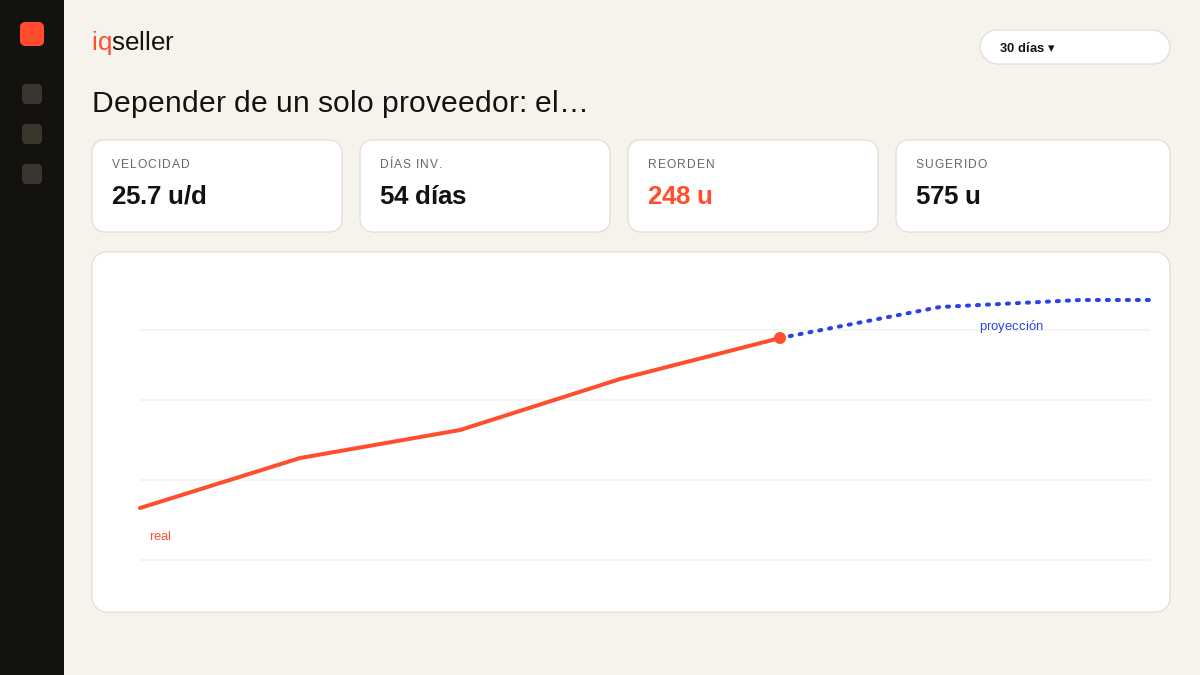
Forecast holds sales velocity and days of inventory per SKU and per channel, which turn that runway into actual days rather than a warehouse figure.
The Parent → Model → SKU tree helps you see concentration where it really lives: often the risk is not a supplier filling 60% of the catalog, but one filling the four SKUs that deliver half the margin.
And Alerts fires when coverage on those SKUs crosses the threshold you set, which is the moment a supplier problem can still be handled with inventory instead of with urgent freight.
a twelve-month plan
To close, a sequence you can execute without stopping the operation:
- Calculate concentration per supplier in contribution margin, not in units. It is the figure almost nobody has looked at.
- Take the five SKUs that concentrate the most margin and calculate their gap: replacement time minus runway.
- Put the exposure in pesos and compare it against the premium of diversifying, using real quotes rather than assumptions.
- Identify and qualify an alternate supplier for those five SKUs, in a low month, with samples and a small lot.
- Negotiate with your main supplier holding the alternate quote. A good share of the premium comes back right there.
- Measure the alternate supplier’s four indicators quarterly so the coverage stays real.
- Review route diversification, not only supplier diversification, if all your volume enters through a single path.
A single supplier is not a mistake. It is a position worth knowing in pesos. What is a mistake is discovering the number on the day it is no longer useful for deciding anything.