
What Amazon Withholds and What MercadoLibre Withholds
September 27, 2026
The question comes up in every seller group whenever someone opens their second channel: “Does Amazon withhold the same as MercadoLibre?” The short answer is yes, because both platforms apply the same law and the same rates. The long answer — the one that actually matters for your operation — is that what changes isn’t the rates, but how they report it to you, when you see it, and how hard it is to reconcile.
And that’s where the real money is lost: not in the withholding, which is creditable, but in the month-end hours spent reconciling three reports in three different formats, and in the credit balances nobody ever claims because the file was never properly assembled.
This article lays out what gets withheld, why, and how the reconciliation work differs between the two channels. It doesn’t replace your accountant: the exact effect depends on your tax regime and your income level, and that gets reviewed with whoever keeps your books.
why they withhold, and who does
Since 2020, when a digital platform intermediates a sale between you and an end buyer, the law requires it to withhold part of your taxes and remit them directly to the tax authority. This is governed by articles 113-A through 113-D of the Income Tax Law and article 18-J of the VAT Law.
The key word is intermediates. Withholding isn’t a punishment or a commission: it’s an advance-collection mechanism the tax authority built on top of the intermediary because it’s far easier to collect from two large platforms than from fifty thousand sellers. The regime that applies to you is called Business Activities with income through Technological Platforms, code 625.
This applies to individuals. If you operate as a legal entity the scheme is different and the platform-regime withholdings don’t apply to you the same way — another reason to review it with your accountant before deciding how to incorporate.
the 2026 rates, which are the same on both
Here’s the fact that settles the group chat argument: Amazon and MercadoLibre withhold exactly the same, because neither of them picks the rate. The law sets it.
For an individual with their tax ID properly registered on the platform:
- Income tax: 2.5% of gross revenue on each sale, before VAT.
- VAT: 8%, which is 50% of the 16% VAT you charged.
- Total withheld: 10.5% of base.
The 2.5% income tax rate is new in 2026. Through 2025, withholding on the sale of goods through platforms was 1%; the 2026 Revenue Law unified it at 2.5%, more than doubling it. If this year’s deposit feels thinner than last year’s and you can’t find the change in the commissions, that’s it: a point and a half of your gross sales that didn’t used to leave.
There are two scenarios where withholding spikes, and they’re worth knowing because they’re avoidable:
- Without a valid tax ID registered on the platform, VAT withholding rises to 100% of the tax charged, and income tax is applied at much higher rates.
- Depositing into foreign accounts triggers the same aggravated treatment.
The difference between having your tax ID properly loaded and not having it is tens of thousands of pesos a month in a mid-sized business, and it’s literally a data-entry task. It’s the most expensive and most easily fixed mistake on this entire list.
the $300,000 threshold that changes everything
This point is explained badly everywhere and it determines whether your tax life is simple or complete.
If your annual platform income is under $300,000 pesos, you can elect to have the withholdings already taken be your definitive payment. You’re done: no monthly filings for that income, no expense deductions, no further paperwork. It’s convenient, and for a small seller it usually makes sense.
If you exceed $300,000, you enter the provisional-payment scheme: you file monthly, you accumulate that income in your annual return, and in exchange you can deduct your expenses — cost of goods, commissions, logistics, advertising — and credit everything withheld from you.
The practical consequence matters: above that threshold, withholding stops being a cost and becomes an advance. But only if you request and keep the receipts. The seller billing $2,000,000 a year who never documented deductible expenses is paying tax on a margin they never had.
Glossary: real net margin, with everything deducted →so where do they actually differ?
If the rates are identical, the difference between Amazon and MercadoLibre lives in three places, and all three are operational.
Where the data lives. Amazon reports its withholdings inside the Seller Central reporting ecosystem, alongside the settlement that also carries commissions, FBA fees and reimbursements, all mixed into a single settlement period. MercadoLibre delivers it separately, tied to the Mercado Pago flow and to each sale’s release. Two different logics: one revolves around the settlement period, the other around the individual sale.
The rhythm. Amazon’s settlement runs on cycles that don’t line up with your calendar month, so one settlement can contain sales from two different months. On MercadoLibre, money is released under its own rules depending on reputation and shipping type. Reconciling “what I sold in September” against “what was deposited to me in September” is non-trivial on both, and it’s different on each.
The receipt. Both platforms issue the withholding tax receipt you need in order to credit. The difference is where it’s downloaded, how often, and how well it ties back to the sales that generated it. That tie — withholding against sale against deposit — is the real work, and it’s what nearly everyone does by hand.
And there’s a fourth difference that appeared only recently: MercadoLibre launched its resale model, where it buys the product from you instead of intermediating the sale. With no intermediation there’s no withholding — they advertise it as “up to 10.5% more liquidity,” which is precisely the 8 plus the 2.5 in this article. It isn’t a tax saving, because you still owe them; it’s a change in when you have the money.
why withholding feels like a cost even though it isn’t
Technically, withholding is a creditable advance on your own tax. In practice it behaves like a cost for one very specific profile: the pure reseller.
The reason is structural. Whoever manufactures or imports accumulates plenty of creditable VAT — customs, inputs, freight, services — that offsets what they charged. Whoever resells domestic product has a much flatter structure, and if they also sell almost everything through a marketplace, a credit balance piles up month after month that can only be recovered by filing for a refund: a process that takes months, demands impeccable paperwork, and that many sellers never begin.
That balance isn’t lost, but it is parked. And for a business that finances its inventory out of its own cash flow, parked capital and lost capital look very similar in practice.
how withholding looks in iqseller
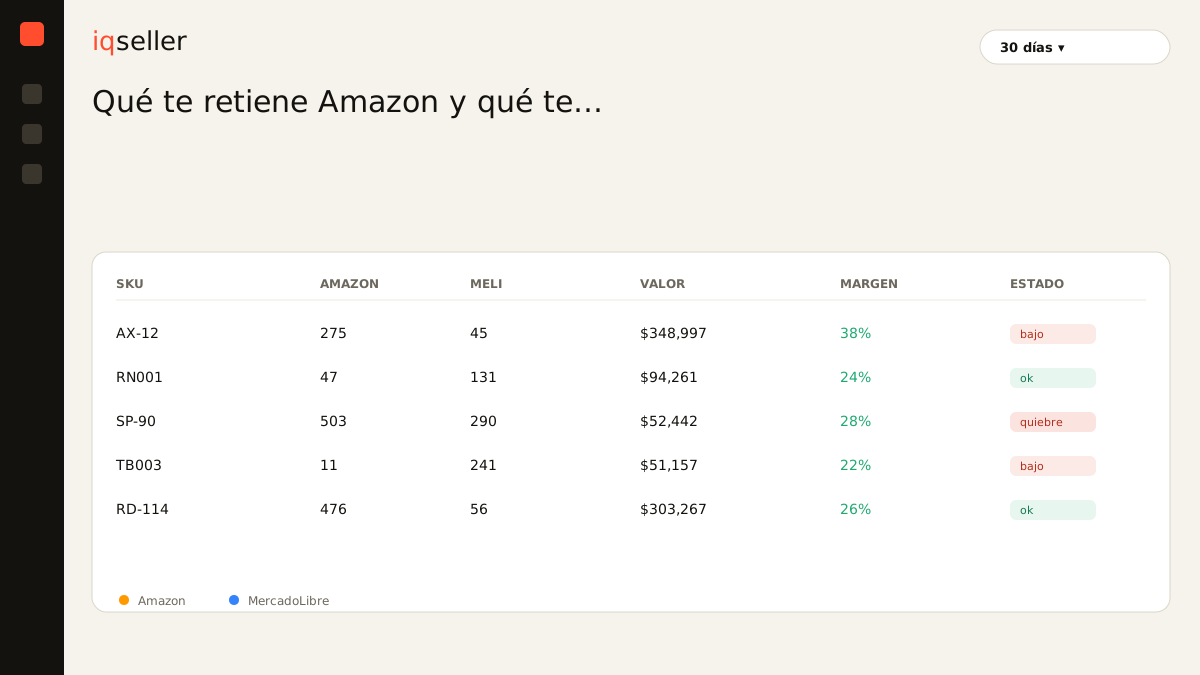
The Profitability module treats withholding as what it is: a separate line, never confused with commission or with margin.
The panel separates the base from VAT and calculates your net margin on the base — COGS, each channel’s actual commission taken from the settlement, fulfillment fees, shipping and advertising. Next to that sits the tax breakdown: the VAT you charged and what each platform withheld, channel by channel, with the figure taken from each one’s report rather than from a typed percentage.
Putting the two readings together is what reveals the real effect: your operating profit on one side, and on the other how much of that profit is temporarily out of reach. The first figure tells you whether the product works; the second tells you what you can count on to restock this week. They’re different questions and almost nobody keeps them apart.
Having the data arrive from both channels in the same format is half the value. The other half is having it current, because a reconciliation done in March on January’s sales is no longer useful for deciding anything.
Glossary: inventory valuation, how much capital is tied up →the short list
If you run two channels or more, these are the five things worth having settled:
- Tax ID properly registered on both platforms. The most expensive mistake and the easiest to fix.
- A domestic deposit account, to avoid the aggravated treatment.
- Monthly download of each channel’s withholding receipt, stored where your accountant can find it.
- Invoices for every deductible expense if you exceed $300,000 a year. Every peso of creditable VAT without a receipt is margin given away.
- A single view of withholdings per channel, so you know how much of your capital is sitting with the tax authority at any moment.
You can’t negotiate the rates. What you do control is not overpaying because of a badly entered field, and knowing at all times how much of your money is waiting somewhere. The rest, as always when taxes are involved, gets decided with your accountant.