
What Is ACoS on Amazon: the metric that decides if your ads make or lose money
July 3, 2026
ACoS (Advertising Cost of Sales) is the percentage of your advertised sales that you spent on ads. You calculate it by dividing what you spent on advertising by the sales that advertising generated, then multiplying by one hundred. If you spent $200 on Amazon Ads and those campaigns produced $1,000 in sales, your ACoS is 20%. In one sentence: ACoS tells you how much, in advertising, each dollar of ad-driven sales cost you.
That is the short answer, and it is enough to get started. But the answer that actually matters to a seller is different: ACoS by itself does not tell you whether you are making or losing money. It tells you how efficient your spend was against the gross revenue of your advertised sales, not what stayed in your pocket after marketplace fees, FBA fees, product cost, and taxes. A 20% ACoS can be a great business on a healthy-margin product and a slow bleed on a thin-margin one. Same number; opposite outcome.
That is why ACoS is the metric that decides whether your ads make or lose money, but only when you read it against your real margin. In this article you will see what it measures exactly, how to interpret it without fooling yourself, what the magic number that separates winning from losing is (your break-even), and why stitching all of this together by hand — Amazon on one side, MercadoLibre on another, your 3PL on a third — is precisely what keeps you from seeing it in time.
what acos measures and what it does not
ACoS is a simple division: ad spend divided by the sales attributed to that advertising. Nothing more. It does not know your cost of goods, Amazon’s category referral fee, the FBA fulfillment fee, inbound shipping to the fulfillment center, or the tax you remit. At its core it is a metric of spend efficiency over gross revenue, not of profitability.
This has a practical consequence many sellers learn the hard way: two products with the same 25% ACoS can live in completely different worlds. If one has a 50% gross margin, that 25% of advertising still leaves you comfortable profit. If the other has a 22% gross margin, that same 25% just put you in the red — you paid more in ads than the product had in margin to give. ACoS does not distinguish between those two cases because it was never designed to. The right question was never “is my ACoS low?” but “what is left after I subtract advertising from my real margin?”.
Glossary: ACoS is ad spend divided by the sales attributed to those ads; a low ACoS does not guarantee profit.how to read acos without fooling yourself
A low ACoS feels good, but on its own it means nothing good or bad. An 8% ACoS can look like a triumph and actually be the sign that you are underinvesting: bids so timid that you stop showing up for profitable searches and hand sales to a competitor. On the other side, a 40% ACoS can be perfectly healthy when launching a new product, where you accept overpaying early to earn reviews, sales history, and organic ranking.
The correct reading is always relative to three things: your margin, your stage (launch, growth, mature), and your goal (volume or profit). The very same 30% ACoS is a different figure depending on where the product is in its life. If you keep only the isolated number Seller Central shows, you have none of those three contexts in front of you. That is why it pays to first understand what ACoS is as a concept before you make bid decisions: the metric is a tool, not a verdict.
the number that separates winning from losing: break-even acos
Here is the heart of it. Before you judge any campaign you need to calculate your break-even ACoS: the percentage of ad spend at which you stop making money and start losing it. It comes directly from your margin before advertising. If after referral fee, fulfillment, product cost, and tax you have 30% margin on the selling price, that 30% is your ceiling: any ACoS below 30% leaves you profit, and any ACoS above it takes profit away.
With break-even in hand, ACoS finally makes sense. You no longer ask whether 22% is “good”; you ask whether 22% sits below or above your particular ceiling. A 22% ACoS against a 30% break-even is profitable with room to spare. That same 22% against an 18% break-even — a thin-margin product — is already losing you money on every advertised sale, even though the number looks decent. To get to this calculation you need the full margin, not the apparent one; it is worth walking through the ACoS formula step by step with a real example and building your own break-even before you touch a single bid.
Glossary: real net margin is what remains after ALL costs — product, fees, shipping, tax, and advertising — not just price minus cost.why break-even changes between amazon and mercadolibre
If you sell on a single channel, your break-even is one number. If you sell across several, it is several numbers, and they almost never match. Amazon’s fees are not MercadoLibre’s. FBA fulfillment does not cost the same as Full or as your 3PL. And pricing sometimes differs because you compete against a different seller on each marketplace. The result is that the same product can have a break-even ACoS of 28% on Amazon and 34% on MercadoLibre.
This breaks any single “keep ACoS below X%” rule. A 30% ACoS can leave you profit on MELI and lose you money on Amazon at the same time, with the same SKU. If you look at a single dashboard — or worse, if you compare Amazon’s ACoS from memory against your gut feel of the MELI margin — you never see that asymmetry. Advertising demands that you read each channel’s ACoS against that channel’s break-even, not against a mental average. And those two numbers, the ACoS and the per-channel margin, almost never live in the same place.
acos, tacos, and the full picture
ACoS only looks at sales attributed to ads. But part of your ad investment also pushes organic sales: you climb in ranking, earn reviews, show up more often in results. That is why it also pays to look at TACoS (Total ACoS): ad spend over total sales, not just the advertised ones.
A TACoS that falls while your sales rise is a good sign: advertising is building organic traction and you depend less and less on paying per click. A TACoS that rises while sales stall is the opposite alarm: you are buying sales that do not hold up on their own. And there is a cruel nuance: sometimes a campaign’s ACoS looks spectacular because you are paying for your own brand keywords, where you already ranked organically. The customer was going to buy from you anyway, but now you added a click cost on top. That campaign’s ACoS shines; your net profit drops. Catching that cannibalization requires cross-referencing the SKU’s organic behavior against its ad spend per term — something that lives neither in Amazon’s campaign interface nor in MercadoLibre’s.
the hidden cost of building all this in a spreadsheet
The underlying problem is not missing data: it is that the data is scattered. Your ad spend in one Seller Central tab, your fees in another, MercadoLibre’s Product Ads spend in its own panel, your product cost in a separate catalog, your 3PL’s fulfillment in an email. To answer something as basic as “which SKU is losing profit to advertising?” you have to download reports, match SKUs that are named differently on each channel, prorate costs, and build a formula that hopefully has no broken reference.
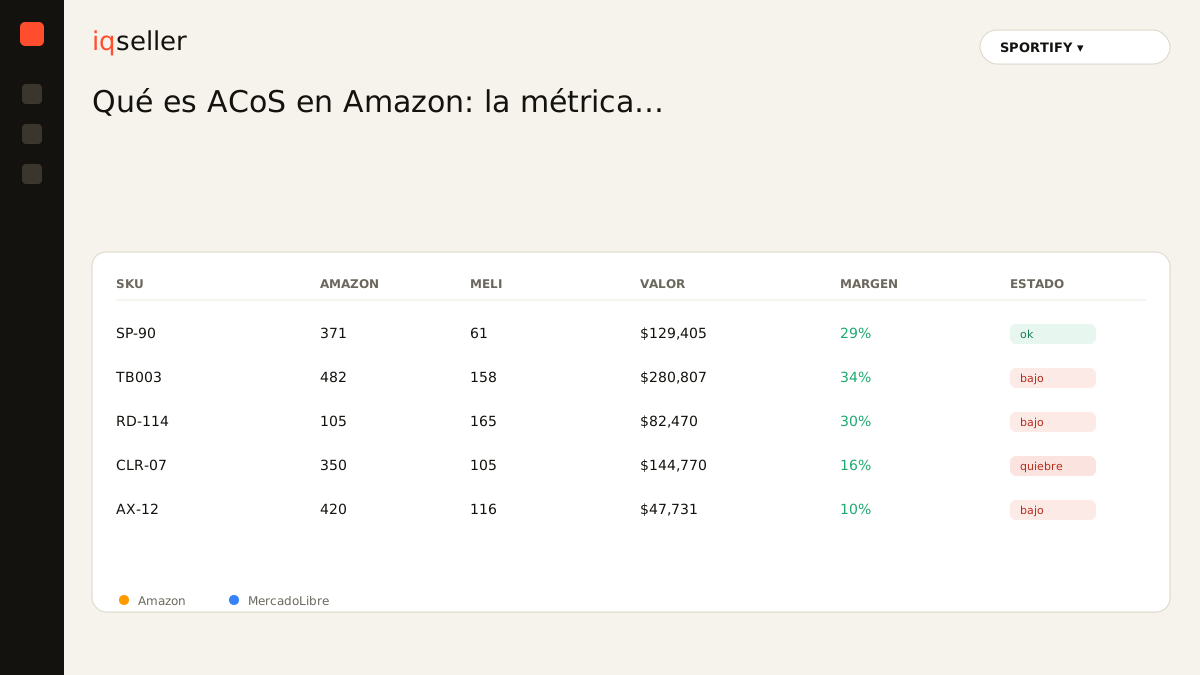
And by the time the table is finally ready, it is already yesterday’s. Campaigns do not wait for your spreadsheet: they keep spending on last week’s bids. Deciding on stale data, in advertising, means overpaying for days before you correct. A single source of truth in real time changes the question from “how much did I spend?” to “did this spend leave me profit today?”. It lets you see, per SKU and per channel, the net margin before advertising, the calculated break-even, the current ACoS and TACoS, and the net profit after subtracting the ad — without rebuilding anything by hand. There, ACoS stops being a loose figure and becomes a lever you move knowing exactly what happens to your profit.
Glossary: real available stock is the sellable inventory net of reservations and in-transit units; if it drops, your conversion falls and your ACoS rises even though the campaign never changed.the decision that actually matters
Optimizing advertising is not chasing the lowest possible ACoS. A very low ACoS sometimes means you are underinvesting and leaving profitable sales on the table. The goal is not a small number but the highest total net profit, and that sometimes means accepting a higher ACoS on a healthy-margin product to gain volume, and cutting bids hard on a thin-margin one.
So “what is ACoS” has two answers. The short one: it is ad spend divided by the sales it generated. The one that makes you money: it is half of a story that only completes when you read it alongside your real margin, your per-channel break-even, and your TACoS — all up to date and with your SKUs unified across Amazon, MercadoLibre, and your 3PL. ACoS without margin is half the picture. Margin without ACoS is the other half. Together, and in real time, they tell you the only thing that matters: how much money each dollar you invested in ads actually left you.