
What is CPC: how much you pay per click and how it affects your ACoS
August 2, 2026
CPC — cost per click — is what you pay each time someone clicks on one of your ads, nothing more and nothing less. You don’t pay to show up, you don’t pay to be seen: you pay only when the click happens. If your average CPC is $8, every person who clicks your sponsored product costs you eight pesos, whether they bought or not. That’s the full definition, and hidden inside that one sentence is almost everything that decides whether your advertising is profitable or eats your margin alive.
What makes CPC so important for a seller on Amazon Mexico or MercadoLibre isn’t the number itself, but that it’s the most direct lever you have over your ACoS. When your cost per click goes up, your cost per sale goes up in the same proportion, even if you changed nothing else. That’s why understanding what CPC is, how it’s set, and what pushes it up isn’t ad-agency trivia: it’s the difference between knowing why a campaign stopped being profitable and guessing blind.
The detail almost nobody explains is that you don’t choose your CPC. You set a bid — the maximum you’re willing to pay — but the real price you end up paying is decided by an auction that runs in milliseconds every time someone searches. And that price changes depending on who else is bidding, how relevant you are to that search, and how well your listing converts. In this article we take that mechanism apart piece by piece so you stop seeing CPC as a number that just “comes out” and start seeing it as something you control.
what CPC is and how it’s calculated
In its simplest form, CPC is a division: total campaign spend divided by number of clicks. If you spent $2,000 in a day and got 250 clicks, your average CPC was $8. That’s the CPC you read in reports, and it’s an average: some clicks cost you $4 and others $15, but in the end the campaign reports a single number that sums it all up.
It’s important not to confuse CPC with the bid. The bid is what you configure: “I’m willing to pay up to $12 for a click on this keyword.” The CPC is what you actually paid: almost always less than your bid, because in a second-price auction you only pay one cent more than the competitor who landed just below you offered. That’s why you can have a $12 bid and a $7 average CPC: you bid high to secure the position, but the market didn’t force you to pay that much.
CPC is also the first half of a chain. A click is not a sale. If your CPC is $8 and one in ten clicks buys, each sale cost you $80 in advertising, not counting the product. That jump — from cost per click to cost per sale — is exactly where CPC connects to your profitability, and it’s the reason a “cheap” CPC with bad conversion can end up more expensive than an “expensive” CPC that converts well.
how CPC is set at auction
Every time a shopper types something into the Amazon or MercadoLibre search bar, an instant auction fires between all the advertisers bidding on that search. But it isn’t simply won by whoever bids most. The platforms combine your bid with a quality factor — how relevant your product is to that search and how likely it is to convert — to decide who shows up and in what position. A highly relevant ad can win the slot from another that bids more but converts worse.
This has a practical consequence that changes how you think about CPC: improving your ad’s relevance and your listing’s conversion can lower your CPC without touching the bid. If the algorithm trusts that your product will convert, it charges you less for the same slot, because to the platform you’re a safer bet. It’s the same logic that makes a high CTR cheapen your clicks: the system rewards what’s convenient for it to show.
On the other side, two things push your CPC up without you doing anything wrong. One is competition: if more sellers start bidding on your keyword, the price of that auction rises for everyone. The other is seasonality: during Buen Fin, Hot Sale or the holiday season, everyone bids more aggressively and CPCs inflate for weeks. Recognizing that a CPC rose because of the market, not because of your campaign, keeps you from making adjustments that fix nothing.
the relationship between CPC and ACoS
Here’s the heart of it. ACoS — the percentage of your sales that goes to advertising — can be written as a formula that puts CPC’s role in plain sight: ACoS = CPC ÷ (sale price × conversion rate). Read it slowly. CPC sits alone in the numerator. That means any change in your cost per click carries over directly and proportionally to your ACoS.
A concrete example. You sell a product at $500, your conversion rate is 10% and your CPC is $8. You need 10 clicks for one sale, you spend $80, and your ACoS is 16%. Now competition enters and your CPC rises to $12 with nothing else changing: now those 10 clicks cost $120 and your ACoS jumps to 24%. You didn’t sell less, you didn’t drop your price, your listing didn’t get worse — only the price of each click went up — and your profitability moved eight points. That’s the power CPC has over your ACoS: it’s the lever that acts fastest and most directly.
That’s why, when you see your ACoS spike, the first useful question isn’t “which campaign is broken?” but “did my CPC go up, did my conversion drop, or both?”. Separating those two causes is what turns an hours-long diagnosis into a minutes-long one. And it’s also why a controlled CPC is the foundation of every profitable campaign: if you don’t master the entry price, everything downstream runs out of control.
Glossary: ACoS is ad spend divided by the sales attributed to those ads; CPC is the lever that moves it most directly.why a low CPC isn’t always good
The most common mistake is treating CPC as a number to minimize at all costs. A low CPC sounds like a win, but it can hide a problem. If you lower your bid so much that your ad drops to positions almost nobody sees, you’ll have cheap clicks but very few sales: you spent little, yes, but you didn’t sell either. A $3 CPC on an ad that shows up on page four does you no good.
Conversely, a higher CPC can be the best deal if those clicks come from a high-intent search that converts at double the rate. What matters isn’t CPC in isolation, but CPC against your margin and your conversion. A $12 click that converts at 15% on a good-margin product leaves more profit than a $5 click that converts at 3%. CPC only makes sense when you read it next to what you earn per sale.
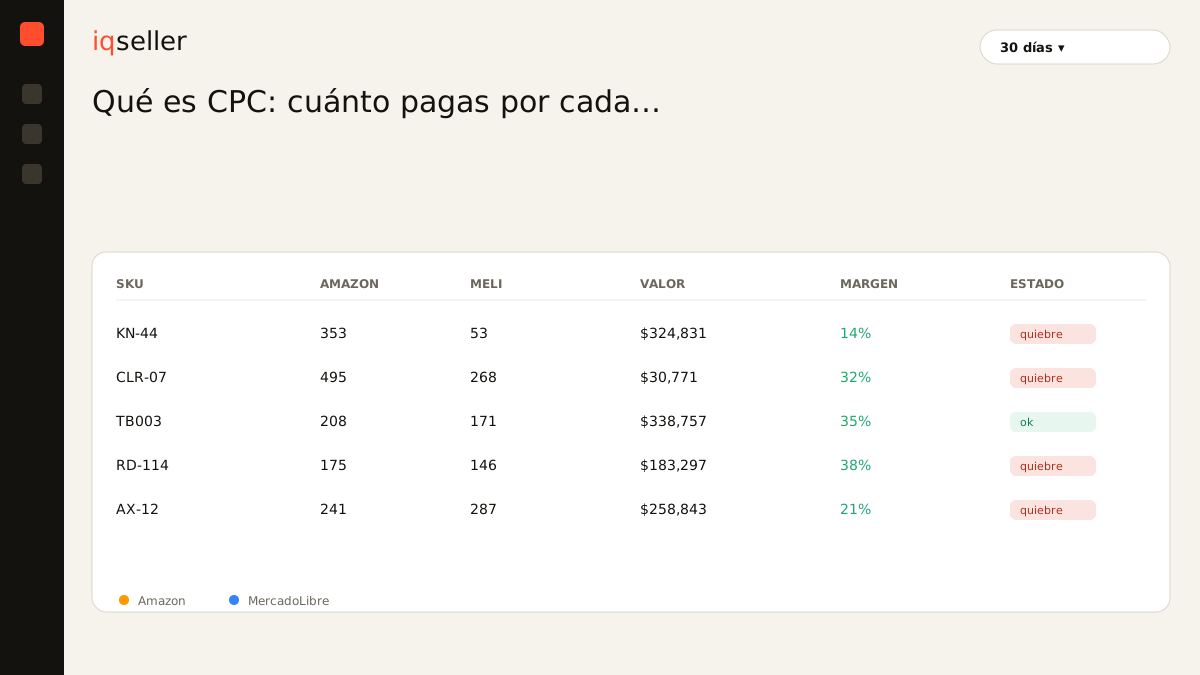
And there’s the trap for the seller who decides on click cost alone: without seeing the real net margin per SKU beside the CPC, you don’t know whether an expensive click is leaving profit or burning it. A $10 CPC can be cheap on a product with 50% margin and brutally expensive on one with 20%. Same number, two opposite verdicts, and the difference lives in a figure that almost never sits on the same screen as the campaign.
Glossary: real net margin is what’s left after ALL costs — product, fees, shipping, tax and advertising; without it, no CPC can be judged cheap or expensive.the problem of reading CPC across several dashboards
For the seller who sells on Amazon and MercadoLibre at once, CPC doesn’t live in a single place. Amazon reports the cost per click of its Sponsored Products with its own logic and its own attribution window; MercadoLibre reports Product Ads with another. Each platform names things differently, refreshes at different rhythms and presents the numbers in tables that don’t line up with each other. Comparing your CPC across channels is, literally, opening two tabs and translating by hand.
And CPC alone isn’t enough: to know whether that click left profit you need to cross it with the sale price, the channel fee, fulfillment, tax and — this one always gets forgotten — your stock. If you run out of the best-selling color, your clicks keep coming and keep charging, but they stop converting, so your effective CPC per sale spikes without the campaign changing a comma. That figure lives in your inventory, not in the ad panel. Understanding well what clicks in advertising are and why not all of them are worth the same is the other side of this same coin.
The cost of pulling all that together by hand isn’t just the time of the 11 p.m. Excel: it’s that you decide on yesterday’s data while today’s bids keep running. When the CPC of both channels, the real margin of each SKU and the available stock live on the same dashboard and in real time, the question stops being “what happened last week?” and becomes “which click is costing me too much right now, and why?”. Seeing real available stock next to CPC is what lets you rule out at a glance the cause that isn’t in the campaign.
Glossary: real available stock is sellable inventory net of reservations and in-transit; if it drops, your clicks keep charging but stop converting and your cost per sale spikes.how to control CPC without shutting off the good sales
Controlling CPC isn’t cutting every bid across the board. It’s telling apart where the expensive click is worth it and where it’s a leak. The first move is to sort your terms by CPC from highest to lowest and cross them with their conversion: the expensive terms that also convert poorly are the ones to adjust first, whether by lowering the bid or moving them to exact match. The expensive terms that convert beautifully are left alone, because they’re buying profitable sales.
The second move is to attack relevance, not just the bid. Since the algorithm cheapens the clicks of ads that convert, improving your photos, your title and your price lowers your CPC through the back door. Negating irrelevant searches that bring empty clicks does the same: it raises your average relevance and with it lowers what the platform charges you for each good click.
The third move is the one almost nobody makes: reading CPC alongside margin and stock, not in isolation. A CPC is only “high” or “low” against what you earn per sale and against whether you have product to sell. When those three signals sit on the same screen and are up to date, you stop chasing an abstract number and start making the only decision that matters: raise the bid where the click pays and lower it where the click bleeds. That’s the real work behind the question “what is CPC,” and it’s the difference between a campaign that grows with margin and one that grows burning it.