
When Buen Fin Money Actually Lands in Your Account
November 13, 2026
Buen Fin 2026 runs from Friday, November 13 to Tuesday, November 17. By Tuesday night you’ll have a sales number on screen that feels like money. It isn’t yet, and the distance between that number and your bank balance causes most of December’s scares.
The problem isn’t that the platforms are slow. It’s that each one is slow in a different way, for different reasons, and the average seller doesn’t have that calendar written down anywhere. They order merchandise against projected sales, pay the supplier against projected sales, buy advertising against projected sales, and then discover that on November 30, with the season already run, the bank holds a fraction of what they sold.
There’s a second layer that makes it worse: the gap stretches precisely when volume rises. More sales mean more units inside the return window, more open claims, more account reviews, and, in fast-growing accounts, a higher chance the platform increases the share of your balance it holds back. The month you most depend on money arriving on time is the month it’s least punctual.
This article explains the mechanics of each stage, why volume stretches it, and how to build your real collection calendar from your own historical deposits instead of from published policy. It is not financial or tax advice; that’s what your accountant is for.
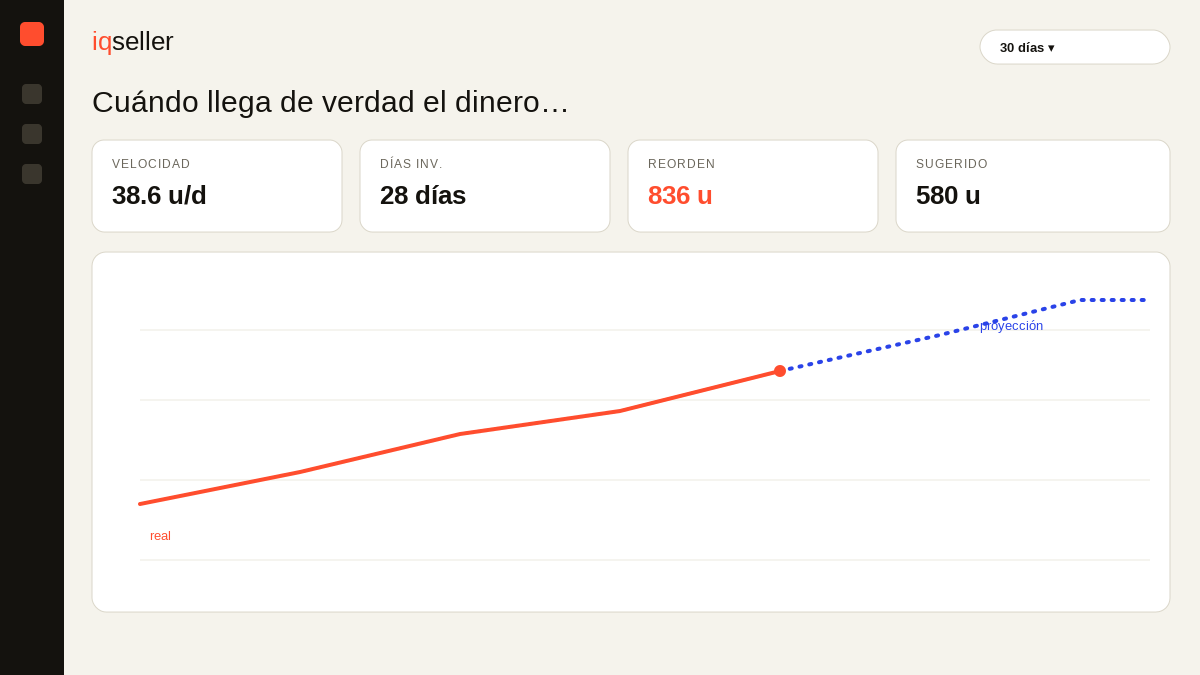
the sale has one date; the deposit has another
Between a buyer paying and that money reaching your bank, at least six things happen, in order:
- The order is confirmed and the channel charges the buyer. That money exists, but it exists on the platform, not in your account.
- The product is delivered. On several channels the payment countdown doesn’t start at the sale, but at confirmed delivery.
- A return window opens and closes. While it’s open, part of that revenue is reversible.
- Deductions are calculated: referral fee, fulfillment fee, shipping, advertising, storage, adjustments from prior periods.
- Tax withholdings are applied where applicable, and the disbursable balance is built.
- The transfer fires according to the platform’s settlement window, plus the business days the bank takes.
Each step adds days. And none of them is a delay: they’re all by design. A marketplace that deposits before the return window closes is taking on a risk it doesn’t want, so it doesn’t.
The practical consequence is that your gross sales and your deposit aren’t just different amounts, they’re different dates. If your planning uses a single number with a single date, your planning is wrong from the first cell.
the Amazon gap: settlement cycle and reserve
On Amazon the mechanic runs on settlement windows. The account accrues sales and deductions during a period, the period closes, a settlement is issued with the net balance, and that balance is transferred. Third-party guides describe a rhythm of roughly fourteen days, with funds becoming eligible for payout about two weeks after the sale, and the Seller Central Mexico seller forum mentions holds of 14 to 30 days as normal for new accounts, under the concept of an account-level reserve.
Three warnings about those numbers. First, most of the available sources are neither official nor Mexico-specific. Second, the reserve is neither a punishment nor an error: it’s a standard mechanism the platform adjusts based on the account’s history and risk profile, and it can move without notice. Third, your real cycle is defined by your account, not by an article: the exact dates of your windows and your current reserve level live in your own payments dashboard, and it’s worth confirming them there and in Seller Central’s help center, because conditions change.
What is structural and worth understanding: the settlement is net. That means October’s storage fees, November’s advertising, and return adjustments from the previous season all come out of the same balance you’re waiting on. In a normal month those deductions are modest. In peak season they can eat a sizable share of the deposit, and that’s the most common reason a December settlement arrives far thinner than the seller calculated.
the MercadoLibre gap: release on delivery
On MercadoLibre the logic is different: money is released after delivery, and the number of days depends on seller and product conditions. Third-party sources disagree with each other. A January 2026 article from a seller-software vendor describes release 2 days after delivery for sellers with reputation selling a new product, 6 days without reputation or for a used product, and up to 28 days if the shipment is never marked as delivered. Another article from the same vendor, with no visible date, gives longer terms: 8 days with reputation and a new product, 14 with a used product or no reputation, and 6 days on Full.
That discrepancy is useful information in itself: it means there is no single number, and anyone who gives you one without looking at your account is guessing. What is consistent across every version is the mechanic: the countdown starts at delivery, reputation shortens the term, a lack of reputation lengthens it, and a shipment without delivery confirmation stretches it to the maximum.
The operational implication for November is direct. A November 13 sale delivered on the 16th starts counting on the 16th, not the 13th. If your release term is six days, that money is available on the 22nd. But a November 17 sale delivered on the 24th because of logistics congestion releases in late November or early December. The same commercial event gets collected across three weeks, and the shape of that distribution depends on how fast you deliver.
Which leads to a conclusion almost nobody connects: on MercadoLibre, delivery speed doesn’t just affect your reputation, it affects your cash flow. A four-day logistics delay doesn’t only cost you a bad rating: it moves the deposit four days to the right, in the month those four days matter.
Glossary: real net margin, with everything deducted →why the gap stretches as volume rises
This is the part that isn’t in any published policy and that explains why the season feels worse than a normal month, even when everything is done right.
More delivered units means more units inside the return window. The return rate may be identical, but the absolute amount at risk multiplies, and channels get more conservative with the disbursable balance as that amount grows.
More volume means more open claims. A lost package, a disputed delivery, a product that didn’t match the description. Each open case can freeze the associated funds until it resolves, and in November every channel’s support team is overloaded, so resolution takes longer.
Fast growth changes the account’s risk profile. An account that goes from 600 thousand to 1.8 million in a month is, from the platform’s perspective, a different account. Reserves exist for exactly that scenario.
Logistics congestion delays deliveries, and where payment depends on delivery, it delays payment. This hits both self-fulfillment and the channel’s own.
And fees grow before deposits do. Storage, advertising, and shipping all rise with volume and come out of the same balance, so net falls as a percentage of gross right at the peak.
The combined effect is that the share of your November sales that reaches the bank in November is smaller than the share of a normal month’s sales. Not because something went wrong, but because that’s how it works. Modeling it with a quiet month’s assumption is the most expensive mistake in the exercise.
how to build your real collection calendar in one afternoon
You don’t build it from policies. You build it from your own deposits, and it can be done in an afternoon if you have the settlements and payout reports at hand.
Step one: pull twelve months of deposits by channel. Each deposit with its date and net amount.
Step two: tie each one to the sales that generated it. For each deposit, identify the sales period it covers. It won’t be perfect; that’s fine.
Step three: compute your real median gap per channel. Days between the period’s average sale date and the date the money became available. The median is more useful than the mean, because one extreme case distorts the mean.
Step four: compute your real net deposit rate. Deposit divided by the period’s gross sales, per channel. That percentage already contains commissions, fees, shipping, advertising, and withholdings. It’s far more useful than estimating each component separately.
Step five: check how those two numbers behaved last season, not across the year’s average. If your median gap last year was 16 days but in November and December it was 24, the number to plan this season with is 24.
Step six: spread your projected sales over that calendar. Sales week plus gap equals deposit week, per channel, multiplied by your real net rate.
The result is a collection calendar you can defend. And it has a virtue no rounded assumption has: when it’s wrong, you can audit why.
a worked example with the numbers adding up
Invented example, with explicit assumptions. These are not benchmarks.
A seller does 900 thousand pesos in gross sales during Buen Fin week, split 60 percent on Amazon and 40 percent on MercadoLibre.
- Amazon: 540 thousand gross. Referral fee, FBA fee, and shipping take 30 percent, so net is 378 thousand.
- MercadoLibre: 360 thousand gross. Commission, Full, and shipping take 32 percent, so net is 244.8 thousand.
- Total net for the week: 622.8 thousand pesos on 900 thousand of gross sales, or 69.2 percent.
Now the calendar. With a settlement cycle of roughly fourteen days on Amazon, sales from the 13th to the 17th land in a window that closes in late November and transfers over the following business days. On MercadoLibre, with deliveries concentrated between the 16th and the 22nd and release tied to delivery, the money is staggered from November 20 into early December. And a portion stays held back or reverses through returns that arrive later.
Distribution of the 622.8 thousand net:
- November 20 to 30: 280 thousand
- December 1 to 10: 230 thousand
- December 11 to 31: 75 thousand
- In January, between released balance, adjustments, and returned reserves: 37.8 thousand
Sum: 280 plus 230 plus 75 plus 37.8 equals 622.8 thousand. It adds up.
The reading that matters: of the 900 thousand pesos the seller saw on screen on Tuesday the 17th, only 280 thousand were in the bank when November closed. That’s 31 percent of gross sales. If that seller committed December payments against “what I sold during Buen Fin,” they’re more than 600 thousand pesos short, and not because anything failed.
the three mistakes that cost the most
Confusing gross sales with money. The most common and the most expensive. Gross sales are the starting point of a calculation, not the result.
Using published policy instead of your own history. The policy describes the general case. Your account has its own behavior, with its reserve level, its channel mix, and its delivery speed. The only data point that predicts your collections is your previous collections.
Forgetting carried-over deductions. Fees and adjustments from earlier months are deducted from the current settlement. A deposit that arrives 15 percent thinner than expected almost always has its explanation there, and you find it by reconciling line by line, not by staring at the total.
Glossary: real-time sync, what it actually means →how this reads in iqseller
iqseller is not a treasury system and it doesn’t predict the date of your next deposit. What it does is keep the data that calendar is built from in one place, which is where the exercise breaks when you have to download reports from each panel and paste them by hand.
The Profitability module reads commissions from the Amazon settlement and MercadoLibre orders, FBA and Full fees, shipping, advertising, and the VAT and withholding breakdown, against the COGS you loaded. That’s where your real net deposit rate per channel and per SKU comes from, which is the multiplier in the calendar. With the Parent, Model, SKU tree you can see whether net is slipping account-wide or only in one family.
The Alerts module flags when a line item deviates from its normal behavior: a commission that rose, a fee that appeared, an adjustment that wasn’t there. In November that signal is worth double, because it’s the difference between finding out now and finding out while reconciling in January.
And the Inventory module gives the counterpart: how much capital is still sitting still while you wait for the deposit, by warehouse and in transit.
What iqseller does not do is tell you when each platform will deposit or how much it will hold back. That data belongs to the platform, lives in your payments dashboard, and is worth verifying there.
the question for your accountant
Two topics in this article are theirs, not yours.
The first is the treatment of the withholdings each marketplace applies: what’s withheld, what it credits against, and in which period. That money never passes through your account but it is yours, and how it shows up in your filing changes your real January balance.
The second is the timing of recognizing revenue versus collecting it. In a seasonal business that mismatch can leave you with a taxable result that looks nothing like your bank account, and it’s worth understanding before the year closes, not after.
Show up to that conversation with your collection calendar built and your real net rate per channel. Those are two numbers nobody else can calculate for you, and they make the conversation much shorter and much more useful.
Sources: Buen Fin 2026 dates per Mexican press coverage from September and October 2026 (Bloomberg Línea, Xataka México, Excélsior). Amazon settlement cycle and reserve per third-party guides and the Seller Central Mexico seller forum; these are not official Mexican sources. MercadoLibre release terms per articles from a seller-software vendor, one dated January 2026, whose figures disagree with each other. All of it is worth confirming in Seller Central and MercadoLibre’s help center, because it changes.