
Why real-time information matters
May 5, 2026
It’s nine at night. You’ve just closed the Amazon Seller Central dashboard, opened another tab to check MercadoLibre, and in the middle of it your 3PL operator texts you asking why a SKU he swears is sitting on the warehouse floor shows as out of stock on one of your marketplaces. You open Excel, paste in a couple of reports you downloaded two hours ago, and discover the numbers no longer match what the platforms are showing. The uncomfortable question isn’t “what happened” — it’s “how old is what I’m looking at.”
That lag is the real problem for the multichannel seller. It isn’t that information is missing; there’s too much of it. What’s missing is information that is true right now. Every platform has its own clock, its own reporting latency, and its own way of counting things, and you end up being the human integrator trying to reconcile three partial truths by copying and pasting. The decisions you build on top of that — how much to reorder, what price to list at, which listing to pause — rest on yesterday’s data dressed up as today’s.
This article is about why the freshness of data matters as much as its accuracy, and why having a single source of truth in real time changes the very nature of the decisions you make every day. This isn’t about having more charts: it’s about no longer having to guess.
the invisible cost of deciding with yesterday’s data
When you work with stale data, the cost almost never shows up as a line in your P&L. It shows up in disguise. It shows up as a stockout you could have avoided, as a promotion you kept paying for two days after the inventory ran out, or as a reorder you placed too late because the report you were looking at still showed 40 units when there were really 6 left.
The trouble with latency is that it’s asymmetric. When sales accelerate — a traffic spike, a mention, a competitor who just went out of stock — that’s exactly when your stale data lies to you the most. A SKU that sold 3 units a day and suddenly sells 30 empties your inventory before the next morning’s report ever reflects it. By the time you find out, you’re already stranded.
Dictionary: a stockout means running out of a SKU right when there’s demand; in a multichannel setup it usually starts out invisible because each platform reports it on its own delay.Data freshness, then, isn’t a technical luxury. It’s what separates a defensive decision (“I react after the fact”) from an anticipatory one (“I act while I can still change the outcome”).
three dashboards, three truths, no agreement
The typical multichannel seller lives between tabs. Amazon Seller Central on one side, with its own definition of “available” that blends FBA inventory, in-transit, and reserved units. MercadoLibre on another, with its Full logic and its catalog. And the 3PL or your own warehouse, which knows the physical boxes but knows nothing about what each marketplace is promising to sell.
Each of these systems is right from inside its own window. The problem is that none of them sees the whole picture, and neither do you, because the only way to join them is by hand. You download a CSV here, export a report there, paste them into a sheet, and pray the SKUs are named the same across all three places (they aren’t). By the time you finish assembling the table, half an hour has passed and the source numbers have already changed.
This isn’t a discipline problem or a “you should organize better” problem. It’s structural: you’re doing manually, and with a delay, an integration job that should happen continuously and automatically. Manual consolidation introduces two ills at once — human error and latency — and multiplies them by each other.
what “a single source of truth” actually means
A single source of truth isn’t a prettier report. It’s the idea that inventory, sales, pricing, and fees from all your channels come together in one place, normalized to one shared SKU vocabulary, and that this place updates as things happen rather than when you remember to refresh.
The practical difference is enormous. When you sell a unit of a SKU on MercadoLibre, its real availability in the shared warehouse drops, and that should immediately reflect in what Amazon can promise from that same physical stock. If that synchronization happens with minutes of delay instead of hours, you avoid overselling; if it happens with hours of delay, you end up canceling orders and damaging your reputation on the platform.
Dictionary: real-time synchronization is the process by which a change on one channel (a sale, a stock adjustment, a price change) propagates to your central source and the rest of your channels within seconds or minutes, not hours.Having that up-to-date base is also the foundation of any serious projection. If your inventory forecast feeds on stale numbers, you’re not forecasting — you’re extrapolating an error. A good forecast starts with a good present.
from data to alerts: let the information come to you
Here’s an important shift in mindset. Even with a single real-time source of truth, staring at dashboards all day doesn’t scale. Nobody can watch 200 SKUs across three channels without missing something. Real-time information only delivers on its promise when it stops being passive — something you go check — and becomes active: something that tells you.
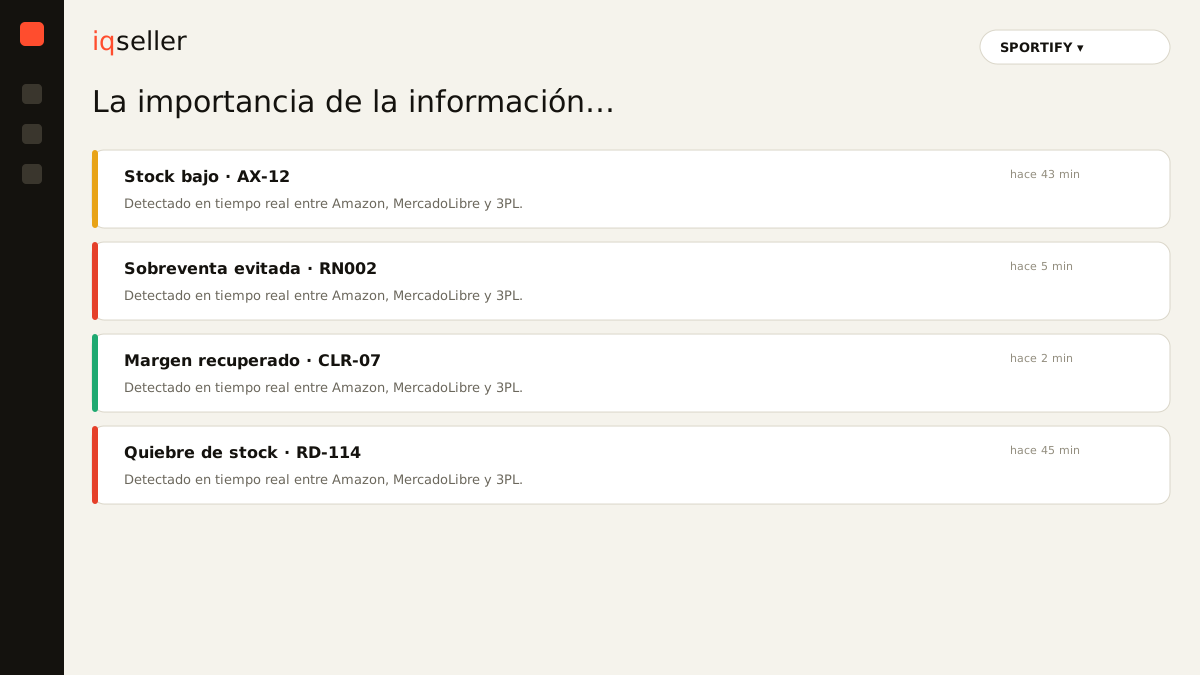
That’s the role of alerts. Instead of you discovering the problem, the system detects it the moment it happens and puts it in front of you. “This SKU dropped below X days of inventory.” “This price fell below your cost plus fees.” “This variant has gone three hours without syncing across channels.” The alert turns a data point into a possible action while the window to act is still open.
Dictionary: days of inventory estimate how many days your current stock will last at the recent sales pace; with real-time data, the alert threshold is computed on today’s actual velocity, not last month’s average.The key is that an alert’s usefulness is proportional to the freshness of the data that triggers it. An alert based on a six-hour-old report warns you about a fire that already burned the house down. An alert based on live data warns you while there’s still time to move inventory, adjust the price, or pause the campaign.
when a number doesn’t add up: anomalies you only see live
There’s a category of problems that simply can’t be caught with daily reports: anomalies. A sharp drop in conversion on a listing, a spike in returns on a SKU, a price that collapsed because a competitor started a price war, or a feed error that delisted half a dozen products without anyone noticing.
These things have a time signature. If you only look at end-of-day totals, a three-hour dip gets diluted into the average and disappears. Only when you watch the flow in real time can you see the break the moment it happens and ask why. Anomaly detection isn’t statistical magic: it is, first and foremost, having data fresh enough that the anomalous pattern is still visible and still reversible.
The seller who operates on yesterday’s data lives in a permanent state of autopsy: explaining what already happened. The one who operates in real time can intervene.
what changes in your day-to-day
The most concrete benefit of real-time information isn’t technological — it’s psychological and operational. You stop starting your day by reconstructing reality by hand. Instead of opening three tabs, downloading reports, and assembling a sheet, you open a single place where the state of your business is already consolidated and where what’s urgent is already flagged.
That frees your attention for what actually moves the needle: deciding how much to buy, where to adjust pricing, which listing to push. Decisions stop being made “with whatever I managed to see” and start being made with the full picture of the moment. Uncertainty doesn’t vanish — selling always carries risk — but it stops coming from an avoidable cause like the delay of your own data.
At SPORTIFY, to take an example of a multichannel store, the difference between learning about a stockout the next morning and learning about it the instant stock crosses the threshold can literally be the difference between losing or not losing a day of sales on its flagship SKU. Multiply that across dozens of SKUs and several channels, and you understand why data freshness is a competitive asset, not a configuration detail.
Real-time information, in the end, isn’t about seeing more things. It’s about seeing the right things at the only moment when you can still do something about them.