
Amazon vs MercadoLibre: the differences that complicate your data
April 30, 2026
You sell the same product on Amazon and on MercadoLibre. In your head it is one thing: one box, one cost, one margin. But you open Seller Central and see one number; you open MercadoLibre and see a completely different one; you check your 3PL and a third appears. Each platform speaks its own language, with its own rules and its own names for the same thing. And at the end of the day you are the one who has to reconcile everything by hand just to answer something as basic as “how much did I sell” or “how much is left in the warehouse.”
That is the real problem of selling across channels. It is not that Amazon is better than MercadoLibre, or the other way around. It is that they are two universes with logics so different that merging their data becomes a constant translation job. The SKU that is one thing on one side splits into three on the other. The sale that is already collected here is still “processing” there. The stock you think is available turns out to be committed in another channel. And while you build the spreadsheet to make sense of it, the numbers keep changing.
This article is not about which marketplace is best. It is about something more concrete: why data from both does not line up on its own, where the traps are that make you decide on wrong numbers, and why the only sensible way out is to stop fighting spreadsheets and work from a single source of truth.
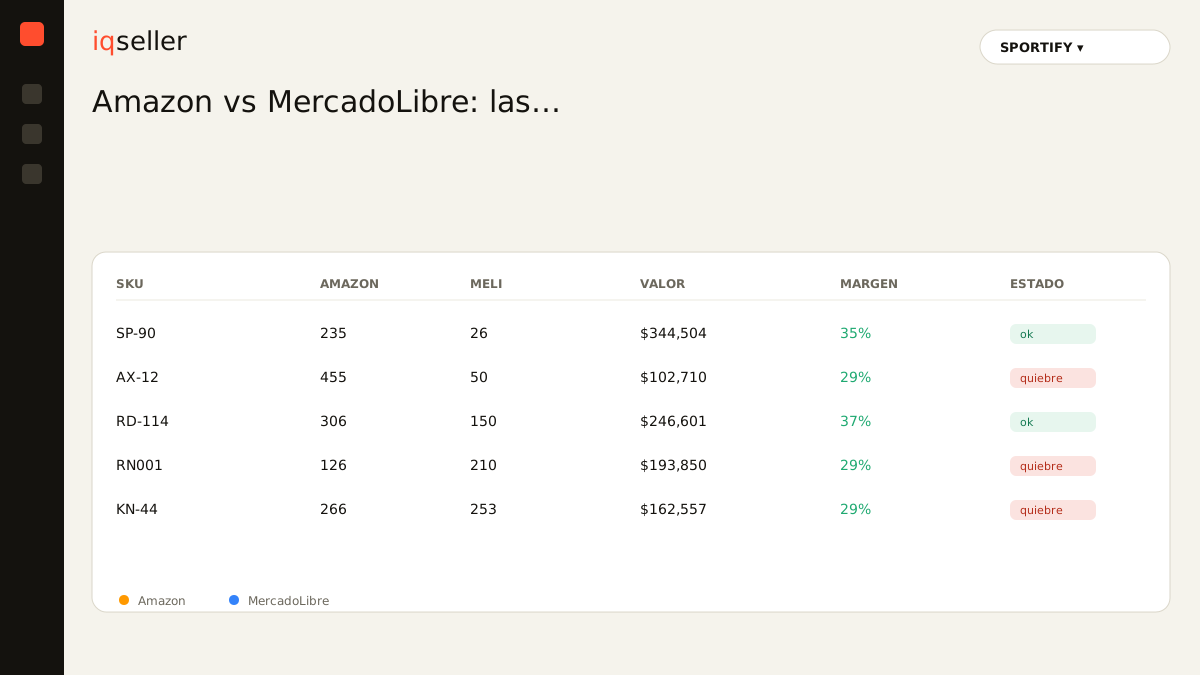
the same product, two catalogs that do not talk
Let’s start at the root. Amazon organizes its world around the ASIN: a unique identifier per product that, ideally, all sellers share when they sell the same thing. MercadoLibre works differently: historically each listing was its own universe, and although a catalog exists today, plenty of products still live as independent listings with their own MLM. For you, with one physical product in one box, this means your commercial identity is fragmented before you even begin.
The most painful clash shows up with identifiers. Amazon requires EAN or GTIN to create or match products; MercadoLibre sometimes asks for them and sometimes ignores them; your 3PL runs its own internal SKU that looks nothing like either. When you want to know how many units of product “X” you have in total across channels, you first have to figure out which MercadoLibre listing maps to which Amazon ASIN and to which warehouse SKU. That mapping table, which many people keep on an Excel tab, is exactly where everything breaks.
Dictionary: the unified catalog is the layer that reconciles the same physical product even when each marketplace names and identifies it differently.sales: what counts as a sale here is not one there
It sounds obvious: a sale is a sale. But in practice, Amazon and MercadoLibre count money at different moments and with different states. On Amazon an order can be “pending” before it confirms, and refunds arrive in separate reports that deduct later. On MercadoLibre you have sales that come in as reserved, payments that settle days late, and returns that move your balance when you least expect it.
If you add up gross sales from one dashboard and the other without aligning states or dates, you get a number that looks fine but lies. The problem gets worse when you try to compare periods: Amazon’s “today” and MercadoLibre’s “today” do not always close at the same hour or in the same time zone. That is why so many sellers end up making pricing or purchasing decisions on yesterday’s data, because consolidating today’s data by hand simply does not fit in the day. If you want to see how this connects with anticipating real demand, it is worth reading inventory forecast in depth, because a forecast built on badly summed sales inherits the error.
fees: each marketplace charges you differently and for different things
This is where the real margin hides. Amazon charges a category referral fee, plus FBA fees if you use its logistics, plus storage, plus possible low-rotation charges. MercadoLibre has its own commission by listing type (classic or premium), a shipping cost that changes with reputation and product price, and free-shipping rules that eat your margin without ever showing up in the price list.
The result is that the same product, sold at the same price on both sides, leaves you with completely different margins. And if you only look at the selling price, you are blind. To compare for real you need to bring each fee down to the per-unit-sold level and subtract it from real revenue, not from gross. Doing that in Excel for dozens or hundreds of listings, with fees that change, is the perfect recipe for getting it wrong. The logistics comparison we detail in FBA vs Full: costs, data and a real comparison helps a lot here, because the choice of which network to use depends on exactly these numbers.
Dictionary: the EAN/GTIN is the product’s global code; aligning it across channels is what lets you cross fees and sales of the same item.stock: the silent enemy of multichannel
Imagine you have 10 units of SPORTIFY in your warehouse. You list them on Amazon and on MercadoLibre. If you do not deduct in real time, both channels think they have 10 available. You sell 6 on Amazon, an order for 5 comes in on MercadoLibre, and now you owe a unit that does not exist. On Amazon that penalizes your account; on MercadoLibre it hits your reputation. Overselling is not a silly mistake: it is the natural consequence of inventories that live in separate silos.
The challenge multiplies when stock is split across FBA, Full and your own 3PL. One unit may physically sit in an Amazon center, another in a MercadoLibre warehouse, another in your own. How much can you really sell without failing a customer? That question is not answered by staring at three screens; it is answered when available inventory is calculated in a single place, subtracting what is committed in each channel at that moment. We break down that chaos of duplicated listings and identities in one product, many MLM: MercadoLibre listing chaos.
visibility: Buy Box versus reputation
Both platforms push you to compete, but by different rules. On Amazon, winning the Buy Box decides whether you sell at all: price, availability, shipping method and account metrics decide who gets the buy button. On MercadoLibre the engine is reputation: your green color, your delivery times, your claims rate. They are two optimization games living in metrics that are not even named the same way.
When you work blind, you end up cutting price on Amazon to fight for the Buy Box without noticing it destroyed the margin that depended on a different fee, or you protect your reputation on MercadoLibre by accepting shipments that cost more than you think. Seeing both signals side by side, translated into the same unit of measure, is what lets you decide where to push price and where to protect margin.
Dictionary: the Buy Box is Amazon’s mechanism for assigning the featured sale; it has no direct equivalent on MercadoLibre, where reputation rules.the way out: a single source of truth in real time
Everything above shares a common pattern: the data exists, but it is fragmented, named differently and out of sync in time. As long as you merge it by hand, you will always decide late and with doubt. The alternative is not more reports but fewer: a single place where the physical product is reconciled across Amazon, MercadoLibre and 3PL, where sales are counted with the same states and the same time zone, where fees are already deducted and available stock reflects what is committed in each channel right now.
That is what a dashboard like iqseller aims to solve: it does not replace Seller Central or MercadoLibre, it translates them into a common language. Instead of opening three screens and building a spreadsheet, you see a number you can trust because it is built on today’s data, not yesterday’s. The difference between the two marketplaces does not disappear, because it should not: what disappears is the manual work of reconciling it every morning.
Selling on Amazon and MercadoLibre at once will always be more complex than selling on just one. But that complexity should live in the platform that gives you the numbers, not in your head or your Excel. When the data arrives already reconciled, you stop being a translator between marketplaces and go back to being what you are: someone making business decisions on information they can trust.