
Contribution Margin per Order: The Metric Monthly Margin Hides
September 8, 2026
Almost every seller I know can tell you last month’s net margin. Very few can tell you what the order that came in ten minutes ago left them. And that second figure governs nearly every decision you make during the week: whether to raise a campaign’s budget, whether to join a promotion, whether to drop price to win the Buy Box, whether it’s worth sending that SKU to Full.
Contribution margin per order is what remains from an order after subtracting only the costs that order caused. No prorating rent, salaries or the software subscription. Only what wouldn’t have existed if that sale hadn’t happened.
It sounds like accounting jargon and it’s exactly the opposite: it’s the most operational metric there is for a marketplace business, because it answers one very concrete question that monthly net margin cannot. The question is: does the next order make me money or cost me money?
what belongs in it and what doesn’t
The rule for deciding whether a cost goes in is a single one: does this cost exist because this sale happened? If yes, it goes in. If the cost would have been there anyway, it stays out.
What does belong, for a Mexican marketplace seller:
- COGS: what the unit cost you, landed in your warehouse. Product plus import freight, duties and handling if you import.
- Channel commission: Amazon’s referral fee or MercadoLibre’s commission, with its VAT.
- Fulfillment: the FBA or Full fee for that unit, or what it costs you to pick and pack it if you ship yourself.
- Shipping: freight to the buyer when you absorb it, which under free shipping is nearly always you.
- Returns: not that specific order’s return, but the provision — that product’s historical return rate multiplied by what a full return costs.
- Attributable advertising: the ad spend that can be assigned to that product.
- Payment processing and financial charges if they apply outside the marketplace.
What doesn’t belong: rent, team salaries, your software, accounting, the owner’s salary. All of that is fixed cost and gets paid out of the sum of every contribution, not out of a single one.
That boundary is what makes the metric useful. By not spreading fixed costs across products with arbitrary rules — per unit, per sale, per weight — you avoid the classic mistake of “killing” a SKU that actually does contribute, just because it happened to carry a large slice of the rent.
the calculation, with numbers
A product you sell on MercadoLibre at $1,160 with VAT included:
- Price with VAT: $1,160
- Base excluding VAT (÷ 1.16): $1,000 ← everything starts here
- COGS: −$540
- Channel commission (≈14% of base): −$140
- Full fulfillment: −$82
- Return provision (8% × $310 cost per return): −$25
- Attributable advertising: −$95
- Contribution margin: $118 per order, 11.8% of base
That $118 is what this order contributes toward paying rent, salaries and, after that, your profit. If your monthly fixed costs are $180,000, you need 1,526 orders like that one to break even. That number — the break-even point in orders — is impossible to calculate without contribution, and it’s probably the single most important figure a marketplace business owner can have taped to the wall.
Note the detail at the start: the calculation begins at $1,000, not $1,160. The VAT was never yours. If you run this arithmetic on the shelf price, you’ll invent a 16% of margin that doesn’t exist, and every decision you make on top will be inflated by that same proportion.
Glossary: real net margin, with everything deducted →why it isn’t gross margin or net margin
The three get confused constantly and they serve different purposes.
Gross margin is price minus COGS. It’s useful for negotiating with suppliers and for thinking about price positioning, and it’s completely useless for knowing whether you make money on a marketplace, because it ignores that the channel keeps between 25% and 40% of your sale across commission, logistics and ads. A product with 55% gross margin can lose money on every single order without any trouble.
Net margin is what’s left at the end of everything, fixed costs included. It’s the truth of the business and it’s the figure your accountant and an investor care about. But it’s calculated at close, it’s an average of everything, and it’s no use for deciding anything at the product level.
Contribution margin lives between the two, and it’s the only one of the three that can be calculated order by order and in real time. That’s why it’s the one you operate with.
The short version: gross margin is for buying, contribution margin is for selling, and net margin is for knowing whether the year went well.
how to set your threshold
Having the number is useless without something to compare it against. The threshold is calculated backwards, from your fixed costs:
- Add up your real monthly fixed costs, including your own salary.
- Divide by the orders you do per month. That’s what each order has to contribute just to break even.
- Add the profit you want. That’s your threshold.
With $180,000 of fixed costs and 2,000 orders a month, each order has to contribute $90 to break even. If you want $60,000 of monthly profit, the threshold rises to $120. Any SKU contributing less than $120 is, literally, being financed by the others.
That doesn’t mean everything below the line should be killed. A low-contribution entry product can make sense if it brings buyers who later buy the expensive thing, or if it sustains the volume that earns you a cheaper logistics fee. But that decision has to be made on purpose, knowing what it costs, not discovered eight months later in an income statement.
the same product, three different contributions
This is what breaks most multichannel sellers’ heads the first time they see it: the same SKU, at the same price, leaves different contributions on each channel.
Commission isn’t the same between Amazon and MercadoLibre, nor between categories within the same channel. Fulfillment cost changes between FBA, Full and self-shipping. The return rate differs by channel, because the buyer and the policy differ. And the advertising you need to move that unit doesn’t cost the same on one search engine as on the other.
The practical result is that the question “is this product profitable?” is badly framed. The right question is “is this product profitable on this channel, at this price, with this level of ads?” And when the answer differs across channels — which is the norm — you have a real lever: move volume toward where it contributes more, or adjust price per channel so contribution evens out.
how it’s calculated in iqseller
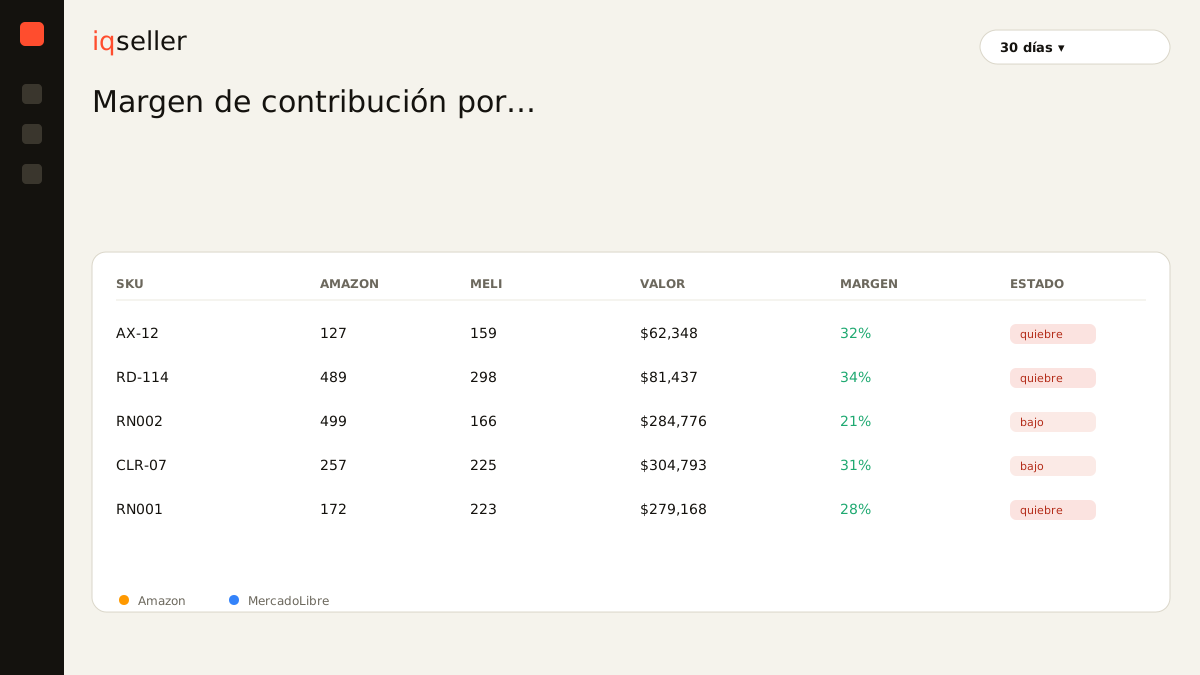
The Profitability module has this calculation assembled. It separates the base from VAT, deducts the COGS you uploaded, the actual commission that comes from Amazon’s settlement and MercadoLibre’s order data, fulfillment fees, shipping and advertising, and delivers contribution per SKU, per model and per channel.
Two things make it different from doing it by hand. The first is that commissions and fees come from each sale’s real data, not from an average percentage typed into a cell: commission changes by category, by promotion and by shipping type, and an average can throw you off by several points. The second is that it’s real time, so the current month’s contribution is visible while the month can still be corrected.
Placed in the Parent → Model → SKU tree, the number stops being a loose data point and becomes a map: which product families hold up the business, which live off the others, and which shouldn’t be in the catalog at all.
Glossary: what the Buy Box is and why it defines your sales →three mistakes that ruin the calculation
Forgetting the return provision. It’s the most common error. A product with a 3% return rate and one with 14% can look identical in contribution if you leave it out, and in reality one of the two leaves nothing.
Using an average commission percentage. Commission varies by category, by price and by listing type. Applying a flat 13% across the catalog introduces an error that, on thin-contribution SKUs, is enough to flip the sign.
Ignoring the cost of idle money. It doesn’t belong in contribution — correctly so — but a product with decent contribution and 180-day turnover can be a worse business than one with lower contribution that turns in 30. Contribution tells you what each turn leaves; turnover tells you how many turns you get. The two together are the answer.
Monthly net margin tells you how it went. Contribution per order tells you what to do tomorrow. They’re different metrics, with different audiences, and confusing them is why so many marketplace businesses find out too late that they’ve spent half a year growing in the wrong direction.