
Cross-channel price-drop alerts
May 7, 2026
There is a kind of loss that almost never shows up in a report: the kind that happens while you are not looking. You sell the same product on Amazon and on MercadoLibre, maybe also in your Shopify store, and overnight a competitor cuts their price, or you left a promo running that should have ended days ago. Nobody tells you. You find out three days later, when you open one channel’s dashboard and notice that SKU’s sales fell off a cliff — or worse, when you see that you sold a ton of units, but at the wrong price and with your margin in pieces.
The underlying problem is not that prices change. That is normal on any marketplace. The problem is the lag between something changing and you finding out. When you run three or four separate panels — Amazon Seller Central, the MercadoLibre panel, your 3PL’s dashboard, plus a spreadsheet where you stitch it all together by hand — that lag is measured in days. And in pricing, a day is an enormous amount of time: it is enough for a competitor to peel away your sales, or enough for you to give away margin without noticing.
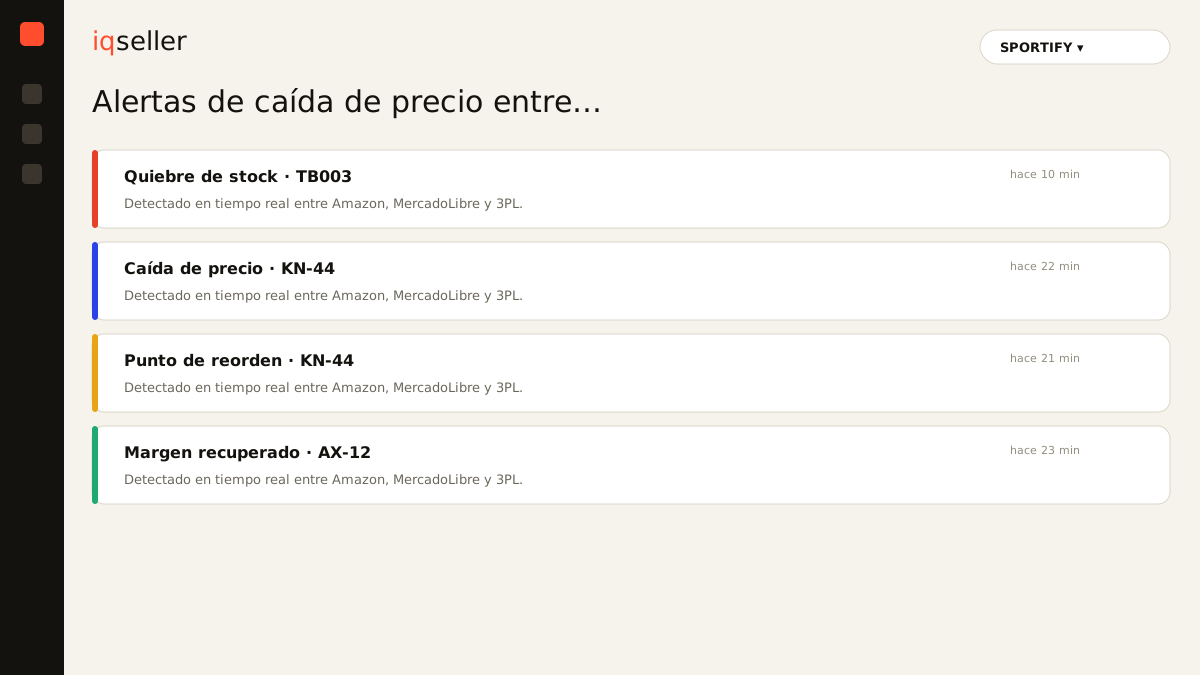
A cross-channel price-drop alert attacks that lag directly. It is not another report you have to go fetch; it is the opposite — the system watches your prices across every channel at once and comes to you the moment something moves outside the range you defined. The difference between checking and being told sounds small, but it completely changes who is in control.
what actually counts as a “price drop”
The first thing to understand is that not every price drop is the same, and treating them the same buries you in noise. There are at least three distinct situations a multichannel seller needs to tell apart.
The first is the self-inflicted drop: you (or someone on your team) changed the price, a promo kicked in, or an automatic repricer adjusted downward. It sounds harmless, but this is where the most margin leaks, because nobody suspects their own price. A sale you forgot to revert sells exactly like a live sale — it just should not exist anymore.
The second is the competitor drop within the same channel. Someone sharing your Amazon listing, or competing for the Buy Box, lowered their price, and suddenly your offer is no longer the attractive one. Here the alert does not say “drop yours too”; it says “look at this before you lose position.”
The third, and most invisible, is divergence between your own channels: the same product at $499 on MercadoLibre and $429 on Amazon because you updated one and forgot the other. The shopper who compares punishes you, and you did not even know you were running two prices for the same thing. A single source of truth catches that divergence in seconds; four separate panels never will.
Dictionary: what real-time synchronization means and why it is the foundation of any useful alert →why separate dashboards always arrive late
The typical multichannel workflow is exhausting: open Seller Central, jot down prices; open MercadoLibre, jot down prices; open the 3PL panel to see what is in stock; dump it all into a spreadsheet; and only then compare. By the time you finish, the numbers you copied are already stale. You decide on yesterday’s data.
That is the hidden cost of the manual spreadsheet: it is not just the time it takes, it is that it freezes information at the instant you copied it. A price is a living data point — it changes while you sleep, while you handle a customer, while you sit in a meeting. A snapshot of that data, no matter how tidy, was already born old.
Alerts flip the burden. Instead of you going to hunt for the change, the system brings it to you. That only works if every channel’s prices live in the same place and update themselves; if the foundation is still four tabs and a sheet, the “alert” would be as late as everything else. That is why alerts and real-time inventory are two faces of the same idea: one panel that sees everything together, now, not yesterday.
the threshold: the line between an alert and an annoyance
An alert that fires for everything ends up ignored, just like the dashboard warning light we all learned to stop seeing. The craft is in the threshold: how much a price has to move, and for how long, before it is worth interrupting you.
A good threshold is not one global number. A low-margin product cannot tolerate the same drop as a high-margin one: three percent on the first can erase all the profit, while on the second it is noise. That is why a smart threshold is defined by margin, not by absolute price. The right question is never “did the price drop?” but “does this drop threaten my net profit, after fees and shipping costs?”
Persistence matters too. A competitor who dips for ten minutes and bounces back does not deserve an alarm; one who holds the low price for six hours does. Telling the flicker apart from the real change is what separates a tool you respect from one you mute within a week.
Dictionary: how a misread price war can push you straight into a stockout →the trap of reacting to price without checking inventory
Here is the costliest and most common mistake: seeing a price drop and reacting by lowering yours, without checking how much stock you have left. If you match an aggressive offer on a product with fourteen days of inventory, what you achieve is draining your stock faster — at the lowest price — and running out exactly when the competitor also runs out and prices climb back up. You sold your inventory at the worst possible moment.
That is why a price alert that does not talk to inventory is incomplete. The right move in the face of a drop depends on how many days of inventory you hold: with plenty of stock, matching can make sense to defend position; with thin stock, the smart play is usually to hold your price and let the competitor run dry first. The same price drop calls for opposite answers depending on the inventory behind it. This connects directly to the problem of stranded inventory on Amazon: sometimes the answer to a drop is not to lower, but to move stock that is sitting idle in another channel.
Dictionary: what days of inventory means and why it changes your reaction to a price drop →from alert to decision, without passing through Excel
Getting the alert is only the beginning. A useful alert does not hand you a raw fact — “the price changed” — and leave you to investigate. It arrives with context: which channel, which SKU, how much it moved, what your net margin is at the new price, how many units you hold, and how many days of inventory that represents. With that, you decide in seconds, not in an afternoon of open tabs.
That context is exactly what the manual workflow destroys. When you stitch the information together by hand, the price lives in one panel, the cost in a sheet, the stock in another panel, and joining them is your job — work you do late and sometimes with errors. When everything originates from the same place, the alert can carry the full picture because the full picture already exists in a single system.
what changes when you stop watching prices by hand
The real shift is not “receiving notifications.” It is no longer being the monitoring system yourself. As long as you are the one checking, gaps are inevitable: you do not check at night, or on Sunday, or across all fifty SKUs the same day. A drop slips through one of those gaps and sits there, quietly costing you margin, until you happen to spot it.
When the watching belongs to the system, those gaps close. Not because you work more, but because you stopped carrying a task a machine does better: looking at everything, all the time, without tiring. Your job stops being to detect and becomes to decide — which is where you actually add value as a seller.
For anyone selling on Amazon, MercadoLibre, Shopify and a 3PL at once, where each channel pulls its own way and prices move around the clock, cross-channel price-drop alerts are one of the few things that give back a feeling multichannel tends to take away: being current without living glued to a screen. It is not magic or a slogan; it is simply what happens when a single source of truth watches for you and speaks up only when something matters.