
Daily ad budget on peak days: why it burns out by noon on Buen Fin
November 15, 2026
The scene is almost a classic of the trade. It is two in the afternoon on day one of the event, the seller opens campaign manager and sees the notice: budget exhausted. For the eleven hours left in the day —including the evening, which in Mexico is usually when people buy from the couch— the ads will not appear. Someone raises the budget on the fly, without knowing by how much, and the next day the same thing happens four hours later.
The problem was not the amount. It was that the amount was calibrated for a normal day and the day was not normal. A daily budget that for eleven months gets consumed evenly across the day gets consumed in a third of the time on a peak day, because there are more searches, the click is more expensive and the competition lifted their own ceilings. It is the same number facing demand that multiplied.
And what hurts is not the spend. What hurts is the opposite: being out of the auction in precisely the hours where conversion concentrates. You paid for the morning’s learning, with the most expensive clicks and the most undecided shoppers, and handed the afternoon and evening —when people close— to whoever did the math.
According to Mexican press reports, Buen Fin 2026 runs from Friday 13 to Tuesday 17 November, five days, with Monday 16 a public holiday for the Revolution commemoration. It is worth confirming on the official Buen Fin site and checking in Seller Central and MercadoLibre’s help center when each platform’s own promotions run, because marketplace calendars do not always line up with the event’s. Five days changes the arithmetic considerably versus a three-day weekend: a budget built for three days and stretched to five leaves two days with nothing.
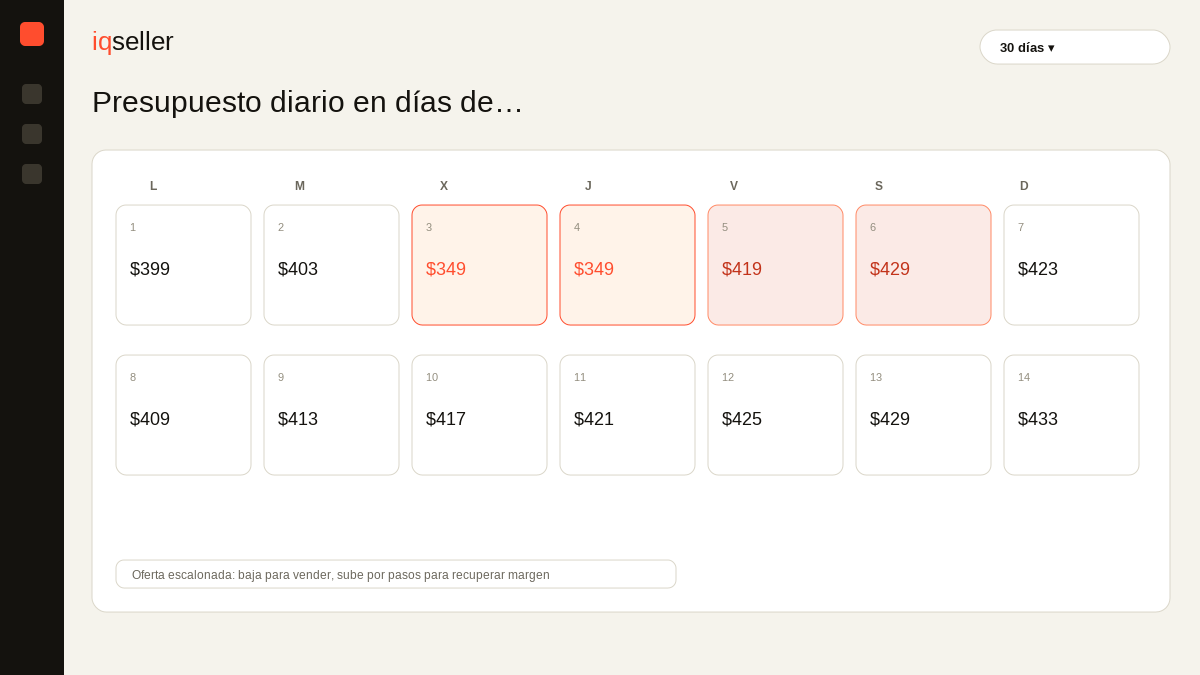
why a budget that lasts a month burns out by noon
Three multipliers act at the same time, and their effect is compounded, not added.
The first is search volume. More people are searching in your category, so your ads collect more impressions per hour. At the same CTR, more impressions are more clicks, and more clicks is more spend per hour.
The second is the price of the click. Seasonal competitors enter, the ones already there raise their bids, and budget stops being the brake for everybody. The result is that each of those extra clicks costs more than the equivalent October click.
The third is the least obvious and the one that wrecks the math: consumption stops being linear. On an ordinary day your budget stretches because impressions trickle in. During the peak they arrive in waves, concentrated in the heavy-traffic hours. The money is not spent “faster” uniformly: it is spent in blocks, and one of those blocks can take all of it.
Multiply the three. If clicks per hour double and the click costs 40% more, the budget drains almost three times faster. A daily budget that normally covers sixteen hours of useful traffic covers five or six. And the hours you lose are not the leftovers: they are the ones that come next.
That is the cannibal part of the problem. The first hours of an event day usually have the worst performance of the day: lots of people comparing, filling carts, looking without deciding. The afternoon and evening hours have the highest conversion, because that is where people close. If your budget runs out at noon, you are systematically buying the worst clicks and giving away the best ones.
a daily budget is not a spend limit: it is a presence limit
This is the idea that reorders everything else. For eleven months the daily budget works as risk control: you cap spend so nothing gets out of hand. On a peak day it serves a different function, almost the opposite: it determines what time you stop existing.
Put another way: on a normal day the budget is a brake; on a peak day it is a switch on a timer, and you do not set the timer, the traffic does. A conservative budget in November is not prudence: it is deciding, without meaning to, that Saturday night belongs to somebody else.
That does not mean “raise everything and pray”. It means the question changes shape. Not “how much am I willing to spend today”, but “which hours do I want to be present in, and what does each one cost”. And that question does have a number behind it, because your own sales history by hour already tells you where your conversion lives.
the hourly curve: data you already have and do not use
Before splitting anything you need to know how your day behaves. This is built from your own data and requires nothing exotic.
Take the orders from the last two or three months —and, if you have them, from last year’s event— and group them by hour of day. You will get a curve with its own shape, different by category and by channel. In most consumer catalogs there are two humps: one mid-morning and a larger one in the evening. In office products the morning weighs more; in gifting and home the evening rules. There is no universal curve, and that is exactly the point: yours is the one that matters.
With that curve, do three things:
- Compute the share of your sales that falls in each block of hours. Four-hour blocks are enough; minute-level precision is not needed.
- Cross the block with conversion, not just volume. There are blocks with many clicks and little sales —the comparison blocks— and blocks with fewer clicks and plenty of closing. The second kind deserves the money.
- Compare last year’s event curve against a normal month. If the evening hump grows during the event, your split should lean to the evening more than usual.
That is what turns hourly allocation into a grounded decision. Without the curve, splitting by hour is as arbitrary as not splitting at all.
Glossary: sales velocity is how many units you move per unit of time; during an event it becomes an hourly read, not a weekly one →how to split by hour in practice
Here it pays to be honest about tooling. Hourly scheduling options depend on the platform and on what is available in your account, and they change over time: check what budget rules or scheduled adjustments your manager offers today in Seller Central and in MercadoLibre Product Ads, rather than assuming whatever you read two years ago still exists. What follows works with or without automation, because it is a method, not a feature.
If scheduling is available, the split comes straight from the curve: more budget to the blocks with better conversion, less to the comparison blocks. The goal is not to spend the same every hour; it is to not run out of money in the hour that closes.
If it is not, the method is checkpoints. Define three or four moments in the day when you will review and adjust —say on waking, mid-afternoon, at the start of the evening— and for each checkpoint have the decision already made for each scenario. The key is “already made”: an improvised adjustment at eight in the evening with the phone in your hand is the one that destroys budgets.
A scheme that works for a five-block peak day:
- Open with the day’s base budget, not the ceiling. If you set the ceiling at dawn, you spend it in the worst-converting block.
- First checkpoint mid-morning. Look at the consumption rate: at this pace, what time does the budget run dry? If the projection lands before the evening block, trim the discovery campaigns, not the brand ones.
- Second checkpoint mid-afternoon. By now you know whether the day is running above or below baseline. This is the moment to move money between campaigns, not to raise the total blindly.
- Third checkpoint at the start of the evening. This is the block to protect. If you arrived with budget left, let it run. If not, raise only what the block needs, with the contribution ceiling clear.
- Close: write down what happened. Which block consumed how much and what it converted. That note is next year’s curve.
splitting by campaign: not all of them deserve to last five days
Hourly allocation solves the “when”. The “what” is still missing, and that is where more money is won or lost.
In a five-day event, keeping every campaign running on the same criteria is the most expensive way to be present. There are three groups and each deserves different treatment:
- Defense campaigns —your brand, your detail pages, your own terms— are the ones that have to keep running all five days without fail. They are the cheapest in conversion terms and they keep a competitor from occupying the space you built. If something has to survive the budget, it is this.
- Volume campaigns on proven terms are the body of the spend. This is where hourly allocation pays off most, because they move most with the block’s conversion.
- Discovery campaigns and new terms should yield first. An event is the worst moment to explore: the click is at its highest price of the year and the read is contaminated by seasonal traffic. What you learn there will not resemble what you live in February. Explore in January, when the click is cheap and the signal is clean.
There is an exception and it should be said: if your product is strictly seasonal —the one that only sells in these weeks— then the event really is your only exploration window and there is no moving it. In that case, explore, but with a hard ceiling and the awareness that you are paying the top price for the information.
And a fourth group almost nobody considers: campaigns on SKUs whose inventory will not last. If a product runs out on day two, its day-three budget should have been sitting on another SKU before the event even started. Leaving it running is spending on a listing about to go out of stock, and the damage is not just the lost click: it is the position a still listing loses. That is what well-configured critical stock alerts are for.
the ceiling that overrules all the others
Everything above is allocation. The limit is still missing, and the limit does not come from a percentage of sales or from what you spent last year: it comes from what the product leaves at the event price.
Let us use numbers, invented but reconciled. A SKU you sell during the event at $812 including VAT, that is $700 net of VAT. Costs: $300 of product, $98 of commission, $80 of fulfillment, $22 of returns provision. Contribution before advertising: $200 per unit.
If your goal is for that product to leave at least $120 per unit after advertising, your ad-spend ceiling is $80 per unit sold. If you expect to sell 150 units of that SKU across the five days, your total budget for it is 150 × $80 = $12,000, or $2,400 per day if the split were flat. Since it will not be flat, that number leans toward the days and blocks with higher conversion: maybe $3,400 on Friday and Saturday, $2,200 on Sunday and Monday, $800 on Tuesday.
What matters about this exercise is not the figure: it is the order it was built in. Contribution first, then the per-unit ceiling, then expected volume, and only at the end the daily budget. Almost the whole trade does it backwards: it starts with the daily budget, which is the only number the platform asks for, and never checks whether that number fits inside the margin.
A daily budget that did not come from a per-unit contribution is a number with no parent. It may be right by accident, but there is no way to know, and when the moment comes to raise it mid-event you will have nothing to compare it against.
Glossary: real net margin is what is left after ALL costs —product, commissions, shipping, returns, VAT and advertising— and it is the ceiling any budget comes from →how this reads in iqseller
Computing the ceiling is the real bottleneck, and that is what the panel solves. The Profitability module builds net margin per SKU from the COGS you load, the commissions from the Amazon settlement and from MercadoLibre orders, FBA and Full fees, shipping, advertising and the VAT and withholding breakdown. That is where contribution per unit at the event price comes from, and it is the only legitimate ceiling for a budget.
The advertising metrics —budget, ad spend, CPC, clicks, impressions, ACoS and TACoS— are read next to that margin, so the day’s consumption rate can be compared against what the product can absorb and not only against what the platform reports. And history is what lets you build the hourly curve and compare this year’s event against last year’s without assembling a spreadsheet from scratch.
The limit should be plain: the panel does not move budgets or bids. That happens in Amazon Ads and MercadoLibre Product Ads. What the panel gives you is the figure the decision rests on —what the SKU leaves, how much coverage remains, how spend is tracking against margin— so the eight-in-the-evening adjustment is not a hunch.
Inventory and Forecast close the picture: coverage by channel is what says whether a SKU deserves budget on day three or whether that money should already have moved, and real-time forecast is what anticipates the stockout before the campaign accelerates it. Alerts flag degrading coverage or margin, which mid-event is the only way to find out in time.
a budget plan for the five days
To leave it actionable, the full order:
- Compute contribution per unit at the event price for every SKU you plan to push. Not at list price.
- Set the ad-spend-per-unit ceiling for each one, and from there the total event budget per SKU.
- Build your hourly curve from the last few months of orders and from last year’s event.
- Split the total across days and blocks following the curve, not in equal parts.
- Classify campaigns into defense, volume and discovery, and decide in advance which yields first if money gets tight.
- Define three checkpoints per day with the decision already made for each scenario.
- Pull from the plan the SKUs that will not have inventory past day two or three.
- Record consumption and conversion by block at the close of each day. That is next year’s input.
The underlying principle is the usual one, and in a five-day event ignoring it gets expensive: a budget is not judged against last year’s budget or against what the competitor spends. It is judged against the contribution of the product that funds it. A budget that burns out by noon is not a small budget: it is a budget that was never compared against the margin it was supposed to defend.