
Prepare for Buen Fin with data, not nerves
March 5, 2026
Buen Fin is probably the single most important weekend on the Mexican retail calendar, and for many sellers it is also the most stressful. Not because demand is missing, but because uncertainty is everywhere. You arrive in November with the nagging feeling that something is going to slip past you: a miscalculated promotion, a listing that runs out of stock by Saturday noon, a price you left five pesos above your competition that cost you the Buy Box right as peak traffic hit.
The problem is almost never that you lack information. The problem is that your information lives in places that don’t talk to each other. Amazon sales sit in Seller Central, MercadoLibre sales in its own panel, what is physically on hand is known by your 3PL (or your own warehouse), and the summary of all of it ends up, once again, in an Excel file you update by hand every night. By the time that Excel is ready, the numbers are already yesterday’s. And during Buen Fin, deciding with yesterday’s data is close to deciding blind.
This article isn’t about how to “sell more” with motivational slogans. It’s about changing the way you arrive at that weekend: moving from nerves to informed decisions, leaning on a single source of truth in real time instead of rebuilding reality by hand every morning.
the real cost of stitching information together by hand
When you sell on a single marketplace, consolidating by hand is still manageable. The trouble starts when you go multichannel. Each platform reports in its own way: Amazon talks about units sold and fees by category; MercadoLibre has its own logic of commissions, shipping, and reputation; your 3PL tracks physical stock that doesn’t always match what each marketplace believes you have available. You, in the middle, are the human integrator.
That integration work carries a cost that rarely gets measured. It’s not just the time you spend copying and pasting. It’s the lag: while you build the report, sales keep happening. It’s human error: a cell dragged wrong, an outdated exchange rate, a duplicated SKU. And above all, it’s trust. When you know your Excel is assembled by hand, deep down you don’t fully trust it, and that distrust freezes you exactly when you need to move fast.
During Buen Fin, that cost multiplies because volume spikes. A mismatch that costs you one sale on a normal day can cost you dozens at Saturday’s peak. The question isn’t whether you can keep working this way, but how much it’s costing you to do so.
a single source of truth: why it matters so much in November
The idea of a “single source of truth” sounds abstract until you live it mid-campaign. It means Amazon sales, MercadoLibre sales, and your 3PL stock are seen in the same place, with the same definition of “sold” and “available,” updating themselves. You no longer ask “how many do I have?” across three screens; you ask it once.
That changes how you operate the weekend. Instead of manually checking each channel every couple of hours, you watch a single dashboard that tells you, in real time, what is moving, where, and how fast. This is exactly what we go deep on in real-time inventory: inventory stops being a number you estimate and becomes a number you observe.
The practical difference is brutal. With yesterday’s data, you react late: you learn a product sold out after you’ve already lost the sales. With live data, you anticipate: you see a SKU’s sell-through rate double in the last hour and you move stock or adjust the promotion’s pace before the problem exists.
Dictionary: days of inventory tell you how long your stock lasts at the current sales rate; during Buen Fin, that rate changes by the hour.planning the promotion with numbers, not gut feelings
The most visible part of Buen Fin is the promotion: the discount you’ll offer. And it’s exactly where decisions get made from the gut. “I’ll knock off 20% because everyone is cutting,” “I’ll run a tiered offer because it sounds good.” A discount is a financial tool, not a gesture, and it deserves to be treated with numbers.
Before setting a promotional price you need to know three things for certain: how much the product costs you landed, how much each marketplace’s fees take (which differ between Amazon and MercadoLibre), and what your real margin is after all of that. Only then do you know how far you can drop without selling at a loss dressed up as “volume.” An aggressive discount on a high-fee channel can leave you working for free, or worse.
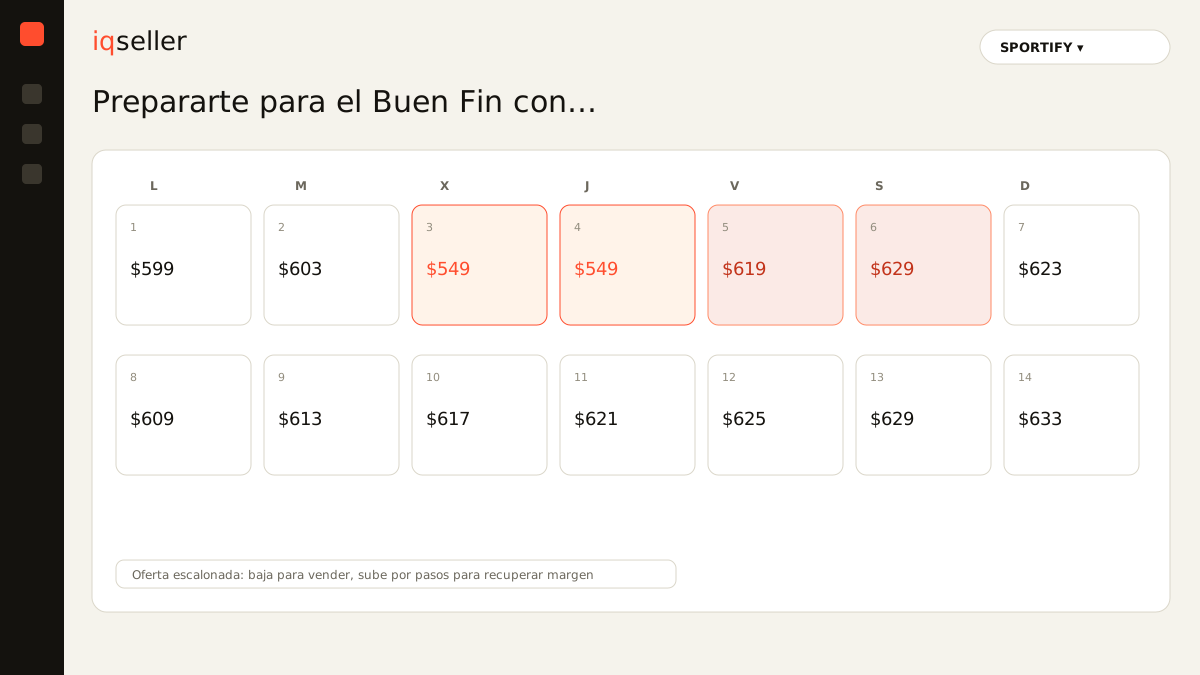
This is where a price calendar planned in advance takes the nerves out. Instead of improvising each price on Friday night, you schedule the drops, validated against your margin, channel by channel. When the peak arrives, you’re no longer calculating: you’re executing a plan you built with a cool head.
Dictionary: a tiered offer applies discounts by volume or by time brackets; planned well it protects margin, improvised it destroys it.stock is what actually keeps you up at night
Ask any experienced seller what they fear most about Buen Fin and they rarely say “that they won’t buy.” They’ll say the opposite: that they’ll buy so much you run out of product, or worse, that you sell something you no longer physically have. A stockout at peak doesn’t just lose that sale; on Amazon it can hurt your ranking, and on MercadoLibre your reputation, right at the year’s moment of highest visibility.
Overselling is the other side of the same coin. If Amazon thinks you have 40 units and MercadoLibre thinks it has those same 40, but the warehouse holds only 40 total, you’ll sell 80 and cancel half. Every cancellation is an angry customer and a penalty. This happens when inventory isn’t synced across channels, and it’s exactly the kind of error a manual Excel can’t catch during a high-turnover weekend.
Having stock consolidated and decrementing in real time as it sells on any channel is what avoids both nightmares at once. You don’t sell what you don’t have, and you see the sellout coming hours ahead, not minutes.
the forecast: stop guessing how much to bring in
A good part of Buen Fin stress is decided weeks earlier, when you define how much product to bring in. Bring too little and you fall short at the golden moment; bring too much and you start December with capital frozen in merchandise that didn’t move. It’s one of the most expensive bets of the year, and many sellers literally make it “by eye,” glancing at what they sold last year on a loose sheet.
A decent forecast doesn’t need to be perfect, it needs to be based on your real, consolidated history across all channels, not on memory. If you can see how each SKU behaved in past Buen Fins, how much your customer base has grown since, and what sales velocity you carry in the weeks before, your estimate stops being a hunch and becomes a defensible range. And as we review in December: the month that defines your year and your inventory, what you decide for November carries direct consequences into your year-end close.
Dictionary: the forecast estimates future demand from your history; during Buen Fin it keeps you from falling short or overloading.what to watch on event day without losing your head
The weekend arrives and the temptation is to watch everything, all the time. That exhausts you and clouds your judgment. With consolidated information, you can narrow your attention to a handful of signals that truly matter: sell-through rate per SKU compared against your forecast, products whose days of inventory are running out faster than expected, and prices that lost competitiveness against the market in the last few hours.
With those three signals in one place, your weekend decisions become concrete instead of anxious: redistribute stock toward the channel moving it fastest, halt a promotion that’s eating margin without generating enough volume, or reinforce the one that is pulling. These aren’t last-minute heroics; they’re small, timely adjustments on a plan you already had.
what changes when you stop operating blind
Buen Fin isn’t won on Saturday night. It’s won in the weeks before, when you decide how much to bring in, at what price you’ll sell, and how you’ll watch your stock. What separates the seller who arrives calm from the one who arrives on edge isn’t luck or catalog size: it’s whether they’re looking at a consolidated, live reality, or rebuilding it by hand every night with data that already aged.
A store like SPORTIFY selling the same product on Amazon, MercadoLibre, and from its own warehouse can’t afford three separate truths during the year’s peak. It needs one, in real time, where price, margin, and stock are seen together. That’s the underlying shift: moving from gathering information to using it. From nerves to data.