
Hot Sale: pricing and stock under pressure
March 3, 2026
Hot Sale is one of those events that changes the scale of your operation overnight. In normal conditions you move a certain number of units per week and your routine holds up: you check prices now and then, you restock when you remember, and mistakes get corrected without much cost. During Hot Sale that margin for error disappears. Demand concentrates into a handful of days, traffic multiplies, and every pricing or stock decision you make in the morning can be obsolete by the afternoon. What in March was a tolerable oversight becomes, mid-campaign, either money lost or a sale you couldn’t capture.
The underlying problem isn’t new, but Hot Sale amplifies it brutally: if you sell on Amazon and MercadoLibre at the same time, and on top of that hold part of your inventory in a 3PL or in your own logistics, your information lives split across several dashboards. You open Amazon Seller Central to see one thing, MercadoLibre to see another, the logistics operator’s panel for physical stock, and you end up pasting it all into a spreadsheet that was born stale. During a four- or five-day event, yesterday’s spreadsheet is exactly what you cannot afford.
This article isn’t about “how to build your Hot Sale campaign” in the abstract. It’s about the concrete tension between pricing and stock when both are under pressure at the same time, and why having a single source of truth in real time stops being a luxury and becomes the difference between a good event and one that leaves you with an inventory-and-margin hangover.
why hot sale breaks your normal routine
Off-season, a product’s sales velocity is relatively stable and predictable. You know a SKU moves, say, eight units a day, and you plan restocks calmly around that. Hot Sale breaks that stability in two ways at once. First, demand spikes: that same SKU can jump to forty or fifty daily units if your offer is good and your ranking holds. Second, demand isn’t uniform across channels or days: the first day usually concentrates a flood of impulse purchases, and what works on MercadoLibre doesn’t necessarily replicate on Amazon.
That combination —more volume, more volatility, and more channels— is exactly the scenario where calculating by hand fails. Not because you’re a bad seller, but because the human eye can’t process in real time what’s happening across three different dashboards while sales velocity quadruples. You need the numbers to arrive already consolidated, not to chase them yourself.
Dictionary: what days of inventory are and why they shrink brutally in a demand spike →pricing under pressure: the offer has to protect the margin
The most common Hot Sale trap is thinking of price as a single flat discount number. You drop everything by a fixed percentage, apply it identically on Amazon and MercadoLibre, and forget about it. The mistake is that commissions, FBA or Full fees, and shipping costs are different on each channel. A 25% discount that still leaves you a healthy margin on one channel can have you selling essentially at cost —or below— on the other. And because Hot Sale volume is enormous, that pricing error isn’t one lost sale: it’s a bleed multiplied by every unit you ship during the event.
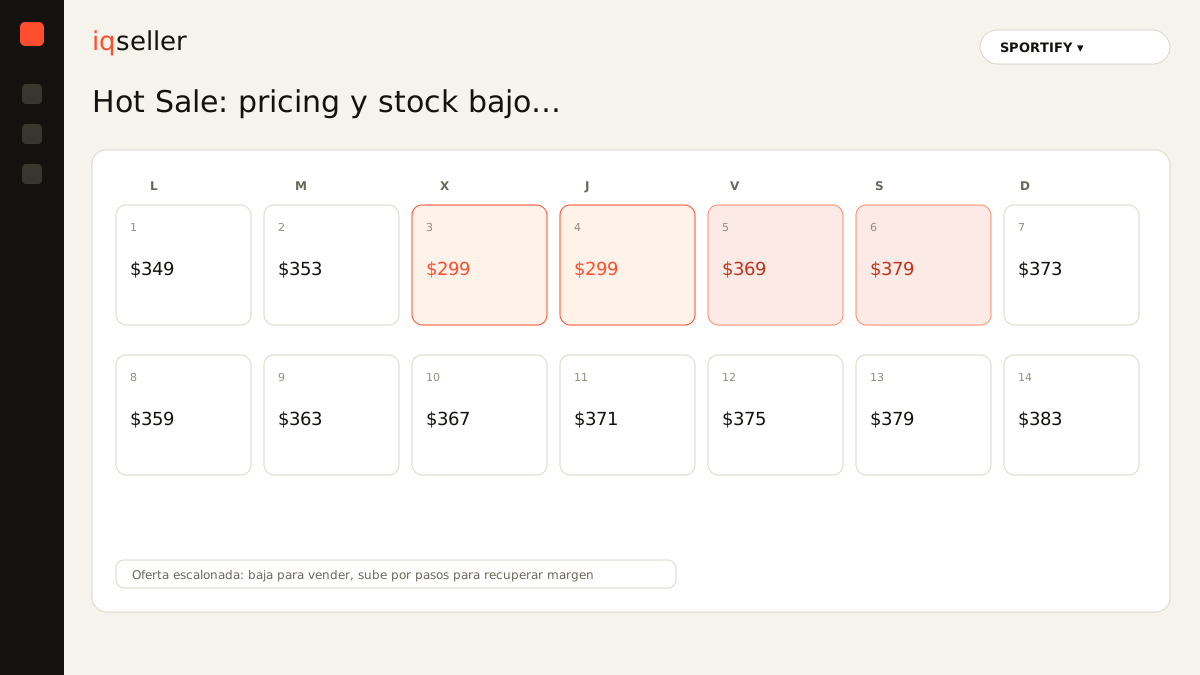
The sensible alternative is to design price starting from the real net margin per channel, not from a cosmetic percentage. And within the event itself it pays to think in a sequence, not a frozen price: a laddered offer that starts aggressive to gain traction in the first days and then climbs in steps as demand stays hot. Jumping straight back to the normal price kills the momentum; stepping up preserves it. Hot Sale doesn’t end when it ends: the tail of the following days is where you recover margin if you planned for it.
Dictionary: the laddered offer, drop to sell and step up to recover margin →stock under pressure: a stockout mid-peak is the worst thing that can happen
If mis-calculated pricing takes your margin, a stock stockout mid-Hot Sale takes something more expensive: the ranking you fought so hard to earn. When a listing runs out of inventory in the middle of the event, you don’t just stop selling those units. You lose the ranking you won, you drop in search, and very often you keep paying for ads that send traffic to a product that can no longer be bought. It’s the worst of both worlds: spending to attract buyers to a page that doesn’t convert.
The risk is especially treacherous when inventory is spread out. Part in FBA, part in Full, part in your 3PL or own warehouse. Each channel “sees” only its slice, and you have to mentally add up how much you have in total and how long it lasts at the current sales velocity —which during Hot Sale changes hour by hour. It’s exactly the kind of calculation yesterday’s spreadsheet can’t give you. This is what an inventory forecast is for: one that looks at the campaign’s real demand and crosses it with your consolidated stock, not with a single channel’s.
Dictionary: what the inventory forecast is and how it adjusts to a campaign’s demand →the real pain: information split across several dashboards
It’s worth naming the pain precisely, because it’s the one almost nobody recognizes until they live it during a Hot Sale. It’s not that information is missing; it’s that it’s scattered. You have Amazon’s prices and sales in Seller Central, MercadoLibre’s in its own panel, physical stock in your logistics operator’s system, and the real commissions hidden in reports you download separately. To make a single decision —“do I raise this SKU’s price or hold the offer one more day?”— you need information from three or four sources that don’t talk to each other.
What ends up happening is predictable: you piece it all together by hand in a spreadsheet, you update it when you can, and you decide with data from several hours ago. In the low season that works. In Hot Sale, deciding with morning data when sales velocity already doubled by noon means restocking late, raising prices late, or running out of stock without having seen it coming. The problem isn’t your judgment; it’s the latency of your information.
a single source of truth, in real time
The solution to that pain isn’t to work the spreadsheet faster. It’s to eliminate the spreadsheet as a middle layer. When Amazon, MercadoLibre, and your 3PL feed the same panel, consolidated stock, sales velocity per channel, and real net margin stop being something you chase and become something you simply see. The question changes from “where’s the number?” to “what do I do with the number?” —which is the only question that actually adds value during an event.
In practice, that means during Hot Sale you can look at one board and answer in seconds what used to take half an hour of copying and pasting: how many days of inventory you have left at the current velocity, which SKU is about to stock out, on which channel your discount is eating the margin, and where it makes sense to step the price up because demand can take it. Each of those decisions, made with data from minutes ago instead of yesterday, translates into margin defended and sales that didn’t slip away through an avoidable stockout.
what to check before, during, and after
Before the event, the work is preparation: define your pricing per channel starting from real margin, not a flat percentage; check that your consolidated stock covers the sales velocity you expect, with a cushion for the peak day; and have the restock already in transit before the calendar asks you to sell hard. During the event, the work is real-time vigilance: days of inventory per SKU, alerts on price drops you didn’t make, and the exact moment when it pays to start stepping the price back up. After the event, the work is recovery: raising prices in steps to recover margin without killing momentum, and reading which SKU oversold and which fell short so the next Hot Sale doesn’t start from zero.
The common thread across all three phases is the same: pricing and stock decisions that hold up because they rest on consolidated, fresh information —not on a per-channel dashboard or a spreadsheet that aged while you were updating it. A seller like SPORTIFY, selling the same catalog on Amazon and MercadoLibre, doesn’t win Hot Sale by discounting harder; it wins by seeing clearly when everyone else is seeing a blur.