
Data that does not drive a decision is noise
March 12, 2026
You open Amazon Seller Central and see a sales chart. You open MercadoLibre and see another. You log into your 3PL panel to confirm inventory and see a third. Every screen has nice numbers, colors, little arrows pointing up and down. And still, when you close the laptop, you do not know what to do tomorrow. You have plenty of information and zero clarity. For a multichannel seller, that is the real problem: you are not short on data, you are drowning in noise.
The trap is that noise feels productive. You spend the morning copying figures from three dashboards into a spreadsheet, aligning SKUs that each marketplace names differently, adding up yesterday’s sales because today’s cut has not closed yet. It feels like work. But in the end you have a blurry snapshot of a moment that already passed, and on top of that blurry snapshot you will decide how much to reorder, what price to set, and where to push ads. Deciding under uncertainty is not strategy: it is gambling with extra steps.
This article starts from a simple, slightly uncomfortable idea: data that does not change a single decision is not information, it is noise. If a metric does not alter what you are going to do this week, it does not deserve space on your dashboard or minutes of your attention. What matters is not how many charts you have, but how many decisions you can make with confidence because of them.
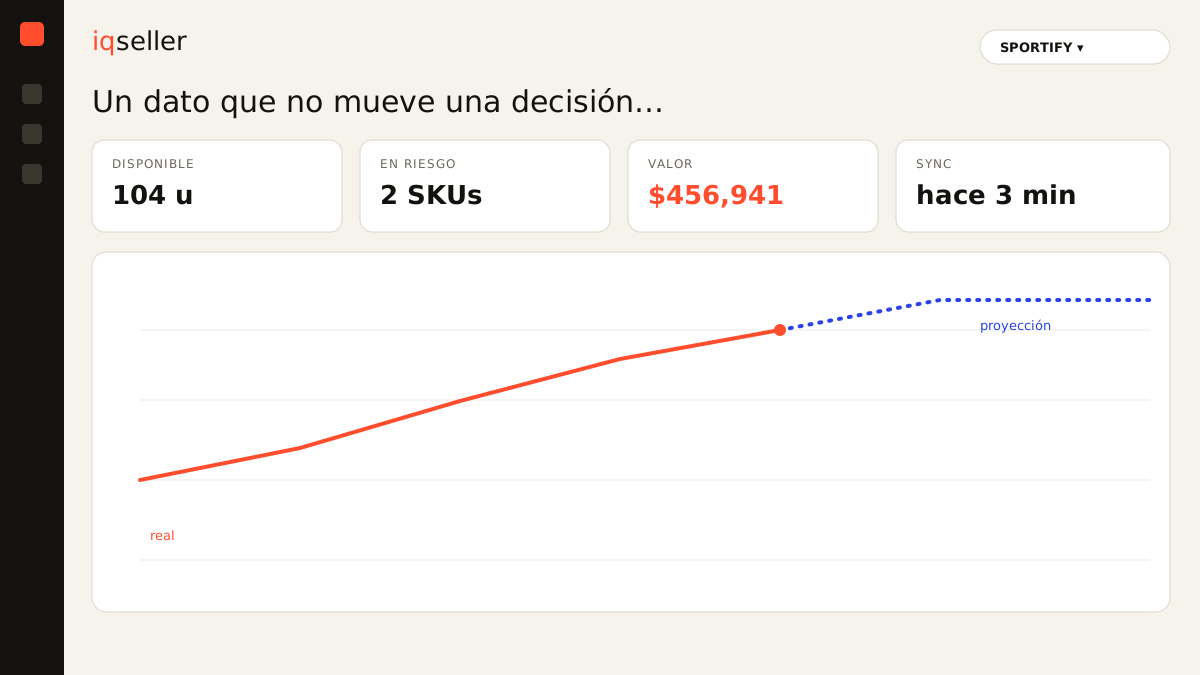
the data is not the problem, the decision that never arrives is
Every marketplace hands you data. Amazon gives you sessions, conversion, Buy Box, ACOS. MercadoLibre gives you visits, reputation, sales per listing. Your 3PL gives you units in the warehouse. Getting numbers was never the issue; the issue is that those numbers live in different languages, on different screens, with different time cuts. For them to be useful, someone has to translate, merge, and turn them into an action. If that work falls on you, every morning, by hand, then the data costs you more than it gives you.
A useful test to separate signal from noise is to ask yourself, in front of every number you look at: “if this goes up or down, does it change anything I am about to do?” If the answer is no, that number is decoration. If the answer is yes, then you need to see it clearly, on time, and next to the context you need to act. A seller does not need a dashboard that shows everything; they need one that orders the few things that actually move the needle.
three dashboards, one unanswered question
Multichannel pain has a very concrete shape. It is not that information is missing; it is that it is scattered. You do not operate “on Amazon” or “on MercadoLibre”: you run a business that sells through several channels with the same inventory behind it. But the platforms force you to think in silos. Each one optimizes its own screen and none of them shows you the whole business.
So you do the only thing you can: you consolidate by hand. And that is where the invisible errors begin. A SKU named one way on Amazon and another on MercadoLibre. A discount you applied on only one channel and forgot to subtract. Stock the 3PL already committed but your spreadsheet still counts as available. Each of those small mismatches poisons the final decision, because you decide on a truth that is not true. The spreadsheet does not lie on purpose: it simply does not update itself, and you do not have time to check every cell every day.
The question no individual dashboard answers is the only one that matters: what do I do this week? How much to order, at what price to sell, which listing to push, which product to pause. That question demands crossing channels, and crossing them by hand is exactly where the noise sneaks in.
the real cost of deciding with yesterday’s data
Deciding late carries a price that almost never shows up in any report. If you find out about a stockout after it happened, you lost sales and, worse, you lost position: each marketplace’s algorithm punishes running out of stock, and recovering ranking takes weeks. If you see a competitor’s price change a day later, you sold expensive and lost the Buy Box, or you sold cheap and gave away margin. Yesterday’s data makes you late to decisions that could have been won today.
It is worth distinguishing two things that get confused: having the data versus having it on time and unified. Knowing your real margin matters little if you calculate it once a month in a sheet that no longer reflects current fees. That is why it pays to nail the concept. Dictionary: real net margin subtracts commissions, shipping, advertising, and returns, not just product cost; it is the number you actually decide with.
A single source of truth in real time is not a technical luxury: it is what separates an informed decision from a well-dressed hunch. When every channel feeds the same dashboard and the dashboard updates itself, you stop asking “is this number right?” and start asking “what do I do with this number?”. That shift in the question is everything.
from metric to action: the filter your dashboard needs
A good dashboard is not measured by how many widgets it has, but by how many decisions it triggers. The rule is simple: every visible metric must be tied to a possible action. Stock coverage is not there for you to contemplate; it is there so you know what to reorder before you run out. The competitor’s price is not there to inform you; it is there so you adjust yours today. ACOS is not there to worry you; it is there so you decide whether to raise or lower a campaign’s spend.
When you think about days of inventory, the number is only useful if it triggers a concrete buying decision. Dictionary: days of inventory estimate how many days your stock will last at the current sales pace; it is your countdown to a stockout, per channel. If your dashboard tells you “you have 9 days left on Amazon and 22 on MercadoLibre”, you are no longer looking at data: you are one step from acting.
That is where the cross-talk between modules stops being decoration and becomes operation. The automatic price calendar only makes sense if the prices it proposes respect your real margin and your available stock; and restock recommendations: what to order this week only help if they start from each channel’s real coverage, not from an inflated total. Isolated metrics are noise; connected metrics are decisions.
a single source of truth, in real time
The antidote to noise is not looking less: it is unifying. When Amazon, MercadoLibre, Shopify, and your 3PL feed the same data model, SKUs reconcile by GTIN, discounts reflect where they belong, and committed inventory is subtracted from available automatically. You stop consolidating by hand because the consolidation already happened before you opened the dashboard.
This changes the nature of your availability. The stock listed in the warehouse is not the same as what you can actually sell today. Dictionary: real available is the stock you can sell right now after subtracting reservations, in-transit orders, and committed units; it is the number that keeps you from selling what you no longer have. With that foundation, decisions stop being bets.
A store like SPORTIFY, selling the same catalog on Amazon and MercadoLibre with inventory in a 3PL, does not need three analysts watching three screens: it needs one dashboard that tells it, every Monday, what to reorder, what to reprice, and what to pause. That is the point of an actionable panel: not to accumulate data, but to reduce it to the few decisions that actually change the outcome.
how to know if your dashboard produces signal or noise
Ask yourself three questions. First: how many of the charts you look at every day changed a decision this week? If most of them moved nothing, they are expensive noise. Second: how much time do you spend assembling the information versus using it? If consolidating takes longer than deciding, the process is backwards. Third: how fresh is the data by the time it reaches your decision? If you decide with yesterday’s cut, you decide late.
The goal is not a prettier dashboard or one with more metrics. It is a more honest one: that shows little, shows what moves the needle, and shows it on time and unified. When every number on your screen is tied to a possible action, you stop drowning in data and start running your business. Because in the end the test is always the same: data that does not drive a decision is noise, and your job is not to look at numbers, it is to decide.