
Dropshipping on Mexican marketplaces: how viable it really is
October 17, 2026
Few topics in this trade carry as much misinformation as dropshipping on Mexican marketplaces. At one extreme sit the courses selling it as a business with no investment and no warehouse. At the other sit the sellers who insist Amazon bans it and that anyone who tries ends up suspended. Both positions are wrong, and the interesting part is that they are wrong for the same reason: neither one read the policy.
Amazon does have an explicit dropshipping policy, and it does not say the model is forbidden. It says which conditions you have to meet for it to be acceptable, and which specific practices are prohibited without exception. MercadoLibre, for its part, does not publish a policy under that name; what it publishes are listing, stock and delivery-time rules that apply whether or not you own a warehouse.
So the question “is it allowed?” has a fairly clear answer, and it is the easy part. The hard question, the one that decides whether this works for you, is a different one: how much margin is left once a third party keeps part of the value, and how much responsibility stays with you when that third party fails?
This post tries to answer both, with the usual caveat: marketplace policies change, and everything described here should be confirmed in Seller Central and in MercadoLibre’s help center before you build an operation on top of it.
what Amazon’s policy actually says
Amazon’s drop shipping policy, published in Seller Central, starts from a simple premise: you must be the seller of record. That means you own the product before the customer buys it, you set the price, you record the sale as revenue, and you carry the tax obligations of that sale.
On that basis, Amazon lists concrete requirements for dropshipping to be acceptable:
- Identify yourself as the seller on all packing slips, invoices, external packaging and any other information included with the product.
- Remove any packing slip, invoice, external packaging or information identifying a third-party drop shipper before the order ships.
- Be responsible for accepting and processing returns of your products.
- Provide customer service that meets or exceeds Amazon’s policies.
- Comply with the rest of your seller agreement and all applicable policies.
Then comes the prohibited part, which Amazon words in unusually blunt terms: buying the product from another retailer — including another Amazon seller — and having that retailer ship it directly to the customer is prohibited when the shipment does not identify you as the seller of record, or when any other name appears on the packing slip, the invoice or the external packaging.
That is the line, and it is the one most often crossed. The “I buy cheap at another online store and have them ship to my buyer” model is not acceptable dropshipping: it is precisely the practice the policy names. Amazon also warns that violating this policy hurts your account health and your ability to fulfill future orders through the merchant-fulfilled network.
It is worth reading the full policy inside your own Seller Central account, because the wording gets updated and there are category-level nuances.
what MercadoLibre regulates, even without the label
On MercadoLibre the situation is different in form and similar in substance. As far as is public at the time of writing, there is no dropshipping policy by that name that explicitly authorizes or forbids the model. What does exist is a set of rules that, in practice, define what you can and cannot do when a third party fulfills for you.
Three carry the most weight. The listing must describe the actual product you will deliver, with no ambiguity and no photos that do not match. The stock you declare must be stock you can genuinely ship: promising availability that depends on a supplier still having the piece is the classic recipe for a cancellation. And the delivery times you offer are your commitment, measured by the channel, with direct consequences for your reputation.
MercadoLibre also runs cross-border selling programs that in practice look a lot like a well-organized international dropship: the channel coordinates the operation, but responsibility toward the buyer stays with the seller. And operationally, if you use Full the dropshipping model simply does not apply, because the goods have to physically sit in MercadoLibre’s fulfillment center.
The honest conclusion: on Meli dropshipping is not flagged as a violation, but every seller obligation remains yours, and the metrics that grade you do not distinguish whether the delay was your fault or your supplier’s. As always with these rules, confirm them in MercadoLibre’s help center and in your account’s terms.
Glossary: real available stock, what you can truly sell right now →real problem number one: the margin
Suppose you build a flawless dropshipping operation, with a supplier contract, neutral packaging and your own customer service. You still face the problem that sinks most of them: the cost structure leaves very little room.
In a business with owned inventory, you buy at wholesale with volume discounts, and gross margin is born right there. In dropshipping you buy unit by unit, almost always at a price closer to list, because the supplier is absorbing the cost of storing, packing and shipping a single piece. That service gets paid for, and it gets paid out of your margin.
Then come the usual deductions. An illustrative example, with invented figures to show the method: you sell at $890 pesos. The supplier charges $520 for the piece and $95 to pick it and ship it to your customer. The marketplace commission, say 15%, is $133. If you advertise and spend 8% of that price, that is $71. You are at $819 of cost and carrying $71 of contribution, a little over 8% of the price.
Out of those $71 you have to pay for your own time, your customer service and the cost of returns. And returns in dropshipping are especially expensive: the piece goes back to a warehouse that is not yours, under the supplier’s rules, and if they refuse it the cost stays with you. A 5% return rate on that example eats a large share of the contribution from the good sales.
Compare that with the same product bought in volume at $410 with $35 of prorated freight. Contribution rises to $241 with the same $133 commission and $71 of advertising. The difference is not the fulfillment model: it is purchasing power.
real problem number two: you do not control the experience
The second problem is harder to fix with a spreadsheet, because it does not depend on you.
You do not control inventory. Your listing says ten units because your supplier said ten. If they sold eight somewhere else and did not tell you, you sell what does not exist and then cancel. On marketplaces, cancelling for lack of stock is among the most expensive things you can do: it hits seller metrics, it can lead to restrictions, and on Amazon it feeds account health indicators with thresholds you cannot ignore.
You do not control delivery time. You promise a date; the supplier decides whether it leaves today or Thursday. Every day of gap between what you promised and what happened is late-delivery risk, and late delivery is a metric both channels track.
You do not control the packaging. Here Amazon’s requirement stops being a formality: if your supplier slips in their packing slip or a branded box, you are violating the policy no matter how good your intentions were. That means you need an explicit agreement with the supplier about neutral packaging, and you need to verify it rather than assume it.
You do not control quality. If it arrives damaged, scratched or different from the photo, you are the one who gets the one-star review. On MercadoLibre that moves your reputation; on Amazon it feeds claims and returns.
There is also a structural problem on top: if the same supplier serves ten sellers, those ten sell the same thing, at the same cost, on the same listing. The only remaining variable is price, and that ends in a war where everyone drops until nobody wins. Dropshipping has a very low barrier to entry, which is exactly what makes it attractive and also what makes it fragile.
when dropshipping does make sense
It is not all bad. There are scenarios where the model is reasonable, and almost all of them share one trait: it is not used to scale, it is used to learn or to complement.
To validate a product before buying it. Listing for a few weeks with supplier fulfillment tells you whether demand exists, at what price and at what conversion rate, without locking capital into a container. When the product responds, you buy volume and move to owned inventory or FBA. That use is sensible and fairly common.
For bulky or slow-moving products. Furniture, large appliances, items not worth storing. If your supplier already runs that kind of logistics, letting them ship can be cheaper and faster than building it yourself.
To extend the catalog of a brand you already sell. If you already have a distributor relationship and sell their core products from owned stock, adding the long tail through dropshipping widens the offer without tying up capital.
With a domestic supplier, not one on the other side of the world. The difference is enormous. A supplier in Mexico delivers in days and answers the phone. A supplier shipping from abroad can take weeks, with customs incidents along the way, and that collides head-on with what Mexican marketplace buyers expect. If you are going to import anyway, it is worth understanding what international freight and the trip through customs involve: once inventory is in Mexico, buying in volume almost always wins.
What does not make sense is what the courses sell: catalogs of thousands of imported products, 5% margins and zero control. That model does not fail because it is illegal. It fails on arithmetic.
what you need in writing before you start
If you decide to do it, there is a short list of things that have to exist in writing, not by handshake:
- An agreement identifying you as the seller of record, which is literally the first thing Amazon’s policy asks for.
- Neutral packaging and paperwork: no supplier logos, packing slips or invoices inside the box. Ask for a photo of a real package before the first shipment.
- A fulfillment time commitment, with a clear deadline from the moment you pass the order along.
- A stock update rule: how often they report available inventory and through what channel. If the answer is a weekly email, you will oversell.
- A returns procedure: who pays the return leg, how many days are accepted, what happens to a damaged piece.
- Clear invoicing, because you are the one recording the revenue and carrying the tax obligations of that sale. This point, like anything tax related, gets reviewed with your accountant, not with a blog.
If your supplier cannot commit to those six points, the operational risk is higher than the margin you are chasing.
Glossary: real net margin, with everything deducted →how this looks in iqseller
Dropshipping does not change what you have to measure; it changes how easy it is to fool yourself.
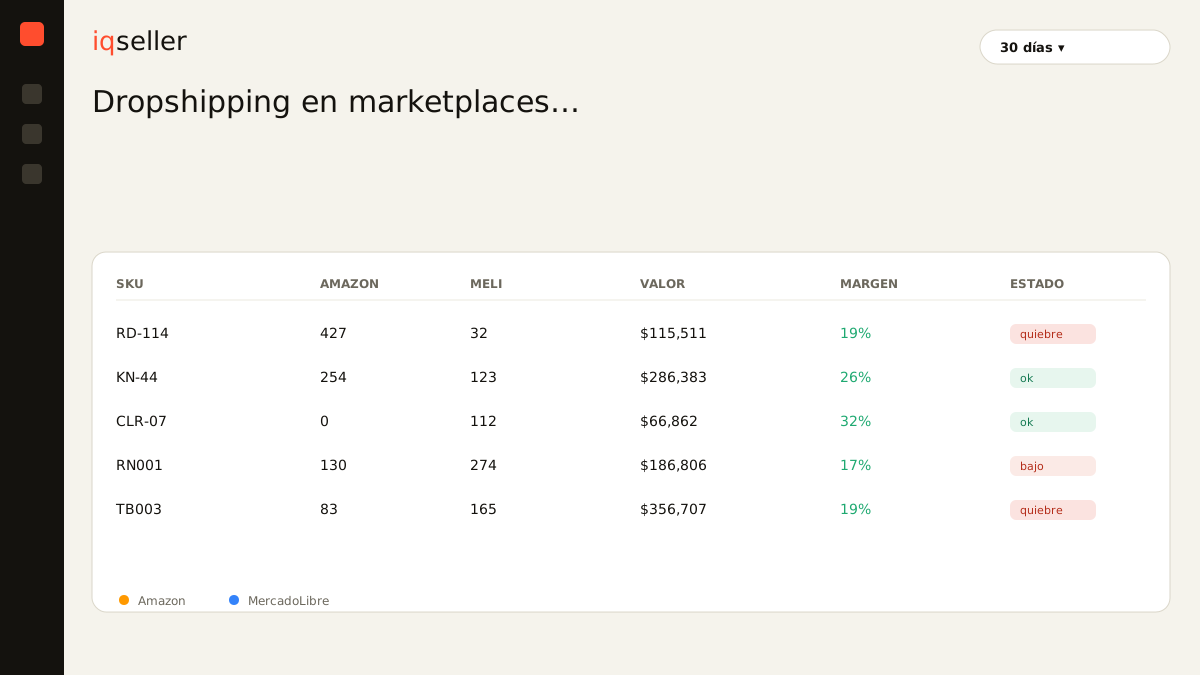
In Profitability, net margin per SKU is calculated on the COGS you load, deducting Amazon settlement commissions and MercadoLibre order fees, FBA and Full fees where they apply, shipping, advertising and the VAT and withholding breakdown. On a product fulfilled by a third party, real COGS includes the supplier’s fulfillment charge, not only the price of the piece. Loading that correctly is the difference between believing you have 20% margin and discovering you have 8%.
In Inventory you see stock by location — FBA, Full, your own warehouse — along with its valuation. In a mixed operation, where part of the catalog is owned inventory and part is supplier-fulfilled, that view is what stops you from treating two very different things as if they were the same.
Alerts is the module that matters most in this model, because the main risk is selling what does not exist. And Catalog, with its Parent → Model → SKU tree, keeps track of which SKU is fulfilled which way, so two businesses with completely different cost structures do not get blended into one report.
the honest summary
Dropshipping on Mexican marketplaces is viable within narrow limits. Amazon allows it if you are the seller of record, if nobody else appears on the package, and if you answer for returns and service; it flatly prohibits buying from another retailer and shipping straight to the customer. MercadoLibre does not name it, but it holds you responsible for the description, the stock and the timing exactly as if you owned a warehouse.
Where it falls apart is not the rulebook. It falls apart on the numbers: buying piece by piece leaves a thin margin, and a thin margin does not survive returns, advertising or a price war with nine other sellers buying from the same supplier.
Use it as a validation tool and as a catalog complement, with a domestic supplier, written agreements and the real cost loaded into your per-SKU margin. As a primary growth strategy, the arithmetic almost never adds up.