
What Is Overselling and Why It Happens in Multichannel Sales
August 18, 2026
Overselling is selling more units than you actually have available: you accept an order for a product you can no longer fulfill because that stock ran out on another channel, got reserved, or was never as full as the report claimed. In plain terms, it is promising something that is no longer on the shelf. And in multichannel sales it is not a rare accident, it is the almost logical outcome of listing the same inventory across several marketplaces that do not talk to each other.
It happens because each channel keeps its own count. Amazon thinks you have 12 units in FBA, MercadoLibre thinks you have 12 in Full, and in your head you think you have 12 total. But very often those are not three separate warehouses: it is the same product, counted three times, listed at once in three places. When a buyer takes one on Amazon, MercadoLibre does not find out instantly. It keeps offering 12 as if nothing happened. If an order lands there too, you have just sold a unit that does not exist. That is overselling, and it triggers precisely when you are selling the most.
The root cause is lag. Between a sale happening on one channel and the other channels lowering their available number, time passes: minutes, sometimes hours, sometimes “until you fix it by hand at night.” That time gap is the window overselling lives in. The slower you update and the more channels you run, the wider the window and the more often you fall into it.
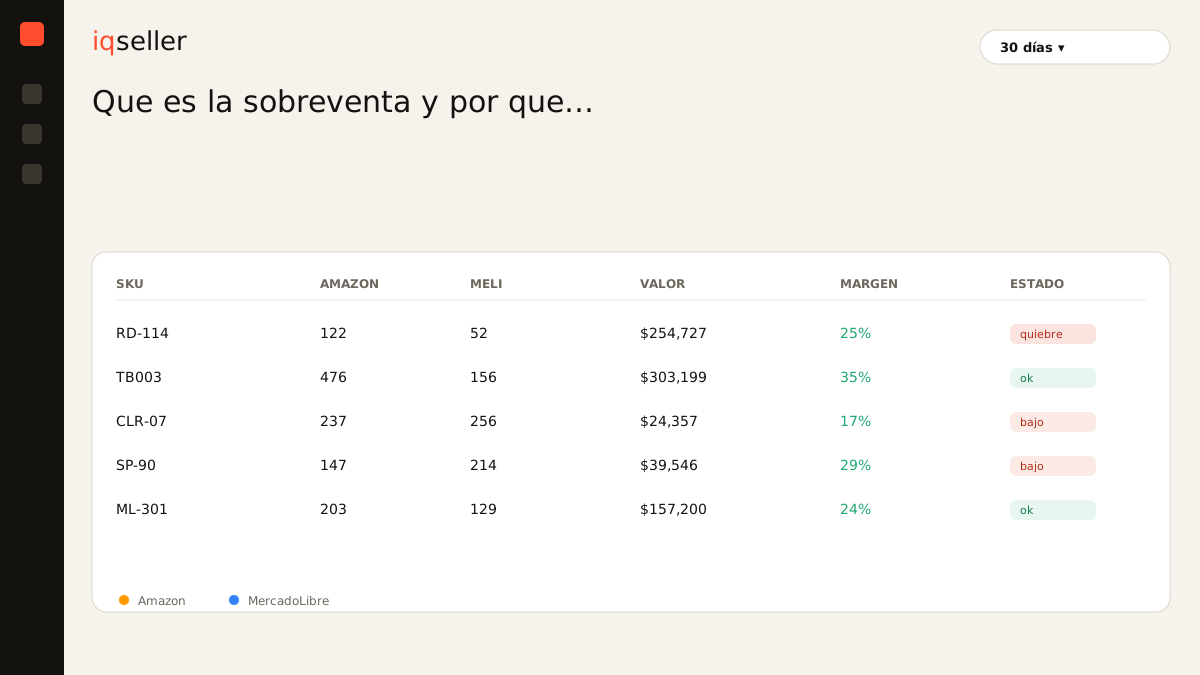
what overselling actually is (and what it is not)
It helps to separate overselling from two things that look similar but are not the same. Running out of stock is not the same as overselling. When you run out, the channel simply stops offering the product: nobody else buys it, you lose sales, but you do not let anyone down. Overselling is worse: the channel kept offering and accepting orders for something you no longer had, so now you have customers with a confirmed purchase you cannot fulfill.
It is also not the same as a one-off typing error. Multichannel overselling is not that you keyed in the wrong quantity; it is a structural problem born from having a single pile of physical stock split across several listings that each count themselves as if they owned all of it. The physical count is one; the sales promises are many. As long as the sum of what you offer across all channels exceeds what you can truly ship, you are exposed to overselling even if each listing on its own looks healthy.
And note, overselling does not always mean selling below zero. You can have 40 pieces in the warehouse and still oversell a channel if those 40 were already committed to orders in process, held by a Full reservation, or blocked in an inspection. The number that matters is not the one the warehouse report shows, it is the one that can actually ship today.
Glossary: real availability is the stock you can sell right now, after subtracting reservations, orders in process, returns waiting to be restocked, and blocked inventory; you oversell when you offer above that number, not above the one the warehouse reports.why the lag between channels causes it
The heart of the problem is that no marketplace knows what is happening on the others. Amazon deducts its inventory when it sells on Amazon. MercadoLibre deducts its own when it sells on Full or Flex. Neither one has a way, on its own, to learn that the unit they were both offering already left through the other door. You are the one who has to wire that communication, and if you wire it late or wire it by hand, the lag is unavoidable.
Picture a product with 5 real units, listed on two channels with 5 available on each. Two orders land almost at the same time, one on each marketplace. If your sync takes fifteen minutes, during those fifteen minutes both channels keep showing 5, keep accepting purchases, and you can pile up orders for 6, 7, 8 pieces out of a stock of 5. You did nothing wrong at input: the world simply moved faster than your update. That is the exact mechanism of overselling.
That is why it gets worse in the moments that matter most: a Prime Day, a Buen Fin, a seasonal spike. When the sales pace goes up, the same fifteen-minute lag window lets far more orders slip through than on a quiet day. The probability of overselling does not depend only on how slowly you update, but on how fast you sell during that delay. More channels and more speed multiply the risk at the same time.
where overselling is born in a real operation
It almost always starts in the same place: at the desk where you gather the information by hand. You know the pattern. You open Seller Central to check FBA stock, then log into MercadoLibre to review Full and Flex, then dig up the 3PL email with this week’s sheet, paste it all into a spreadsheet, and try to reconcile how much of each SKU there is. By the time you finish building the picture, the picture is already an hour old, and sales kept happening while you copied and pasted.
That spreadsheet is what decides how much to list on each channel, and because it is born old, it lists too much. You tell MercadoLibre there are 12 because that is what your sheet said at nine in the morning, but by eleven you already sold three on Amazon and your sheet never found out. The system did not fail out of malice: it failed because you fed it a stale number. Seen this way, overselling is almost always an out-of-date-information problem wearing an inventory-problem costume.
It is also born from invisible holds. An order that came in but has not shipped still “occupies” a physical unit even though the warehouse report still counts it as available. If you list against the warehouse number and not against what is left after subtracting those holds, you are offering pieces that already have an owner. Here it pays to understand well what it means for your stock to be truly available, a topic we develop in what is real-time inventory and why it changes your selling decisions: the gap between “what is in the warehouse” and “what I can promise today” is exactly where overselling sneaks in.
what overselling costs you
The obvious cost is the order you cannot fulfill, but that is the cheapest one. Canceling a confirmed sale hits you where it hurts most on every marketplace: your cancellation metric and your reputation. On Amazon, a high order defect rate from orders you fail to ship pushes you toward account suspension. On MercadoLibre, cancellations drop your reputation level and knock you out of the positions where products actually sell. A single overselling mistake can cost you visibility for weeks.
Then comes the cost of the emergency fix. Sometimes, to avoid canceling, you end up buying the piece at a worse price, shipping it express in a way that eats the margin, or pulling it from another channel where it was also needed. You fulfill the order, yes, but you lose money on it or strip one listing to dress another. Overselling rarely comes free: you either pay with reputation or you pay with margin.
And there is a silent cost that shows up in no report: distrust in your own numbers. Once you have been burned by overselling a couple of times, you start listing too little “just in case,” you leave enormous safety buffers on every channel, and you end up with idle inventory you do have but do not dare to offer. Overselling turns you conservative, and being overly conservative also costs sales. It is the worst of both worlds.
Glossary: a stockout is running out of sellable units on a channel; overselling is its toxic cousin: you not only ran out of stock, you already promised units that do not exist and now you have to break the promise or overpay to keep it.how it connects to days of inventory and sell-through speed
Understanding overselling deeply forces you to look at two numbers together: how much you have left and how fast it leaves. The same stock buffer is a bunker for a slow product and a trap for a fast one. If a SKU sells 20 a day on Amazon and another 8 on MercadoLibre, your lag window has to be tiny, because several pieces move in a few minutes and a short delay is enough to over-promise. If it sells one every three days, that same delay almost never bites you.
That is why days of inventory are the right lens for thinking about risk, not loose units. It is not about “I have 30 pieces,” it is about “at this pace, those 30 last me a day and a half total across both channels.” When you think in time and not in units, you see the zone where overselling becomes likely coming, and you can close the gap early: lowering what you list, setting aside a buffer per channel, or speeding up replenishment.
Glossary: days of inventory measure how long your stock will last at the current sell-through pace; read per channel, they tell you how narrow the margin is before a sync lag pushes you into overselling.why real time is the underlying answer
Everything above points to a single root cause: overselling is a problem of information arriving late. It is not caused by volume or by the number of channels on their own, it is caused by the gap between something happening on one channel and the others finding out. Close the gap and the problem dissolves; leave it open and no safety buffer fully saves you, because you are only compensating for the delay with idle inventory.
Closing that gap is exactly what a real-time inventory does: instead of you gathering the figures by hand every morning, the system deducts a channel’s sale and instantly adjusts what is available on all the others, always calculating against real availability and not against the inflated warehouse number. When the count is single and updates itself, you stop offering the same piece in two places as if it were two pieces. Overselling stops being a permanent possibility and becomes a rare case that alerts help you catch before it reaches the customer.
This is not about selling in fear or leaving huge buffers in case your spreadsheet lied. It is about your inventory picture being the same for every channel and always up to date. That is the difference between reacting to overselling by canceling orders and preventing it because your numbers no longer contradict each other.