
Returns: the hidden cost that kills your margin
March 30, 2026
You sold 100 units this month. The Amazon Seller Central report shows gross sales that look healthy, the listing converts well, and your pricing seems competitive. But when you close the month and pull everything into Excel, the bank balance doesn’t match what you thought you earned. A few thousand pesos are missing, and they don’t show up anywhere obvious. The answer is almost always the same, and almost nobody looks at it head-on: returns.
The problem with returns isn’t that they exist. It’s that they hide. They don’t appear in your sales dashboard as a red line screaming “you lost money here.” They get scattered into little pieces across several reports, in different marketplaces, under different names and with different cutoff dates. By the time you assemble the information by hand, you’ve already made decisions about stock, pricing, and ads using numbers that were inflated. You decided with yesterday’s data, and yesterday’s data didn’t include what the customer returned today.
If you sell on Amazon Mexico, MercadoLibre, Shopify, and move inventory through a 3PL, the problem multiplies. Each channel treats a return differently, charges you different fees, and notifies you at different moments. The sale you celebrated on Tuesday can turn into a net loss by Friday, and you won’t know until someone sits down to cross-reference reports. This article is about why that happens, what it’s really costing you, and why a single source of truth in real time changes the conversation.
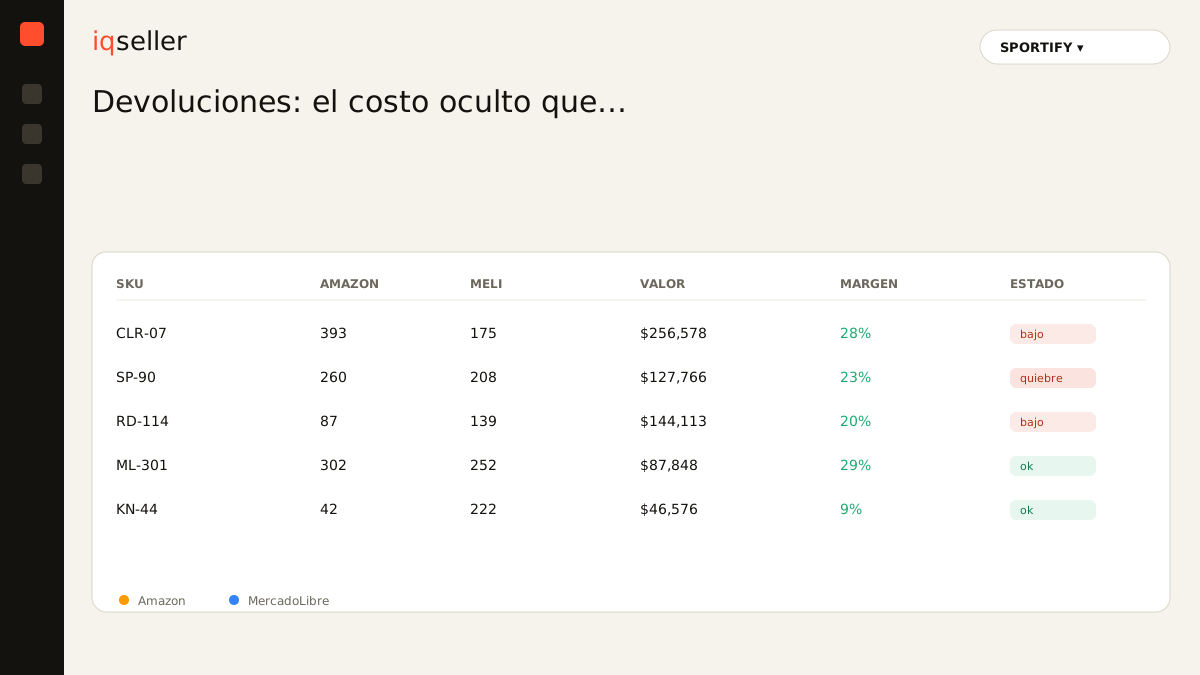
a return isn’t an event, it’s a chain of costs
When a customer returns a product, in your head only one thing happens: “I lost that sale.” In reality, six or seven things happen. You lose the sale revenue, yes, but you also lose the original shipping cost you already paid. In FBA, Amazon charges you a return processing fee. The product comes back to the warehouse and someone has to inspect it: sometimes it goes back on sale as new, sometimes it drops to “used - like new” at a lower price, and sometimes it arrives damaged and goes straight to destruction or liquidation, where you recover cents on the peso.
Add the reverse logistics cost, the repackaging, your 3PL’s labor, and the capital tied up while that unit made the full round trip. A single return can carry five or six separate charges, and none of them live on the same screen. The average seller sees the “refund” line and believes the damage ends there. It doesn’t end there. It starts there.
Dictionary: real net margin deducts every cost tied to the sale —including returns, reverse fees and liquidation— not just the product cost.why your return rate per SKU matters more than the global one
Many sellers look at a single figure: “I have a 6% return rate.” That global number is almost useless for making decisions. What kills your margin isn’t the average, it’s the distribution. You have SKUs at 1% returns that are perfectly healthy, and you have two or three SKUs at 22% that are bleeding and dragging the average up. If you only see the 6%, you’ll never find the culprit.
A high return rate per SKU almost always tells a concrete story: sizes that don’t match the description, listing photos that promise more than the product delivers, a category where customers buy three to keep one, or a real quality problem from the supplier. Each of those causes has a different fix —correct the listing, adjust the size guide, switch suppliers, pull the product— but all of them require that you first see the return at the SKU level, by channel, without building a pivot table every Monday.
This is where the multichannel pain gets sharp. The same SKU can have a 4% return rate on Amazon and 15% on MercadoLibre because the buyer is different, the expectation is different, and the marketplace’s return policy is different. If you look at channels separately, in separate dashboards, you’ll never notice that the problem lives in a specific channel and not in the product itself.
the domino effect on your available inventory
Returns don’t just cost you money, they dirty your forecast. When a unit comes back to the warehouse and sits in “pending inspection” status, it’s technically in your inventory but you can’t sell it. If your system counts that unit as available, you’ll believe you have more stock than you can actually move, and you’ll delay a reorder you should have placed two weeks ago. If you don’t count it and it later does get resold, you underestimate and over-buy.
That’s why returns and the inventory forecast are the same problem seen from two angles. A good demand forecast has to discount the fraction of units that historically come back, because selling 100 and getting 15 returned is not the same as selling 85 clean. Your real sell-through rate —the one that matters for reordering— is the net rate after returns, not the gross one.
Dictionary: true available stock separates sellable inventory from what’s held by inspection, damage or return transit, preventing miscalculated reorders.returns also eat your advertising
There’s a return cost almost nobody accounts for: what you paid in ads to win the sale that ended up returned. If you invested in a Sponsored Products campaign and the click turned into a purchase the customer sent back, that ad spend is not refunded. Your reported ACoS is calculated on gross sales, but your real ACoS —the one that matters— should be calculated on the sales that stuck.
Picture a SKU with a seemingly healthy 18% ACoS and a 20% return rate. Your effective ACoS shoots up, because you’re paying for ads on sales that evaporate. That product that looked profitable in the campaign report can be losing money once you cross ad spend with returns. We dig into that mechanic in ACoS and margin: when ads eat your profit, but the core idea is simple: a return doesn’t just cancel the sale, it cancels the investment you made to win it.
Dictionary: ACoS measures ad spend as a percentage of attributed sales; when returns are high, the effective ACoS is higher than the reported one.the cost of assembling it by hand
So far, all of this can be measured. The problem isn’t that the information doesn’t exist; it’s that it lives scattered. The refund is in one Seller Central report, the processing fee in another, the ad spend in the advertising console, the product cost in your cost sheet, and the physical status of the returned unit in your 3PL’s system. MercadoLibre has its own logic of claims and mediations that looks nothing like Amazon’s.
The seller who wants to know their real margin after returns has to download five reports, align them by SKU, reconcile dates that don’t match, and build an Excel formula that breaks the next month when a marketplace renames a column. By the time it’s done, the data is already two weeks old and the decision it was meant to inform has already passed. That’s how a store like SPORTIFY can sell more and earn less for months without realizing it: not because it lacks data, but because it has too many disconnected sources.
what changes with a single source of truth
The alternative isn’t to work harder in Excel; it’s to stop working in Excel. When every channel —Amazon, MercadoLibre, Shopify, 3PL— feeds one place in real time, the return stops being invisible. Each returned unit is automatically deducted from revenue, the reverse fees are subtracted, the associated ad spend is charged against it, and the true available inventory is adjusted. The margin you see is the margin that is, not the one you thought you had before closing the month.
That lets you ask the right questions while they still matter: which three SKUs have the worst net margin after returns? In which channel does this product get returned more, and why? Does this listing I’m about to scale in advertising actually hold more spend, or will its return rate eat it? With today’s data and not data from two weeks ago, those questions have an answer before the decision is already made.
Returns will never be zero, and they shouldn’t be —a healthy return policy is part of selling online. The goal isn’t to eliminate them, it’s to see them. A cost you can’t measure, you end up paying in full without noticing. A cost you see at the SKU level, by channel and in real time, you can attack: you fix the listing that generates size-related returns, you pull the SKU that bleeds, you cut ads on a product that can’t sustain them, and you reorder with your real net velocity. That’s where the margin that was slipping away comes back to your pocket.