
Walmart Marketplace Mexico: how it works and who it fits
October 3, 2026
When a Mexican seller already runs Amazon and MercadoLibre and starts asking what the third channel should be, Walmart Marketplace is almost always on the short list. And it lands there for a different reason than the other two: it is not a platform that built a store starting from the internet, it is a very large physical retail chain that opened its site to outside sellers.
That difference in origin explains nearly everything else: the type of shopper, which categories carry weight, how the commission is charged, and even the tone of the onboarding process, which feels closer to registering as a supplier than to opening an account in an app.
It also explains the most common confusion. Walmart Marketplace is not the same as being a supplier to the physical stores. As a supplier you sell to Walmart, negotiate terms and deliver into their distribution centers under their commercial scheme. On Marketplace you sell to the consumer, on Walmart’s site, with your own inventory and your own invoicing, and Walmart charges a commission on each sale.
This article covers how it works, what it asks for, how commissions and fulfillment are structured, how it differs from the other two channels and which seller profile fits. Everything with a number in it changes often, so confirm it on Walmart Mexico’s official Marketplace Learn portal before you run final figures.
what it is and what it is not
It is a 3P model: outside sellers list on Walmart Mexico’s digital properties and sell directly to the end consumer. The buyer sees the product inside Walmart’s site, with the brand trust that implies, but the seller is you.
What matters for your operation is what stays on your side. The inventory is yours, you set the price, you issue the invoice to the consumer, and customer service is yours unless you use their fulfillment service. Walmart provides the storefront, the traffic and the rules.
What it is not: it is not a wholesale purchase, there is no entry-margin negotiation like a 1P supplier relationship, and there is no purchase order guaranteeing you volume. You sell whatever sells.
One detail worth knowing from the start: Walmart Mexico’s digital ecosystem includes more than one property, and listings can reach shoppers across different formats of the group. That widens your reach, but it also means your product page and your price are seen in different buying contexts at the same time.
how you get in: requirements and catalog
Onboarding is designed for formally constituted Mexican businesses, and that is where most improvised applications fall apart. Registration itself is free: there is no monthly subscription like Amazon’s Professional plan, and Walmart’s revenue comes from the per-sale commission.
What is asked for, according to Walmart Mexico’s own materials, clusters into four blocks:
- Tax and legal identity: an active, valid RFC, articles of incorporation for a legal entity, proof of fiscal address, and complete invoicing information.
- A Mexican bank account under the same registered business name. Matching names is not a formality: mismatches are a frequent cause of rejection.
- A catalog with valid codes: products need legitimate GS1 GTIN or UPC codes. This is the step that most delays sellers who grew up improvising their codes.
- Product policy compliance: your catalog has to stay outside the prohibited products policy and meet each category’s requirements.
The review process takes time and happens in stages, so it pays to arrive with complete documentation instead of correcting as you go. If your product data is already well structured for Amazon, much of the work is done; if your catalog lives in a spreadsheet with half the dimensions missing, that is your real cost of entry.
Glossary: EAN and GTIN, the key to your catalog →commissions and where to confirm them
Walmart Marketplace Mexico’s commission is charged per sale and depends on the subcategory the item is loaded into, not on the product in general. That matters more than it sounds: two products you would consider similar can end up in different subcategories and pay different rates.
The official commission guide published on Marketplace Learn shows a wide range by category, with low-rate categories in the high single digits and high-rate categories near twenty percent. Among the examples the guide itself lists, wines and spirits sit at the low end of the range while jewelry sits at the high end; the rest of the catalog spreads between those two poles.
There is a second element that changes the math and is particular to this channel: interest-free installments. Turning on the premium MSI scheme adds percentage points on top of your category’s commission. That is not a minor detail in Mexico, where interest-free months move conversion on higher tickets, but it is not free either: it is a margin decision, not a marketing one.
Like every fee table, this one gets updated. Before you calculate your minimum profitable price for this channel, download the current table from Walmart Mexico’s official portal and use the exact subcategory your item will live in, not an approximation.
fulfillment: you ship, or WFS ships
There are two routes. In the first you fulfill: you hold your inventory, pack and ship under the delivery standard the platform requires, and handle returns. It is the route with the lowest fixed cost and the highest operational demand.
In the second you use Walmart Fulfillment Services (WFS), the channel’s own fulfillment program. You send inventory into Walmart Mexico’s distribution centers and they handle storage, picking, shipping to the end customer, and much of the support and returns. To use it you have to already be a Marketplace seller: it is a layer on top of onboarding, not an alternative to it.
WFS costs concentrate in three concepts, according to its own guides: a fulfillment fee covering receiving, packing and dispatch; a shipping fee; and storage. The exact amounts and the size and weight tiers live in the fees section of Marketplace Learn and they change, so that is where to verify them.
The choice between the two is the same one you already know from FBA and Full, on the same axes: WFS improves the delivery promise and takes operations off your hands, in exchange for committing inventory to a warehouse that only serves that channel. For a fast mover the math usually works; for a slow mover, storage eats the argument.
how it differs from Amazon and MercadoLibre
All three sell online in Mexico, but they behave differently and it is a mistake to treat them as interchangeable.
- Origin and shopper. MercadoLibre was born a marketplace and carries a culture of comparison and standalone listings. Amazon was born a store and organizes everything around the catalog and the ASIN. Walmart arrives from physical retail, with a shopper who already knows the store brand and often compares against the shelf price.
- Catalog structure. On Amazon you compete inside the same product page for the Buy Box. On MercadoLibre you can end up with several listings for the same product and the duplicated-MLM problem. On Walmart the GTIN requirement at the door pushes toward a cleaner catalog, which helps if your codes are already in order and gets in the way if they are not.
- Revenue model. Amazon combines a monthly Professional plan subscription with a referral fee. MercadoLibre charges a per-sale commission with its own exposure schemes and shipping costs. Walmart charges no subscription and concentrates its revenue in the category commission, plus the added points for premium MSI.
- Competition. On Amazon and MercadoLibre you compete against thousands of sellers in almost any category. On Walmart Marketplace seller density varies by category, and that is a good part of its appeal for anyone selling something already saturated on the other two.
None of those differences is an advantage in the abstract. They become an advantage or a liability depending on your product, your margin and your ability to deliver.
what to expect in volume (and why nobody can hand you the number)
Here is where honesty is required: there is no reliable, comparable figure for how much you will sell. The traffic and market-share numbers circulating in articles and agency blogs usually come from different methodologies, from sources that cannot be audited, or they blend the retailer’s own sales with marketplace sales. Using them to project your revenue is budgeting on sand.
What you can do is measure it yourself, and it does not take long:
- Open with few SKUs, the ones with enough margin to absorb their subcategory’s commission and with proven rotation on your other channels.
- Set a test window — a quarter is reasonable — and a target in monthly units, not in gross revenue.
- Measure sales velocity per SKU, not channel totals. A channel can look flat while two SKUs take off.
- Compare margin against margin, not revenue against revenue. The question is not whether Walmart sold more or less than Amazon, but what profit per unit each one left you.
- Decide with the rule you wrote before opening. If it missed the target, close it or shrink the catalog; if it beat the target, expand.
That process gives you a number that is actually yours and actually comparable, which is exactly what no third-party chart will ever give you.
how a third channel reads in iqseller
The invisible cost of opening Walmart is not the commission: it is that your operation goes from two views to three. Three fee tables, three promotion calendars, three payout reports with their withholdings, and one inventory now split across more locations.
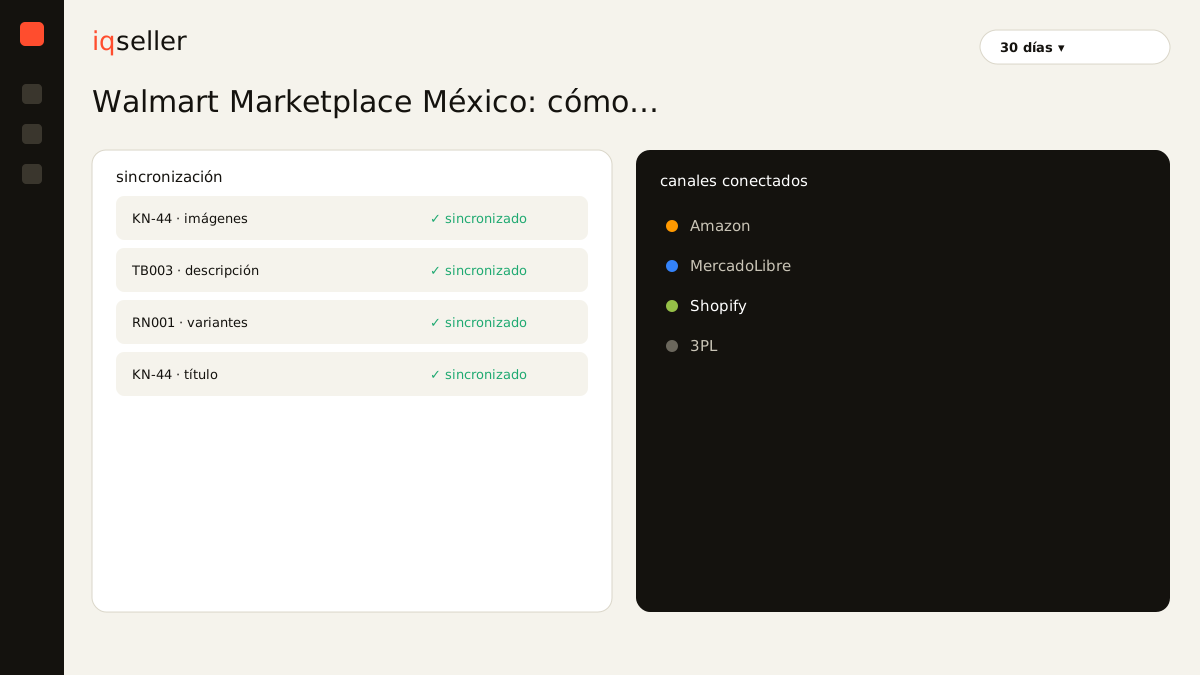
In iqseller the product lives once in the Catalog, with its Parent → Model → SKU tree, and every channel listing hangs off the same master SKU. That is why the codes matter so much: a properly set EAN or GTIN is what lets the same product be recognized across all three places instead of becoming three different products.
Inventory shows one stock split by location — FBA, Full, 3PL, your own warehouse — with its valuation, so the new channel never promises units already committed elsewhere. Alerts flags critical stock before it becomes a stockout, and Forecast uses each channel’s real sales velocity to say how much to reorder.
And Profitability is where the question that started the whole exercise gets answered. Net margin per SKU is built from the COGS you load plus what each platform actually deducted: Amazon settlement commissions, MercadoLibre order commissions, FBA and Full fees, shipping, advertising, and the VAT and withholding breakdown. Seeing the same product with its margin channel by channel is what turns “I think Walmart is doing fine” into a number.
Glossary: real net margin, with everything deducted →who it fits and who it does not
It fits the seller with a formal catalog and GS1 codes already in order, whose margin absorbs the subcategory commission with room to spare, who can meet the delivery standard without rebuilding their operation, and who sells in categories where the Walmart shopper already buys. It also fits anyone saturated with competition on the other two channels and looking for a place with different seller density.
It does not fit anyone who improvised their product codes, anyone operating at the limit of their fulfillment capacity, anyone whose margin sits on the floor — where a few extra commission points, or the premium MSI points, push it into a loss — or anyone who still cannot say from memory what their net margin per SKU is on the channel they already run.
The final test is the usual one. A third channel multiplies the information you have to review, and it only pays off when the margin on the first two is already under control. If that number does not exist yet, solve it first; and the moment you start setting prices, download the current fee table from the official portal, because the figures in this article are the map, not the territory.