
When to pause a campaign mid-event and when to hold your nerve
November 15, 2026
Mid-afternoon on day two of the event, the report shows a campaign with double a normal day’s spend and an ACoS that looks frightening. The seller has a finger over the pause button and two voices in their head: one says money is being thrown away, the other says killing it will cost the evening’s sales. In the next ten minutes they will make a several-thousand-peso decision on incomplete information with their pulse up.
That decision goes wrong in one of two directions almost every time, and both are expensive. The first is killing something that was working, because the number on screen was not what they thought it was. The second is leaving something running that really was bleeding, out of fear of losing presence. What decides which mistake you make is not composure: it is having decided in advance which signals count.
And there is one technical detail that explains half the trade’s mistaken shutdowns: during an event, the report you are looking at is not complete. Sales attributed to advertising are recorded against the click date and appear with a lag, so today’s spend is already counted and today’s sales are not. Looking at the ACoS from three hours ago is seeing the whole numerator and a fraction of the denominator. The number looks catastrophic by construction, not because the campaign is broken.
This post separates the two lists: the signals that genuinely justify cutting in the heat of the moment, and the ones that look bad and are not. And first of all, it makes clear what the decision gets compared against, because it is not the campaign’s ACoS: it is the contribution of the product that funds it.
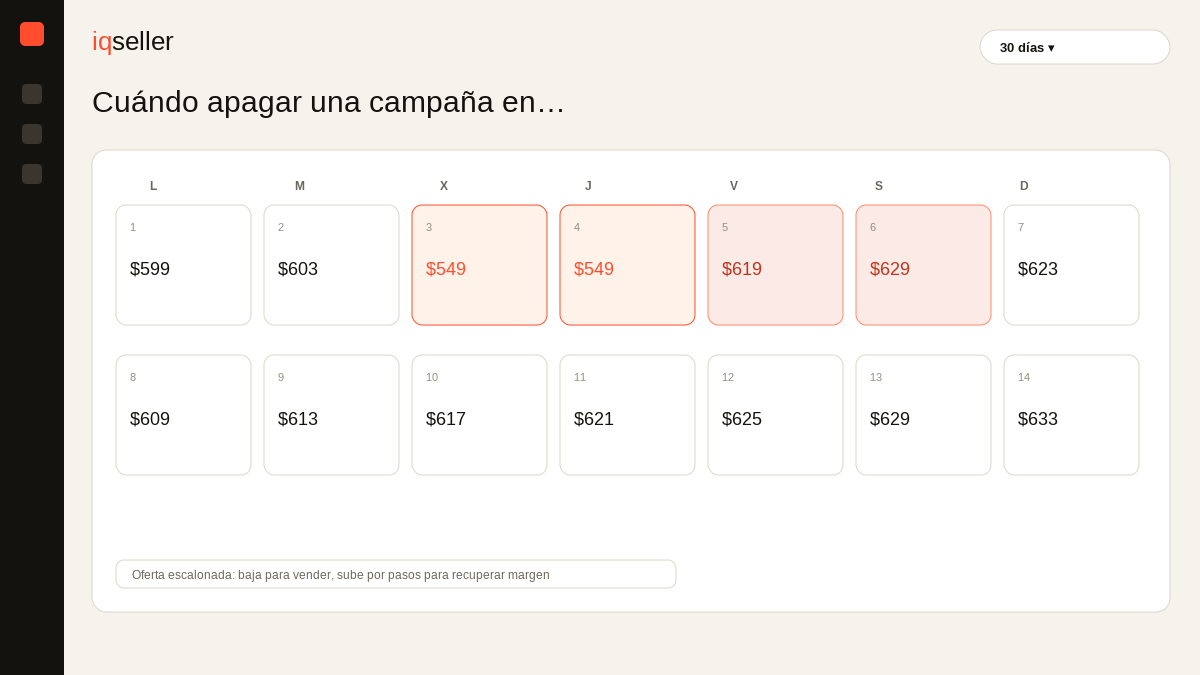
killing in the heat of the moment is not optimizing
In a normal month, optimizing a campaign is a process: you gather two or three weeks of data, identify the terms that do not convert, adjust bids, add negatives and measure again. The cycle is deliberately slow, because signal needs time to become signal.
During an event you do not have that luxury, and that changes the nature of the decision. Killing something mid-event is a loss-containment decision in a short window, not an optimization decision. The question is not “is this campaign well structured?” but “in the hours left in this event, does the money it will consume leave anything or subtract?”.
That has two practical consequences worth settling before touching anything.
First: the criteria have to be coarser than in a normal month. No micro-optimizing terms with nine clicks. During an event you only act on large signals, because only large ones are readable in a few hours.
Second: killing has a cost that appears in no report. A listing that stops receiving traffic mid-event loses sales velocity, and sales velocity feeds position. Turning the campaign back on the next day does not return you to where you were: the platform has to gather signal again. Switching off and on twice in five days is worse than either decision held steady.
the signals that genuinely justify cutting
There are few, and they all share one trait: they do not depend on interpreting a percentage, but on a verifiable fact.
Inventory is about to run out. The first and the clearest. If coverage says that SKU has two days of stock left and the event has three days to go, the campaign stops making sense before the inventory runs out, not after. Continuing to spend there buys clicks that land on a listing about to go out of stock, with the added damage that a stockout mid-event punishes position exactly when traffic is highest. The money should move to another SKU, not be switched off.
The price no longer covers the ad cost. If you cut price during the event and the click also got more expensive, spend per unit may already exceed contribution. This is not an impression: it is a subtraction. Contribution per unit at the event price minus ad spend per unit sold. If the result is negative with enough units to believe it, every additional sale in that campaign destroys money and no amount of volume compensates.
One term shot far above the rest. When a single term carries a CPC two or three times your baseline while the others barely moved, usually somebody showed up willing to pay anything for that slot. Fighting them is funding their strategy. Here what gets cut is the term, not the campaign.
The product is no longer genuinely available. It happens more than you would think: the listing is still live but real available stock is zero because pending orders already committed it. The campaign keeps spending and sends traffic to something that cannot be bought or will get cancelled. This is not an advertising decision: it is pure leakage.
A real operational error. Wrong price loaded, wrong variant, suppressed listing, broken image. When the cause of poor performance is an error, you fix the error; if it cannot be fixed on the spot, you switch off until it is. It is the only case where pausing is clearly better than adjusting.
Glossary: a stockout is running out of units of a SKU; mid-event it costs sales and also position, because the listing loses velocity →the signals that look bad and are not
This list saves the most money, because each item is a mistaken shutdown the trade commits every November.
Today’s ACoS, looked at today. Mistake number one. Spend reports almost immediately and attributed sales appear with a lag, because they are assigned to the click date and the shopper may buy hours or days later. During an event the purchase decision window stretches —people compare more— so the lag is larger exactly when you are most impatient. The ACoS you see at four in the afternoon on Saturday will come down on its own as the report completes. Compare a closed day against a closed day, never a day in progress against a closed one.
High spend with no sales in the early hours. Same thing from the other side. The early hours of an event concentrate people comparing and filling carts; closing comes later. A morning block with many clicks and few sales is normal peak behavior, not a broken campaign.
CTR dropped. It almost always drops during an event and it is almost never your fault. There are more ads competing for the same slots, so your ad shows up more often in worse places. More impressions of lower quality with the same clicks produces a lower CTR without anything having worsened on your end. A CTR falling while absolute clicks rise is a sign of more competition, not a bad ad.
CPC went up. A more expensive click is not, on its own, a reason to switch off. It is the market price of being present. The right question is whether that higher CPC still fits inside the product’s contribution, and only the subtraction from the previous section answers it. Switching off because CPC rose 30% when your margin absorbs an 80% rise is handing the event to your competitor.
A campaign with few clicks and zero conversions. In three hours, twenty clicks with no sale means nothing statistically. If your normal conversion is 1 in 15, a run of twenty clicks without closing is perfectly possible by chance. Acting on samples like that is the definition of noise, and during an event the temptation to do it peaks.
Impression share fell. Losing relative presence when twenty new competitors enter is arithmetic, not failure. What matters is not what percentage of impressions you take, but whether the ones you take leave margin.
Day one’s margin looks worse than a normal day’s. Of course it does: you sold at a discount and paid expensive clicks. That was the plan. The valid comparison is against the event plan and against last year’s event, not against a Tuesday in October.
pause, lower the bid or drop the term: three different actions
Many people treat the pause button as the only tool, which is why they use it badly. During an event there is a ladder of actions, and the right answer is almost always on the lower rungs.
- Lower the term’s bid. The finest action and the one with the least collateral damage. It reduces what you pay for position without disappearing from the auction. For the inflated-term case, it is almost always the answer.
- Drop the term or add it as a negative. When one specific term is consuming and not converting, you cut the term and the campaign stays alive with the rest. This is not long-term optimization: it is containment.
- Lower the campaign’s budget. Useful when the whole campaign is expensive but you do not want to vanish. It leaves partial presence in the blocks that matter.
- Move the budget to another campaign. The most profitable of all and the least used. If one SKU runs out of inventory and another has plenty, the money is not switched off: it is relocated.
- Pause the campaign. The last rung. Reserved for the operational error, for the inventory that ran out, and for the subtraction that came out negative with enough sample.
The golden rule: if you do not know which rung you are on, you are on “lower the bid”. Pausing is irreversible inside the event, because turning it back on does not return the position you had.
the protocol you write before, not during
None of the above works unless it is decided before the event starts. During the event there is no head for building criteria; there is only head for applying them.
A short protocol that fits on one page:
- For every SKU you will push, write down its contribution per unit at the event price. That is the number everything gets compared against.
- Write down the maximum ad spend per unit you are willing to pay on that SKU during the event. That is your cut trigger.
- Define the minimum sample to act on. For example: nothing gets touched below a certain number of accumulated clicks on the term. You set the number according to your normal conversion, but set it.
- Define the attribution rule. In writing: “the day in progress is not judged”. Only closed day against closed day, or against the plan.
- List the SKUs with tight coverage and the date their budget moves to another product. This gets decided beforehand, with the forecast in hand.
- Name who decides. If there is a team, make it clear who can pause and who cannot. Half of all event disasters are two people adjusting the same account without talking.
- Set three checkpoints per day and forbid yourself from touching the account outside them. Continuous monitoring during an event improves nothing: it only raises the odds of acting on noise.
Point seven is the hardest and the highest-yielding. Checking the panel every twenty minutes during an event does not produce better decisions; it produces more decisions, which is not the same thing.
Glossary: real net margin is what is left after ALL costs; it is the only legitimate ceiling for judging whether a campaign should keep running →an example with the subtraction done
Invented figures, reconciled arithmetic. Two campaigns, same seller, day two of the event.
Campaign A. A SKU you sell at $928 including VAT, or $800 net. Costs: $360 of product, $112 of commission, $85 of fulfillment, $18 of returns. Contribution before advertising: $225. On the previous closed day, the campaign spent $9,800 and sold 56 units: $175 of advertising per unit. That leaves $50 per unit. Its ACoS is $9,800 / (56 × $800) = 21.9%, which looks high for its category. Do not switch it off. It is leaving $50 clean per unit and moving volume. What you do is lower the bid on the two or three most expensive terms to push that $175 down.
Campaign B. Another SKU, $580 including VAT, $500 net. Costs: $240 of product, $70 of commission, $75 of fulfillment, $15 of returns. Contribution before advertising: $100. The previous closed day it spent $6,200 and sold 48 units: $129 of advertising per unit. It loses $29 on every unit sold. Its ACoS is $6,200 / (48 × $500) = 25.8%, barely four points above campaign A. To anyone looking only at ACoS, the two campaigns look alike. To anyone looking at contribution, one earns $50 per unit and the other loses $29.
That is the whole difference. Two nearly identical ACoS figures, two opposite decisions. And the only data point separating them is what the product leaves underneath, which is precisely the data point that does not appear in campaign manager.
how this reads in iqseller
The protocol above needs two numbers that live in different places and that during an event have to be seen together: what the SKU leaves and what its advertising is consuming.
In the panel, the Profitability module builds net margin per SKU from the COGS you load, the commissions from the Amazon settlement and from MercadoLibre orders, FBA and Full fees, shipping, advertising and the VAT and withholding breakdown. Next to it sit the advertising metrics —ad spend, CPC, clicks, impressions, ACoS and TACoS— so the subtraction from the example above does not have to be assembled by hand across two tabs.
Inventory and Forecast solve the other half of the protocol: real available stock, coverage by channel and critical stock are what say whether a SKU deserves to keep receiving budget or whether inventory already made the decision. Alerts flag falling coverage or degrading margin, which mid-event is the only way anyone finds out without staring at a screen.
And it should be said plainly what the panel does not do: it does not pause campaigns, change bids or move budgets. All of that is executed in Amazon Ads and MercadoLibre Product Ads. What the panel solves is the prior step, which is where the money is lost: knowing, with reconciled numbers and per SKU, whether what you are seeing justifies acting or is attribution noise. The Parent → Model → SKU tree also lets you read it at the right level, because sometimes the whole model is fine and only one size is bleeding.
what to do the day after
The close of the event is when the information finally becomes useful, and it is when almost nobody looks at it because they are already thinking about December. Half an hour well spent:
- Reread the closed days with complete attribution. You will find that several campaigns that looked disastrous ended up reasonable. Note which ones, because those are the ones not to switch off next year.
- Review which shutdowns were right and which cost you. A shutdown that coincided with the highest-converting block has an estimable cost: lost clicks times conversion times that SKU’s contribution.
- Save the ad spend per unit for each SKU during the event. That is your calibrated trigger for next time.
- Note the terms that inflated and by how much. That list decides your opening bids next year.
The principle that remains is the same as in the other three sides of this topic: a campaign is not judged against its own ACoS, least of all mid-event, when the ACoS you see is incomplete. It is judged against the contribution of the product that funds it. If that subtraction comes out positive with enough sample, the campaign stays even if the percentage looks steep. If it comes out negative, it gets cut even if the percentage looks decent. Everything else —CTR, impression share, the eleven-in-the-morning panic— is context, not criteria.