
Amazon and MELI ads in one view
April 3, 2026
If you sell on both Amazon and MercadoLibre, you already know the routine. You open Amazon Seller Central, go to the Campaigns console, and jot down the week’s spend and ACOS. Then you switch tabs, open MercadoLibre’s Product Ads, and write down another investment figure, another cost per click, another attributed sale. Each platform has its own dashboard, its own attribution window, and even its own name for the same thing. By the time you finish copying everything into a spreadsheet, half the morning is gone and the numbers you have are from yesterday’s close.
The problem isn’t a lack of data. Quite the opposite: there’s too much of it, scattered across places that don’t talk to each other. What’s missing is a view that brings it together and translates it into one language, so you can compare apples to apples. Without that, deciding where to put your next advertising peso becomes a hunch dressed up as analysis. You raise the budget on one channel because it “feels” like it’s working, not because you know each peso returns more there than on the other.
This article is about why bringing Amazon and MELI advertising into a single view changes how a multichannel seller makes decisions, and what it takes for that view to be trustworthy rather than just good-looking.
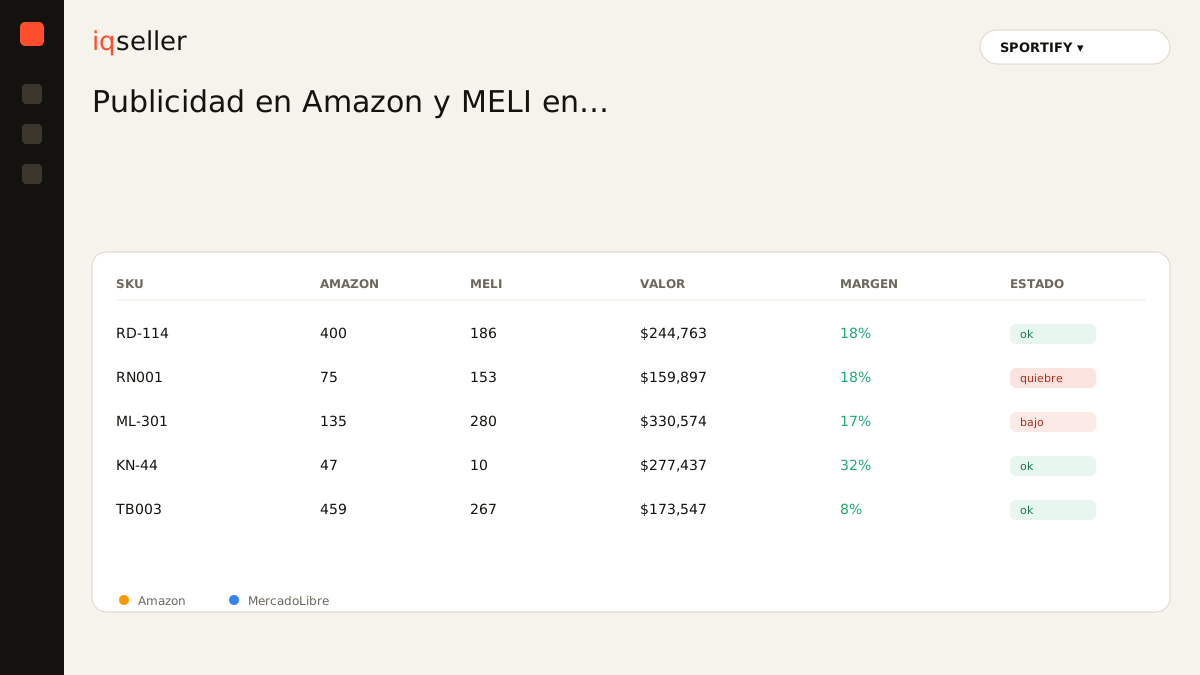
why two dashboards never give you one answer
The core obstacle is that Amazon and MercadoLibre don’t measure advertising the same way. Amazon Advertising shows you ACOS (spend over attributed sales), splits investment across Sponsored Products, Sponsored Brands, and Sponsored Display, and attributes sales with a window that depends on the campaign type. MercadoLibre’s Product Ads runs on its own attribution model, its own cost per click, and its own relevance logic inside the marketplace. Neither is “wrong”; they simply speak different languages.
When you try to add them up by hand in Excel, you end up comparing figures that aren’t equivalent. An 18% ACOS on Amazon doesn’t mean the same as 18% spend over sales on MELI, because behind each sale sit different fees, different shipping costs, and different margins. Summing the total spend of both channels and dividing by total sales gives you an average that hides exactly what you need to see: which channel is making you money with your advertising and which one is giving it away.
Dictionary: ACOS is the percentage of ad spend over the sales it generated; a low ACOS doesn’t always mean profit if the product’s margin is thin.the invisible cost of consolidating by hand
Pulling the information together manually doesn’t just cost time; it costs trust. Every time you copy and paste from one panel to another, you open the door to an error: a shifted column, a wrong date range, an exchange rate you forgot to apply. And because the file is yours and only you understand it, no one else can check it. The result is that you make budget decisions on a foundation you’re not actually sure is correct.
There’s a worse cost, and it’s speed. Marketplace advertising moves by the day. A campaign that performed well yesterday can spike today because a competitor raised their bid, or because your product ran out of Dictionary: available-to-sell stock is what you can genuinely sell today, after subtracting reserves and in-transit orders; running ads on a product with no available stock is burning budget. and you keep paying for clicks that don’t convert. If your only way to find out is Friday’s manual close, you react four days late, and in advertising four days is a lot of money.
one source of truth, in real time
The alternative is to bring both channels into a single view that updates itself. This isn’t about having one more screen; it’s about having the screen: one where spend, clicks, attributed sales, and the resulting margin from Amazon and MELI live together, normalized to the same period and the same currency. When data arrives like that, you stop consolidating and start deciding.
What matters about that single view isn’t that it looks tidy, but that it’s comparable. For comparing channels to make sense, the platform has to translate each marketplace’s native metrics into a common denominator, and cross them with your real costs: selling fees, advertising commissions, shipping cost, and product cost. Only then can you move from “I spent this much on ads” to “I earned this much after ads,” which is the question that actually matters.
This is the same principle behind inventory forecast in depth: raw data from each channel is worth little until it’s unified and checked against the reality of your operation. Advertising is no exception; it’s one of the places where the lack of unification translates into lost money fastest.
from spend to margin: what the single view reveals
When you see Amazon and MELI side by side under the same rules, patterns appear that were invisible apart. You discover, for example, that a SKU has an acceptable ACOS on Amazon but that, after adding the FBA fee and shipping, its net margin with advertising is nearly zero, while the same product on MELI Full leaves more profit even though its cost per click is higher. That’s exactly the kind of conclusion a combined average would hide from you.
Dictionary: real net margin is what genuinely remains after subtracting every cost —product, fees, shipping, and advertising— from the sale; it’s the figure that decides whether a campaign is worth it.It also changes how you split the budget. Instead of dividing investment out of habit or intuition, you put it where the extra peso generates the most margin, channel by channel and product by product. The single view turns budget allocation into an evidence-based decision: if the same product returns more on one marketplace than another, that’s where the money goes, with no guessing required.
advertising doesn’t live alone: stock, price, and seasonality
One of the traps of looking at advertising in its own silo is forgetting that it depends on everything else. Bidding hard on a product about to stock out is throwing money away, because you pay for clicks that land on a listing with no availability or long delivery times. That’s why the ads view gains value when it connects to inventory: if the system knows your available-to-sell stock per channel, it can warn you to lower the bid before you pay for visits that can’t convert.
The same goes for pricing and seasonality. A campaign that performs in the low season can be insufficient during Buen Fin or Hot Sale, when competitors raise bids and costs per click inflate. And the reverse: keeping budget high off-season can drain margin without moving sales. Crossing advertising with demand behavior is part of analyzing sales by product family and season, because the right ad weight shifts with the time of year and the category.
When all of this lives on the same platform —ads, stock, price, fees, and seasonality— advertising stops being an isolated lever and becomes part of a complete decision. That’s the real argument for the single view: it’s not convenience, it’s the only way to see advertising for what it actually is, an investment that only makes sense measured against the margin it leaves.
what to demand from a multichannel ads view
If you’re going to trust a single view to decide your investment, that view has to deliver on a few things. First, real-time or near-real-time updates: today’s data, not yesterday’s close. Second, honest normalization: Amazon and MELI metrics translated into a common language, with the calculation in plain sight so you can audit it. Third, a connection to your real costs, not generic averages, so the margin is yours and not a textbook estimate.
Fourth, granularity: the ability to drill from the channel total down to the individual SKU, because that’s where you win or lose. And fifth, alerts that warn you before the money is gone —a campaign whose spend spiked, a product that ran out of stock while you kept advertising, a cost per click that drifted out of range. A view that only describes the past is a report; one that warns you in time is a decision tool.
Bringing Amazon and MELI advertising onto one screen isn’t a luxury for big sellers. It’s what separates deciding on today’s data from deciding on yesterday’s hunch. When you stop consolidating by hand and start seeing both channels under the same rules, the question stops being “how much did I spend?” and becomes “where does each peso leave me more margin?”. That’s the question that grows a multichannel operation.