
Analyzing sales by product family and season
March 31, 2026
Once you have been selling across several marketplaces for a while, you stop thinking in individual SKUs and start thinking in families: the line of insulated bottles, the sports backpacks, the car accessories. Each family has its own demand logic, its own margin, and above all its own season. The bottle that barely moves in July becomes your hero product in December. The school backpack takes off in August and dies in October. The problem is that almost no seller looks at their numbers this way. They look at monthly totals, glance at a couple of listings that “seem fine,” and make buying and pricing decisions from that blurry snapshot.
The root cause is operational. Your sales live in different places: part in Amazon Seller Central, part in MercadoLibre, part in whatever your 3PL reports. To see how a whole family behaved you have to export from each channel, paste everything into Excel, normalize product names that do not match, group by category by hand, and only then start reading a trend. By the time you finish, the data is already a week old and the season has moved on without you.
Analyzing by family and by season is not an analyst’s luxury. It is the difference between buying inventory ahead of time or running short in your best month, between raising price when demand can take it or giving away margin at the peak. This article explains what that analysis looks like when the data lives in one place, and why it changes the way you decide.
why the family is the right unit of analysis
An individual SKU lies to you easily. If one variant ran out of stock for two weeks, its sales drop and it looks like the product “stopped selling,” when in reality demand shifted to the sibling variant. If you read color by color, size by size, you lose the forest for the trees. The product family groups what the customer perceives as a single proposition: the brand, the function, the price range. At that level trends become legible and stop being contaminated by isolated stockouts or by cannibalization between variants.
Thinking in families also brings order to catalog decisions. When you see a whole line growing steadily, you know it is worth expanding with new variants or defending its buy box more aggressively. When an entire family declines quarter after quarter, it is not one listing with a bad photo: it is a category that is dying and where you should not put more capital. For SPORTIFY, for instance, telling “the hydration line is up 18% year over year” apart from “one green bottle lost its reviews” is what separates an assortment decision from an operational one.
the season hides the truth in your numbers
The second axis is time, but not just any time: time compared against itself. Selling more in December than in November means nothing if December always sells more. What matters is whether this December outsold last December, and whether the curve rose earlier or later than usual. That is seasonal analysis: laying this year’s season on top of the previous one and seeing where the lines diverge.
Without that comparison you fall into two expensive mistakes. The first is celebrating a peak that was actually weaker than last year’s. The second is panicking over a January dip that is perfectly normal after a strong December. Looking month over consecutive month gives you the illusion of a trend; looking month against the same month a year earlier gives you the real trend. And for families with a marked season — back to school, year end, hot weather — that framing is the only thing that lets you decide when to buy and when to release inventory.
the hidden cost of building this in excel
Doing this analysis by hand is possible, but fragile. Each export carries different product names depending on the channel, the periods do not always line up, and grouping by family depends on someone tagging every SKU correctly every time. One mispasted cell and the whole family reports the wrong margin. Worse: Excel does not refresh itself, so the picture you see is the last manual snapshot, not today’s.
The single source of truth approach solves the cause, not the symptom. If your channels unify by product identifier and each SKU already belongs to a family, grouping and comparing stops being work and becomes a view. The same logic that applies to real-time inventory applies here: the value is not in having the data, it is in having it clean, joined, and live at the moment you decide.
Dictionary: real available stock is what you can actually sell today, after reserves and pending orders — essential so you do not oversell your hero family.from family to margin, not just volume
Selling a lot of a family does not mean earning a lot from it. A line can dominate your unit sales and still leave you little, because its fees are high, its returns frequent, or its pricing is fighting itself across channels. That is why family analysis has to reach all the way to margin, not stop at volume. This is exactly the argument in profitability per product: beyond it sells a lot: the unit that turns over most is not always the one that contributes most.
When you cross family, season, and margin at the same time, decisions appear that you could not see before. You discover that your best-selling family in high season is also your worst-margin one, and that it is better to push a more profitable secondary line during the peak. Or that a small but clean family deserves more advertising budget because its margin can carry the spend.
Dictionary: real net margin is what a family truly leaves you after fees, shipping, commissions, and returns — not price minus product cost.what you decide differently when you see the season coming
The point of all this is to anticipate, not to explain the past. If you know your bottle family climbs in the second half of October because it has done so for the last two years, you buy inventory in September and arrive stocked at the peak instead of running short in your best month. If you know demand can take it, you raise price during the hot window and recover margin without losing volume. And when the season cools, you release stock with a controlled discount before it turns into dead inventory.
That anticipation also shapes your advertising spend. It makes no sense to spend the same all year on a seasonal family. You concentrate the budget in the weeks where demand is already rising and cut it when the historical curve falls. Spend follows the season, not the other way around.
Dictionary: ACOS measures how much you spend on advertising per dollar of sales — reading it by family and season keeps you from burning budget outside your strong window.what the analysis looks like when the data is joined
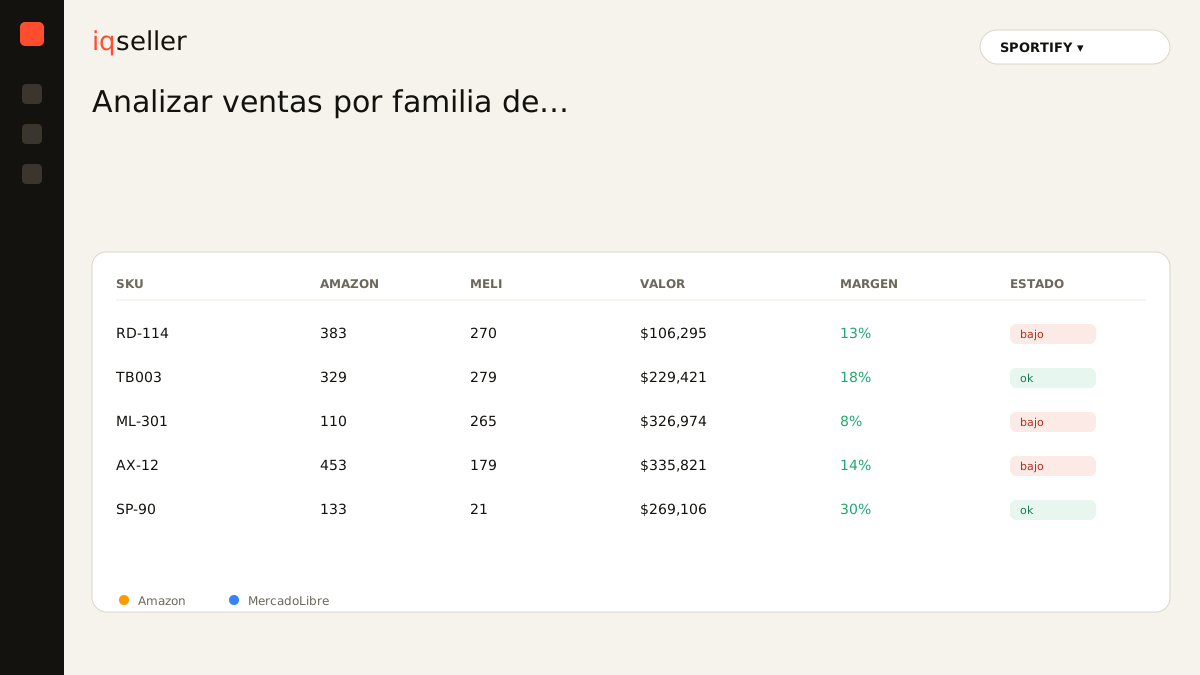
With a single source of truth, opening the module and picking a family immediately shows its sales curve, its comparison against the same period a year earlier, and its real margin, already unified across Amazon, MercadoLibre, and 3PL. You export nothing, paste nothing, normalize no names. The question stops being “can I assemble the data in time?” and becomes “what do I do with what I see?”.
That shift is the real goal. It is not about having one more dashboard, but about moving from deciding with yesterday’s snapshot and the uncertainty of Excel to deciding with today’s curve and the right comparison. The family tells you where your business is, the season tells you when to act, and the margin tells you whether it is worth it. Seeing them together, live and clean, is what turns analysis into an advantage.