
Average ticket and conversion: reading the right signals
April 2, 2026
There are two numbers nearly every seller checks daily and almost nobody reads correctly: average ticket and conversion rate. They sit at the top, in large type, on the Amazon Seller Central dashboard and on the MercadoLibre panel. They go up, they go down, and you react. But an average ticket that rises is not always good news, and a conversion rate that falls is not always a problem. The signal lives in the context, and the context almost never fits on a single screen.
The real trouble starts when you run more than one channel. Amazon’s average ticket does not mean the same thing as MercadoLibre’s, because the baskets, the fees, and the buying behavior are different. A new listing’s conversion is not comparable to a mature one’s. And when you also move stock from a 3PL, the “average” you see on each panel is computed over universes that never talk to each other. You end up exporting everything to Excel on a Sunday night, cross-referencing columns by hand, and making pricing decisions on Monday with Friday’s data.
This article is about reading those two metrics as a pair, not as two loose indicators, and why a single source of truth in real time completely changes what you decide to do with them.
what the average ticket actually tells you
Average ticket (AOV, average order value) is revenue divided by the number of orders. It sounds trivial, but it hides three things moving at once: how many units each customer takes, the price of those units, and the product mix that makes up each order. When the number rises, any of those three levers could have moved, and each one means something different for your business.
Suppose your Amazon average ticket climbs from 480 to 540 pesos in a week. Sounds like a win. But if what happened is that your cheap, high-rotation product ran out of stock, what you are seeing is not that you sell at higher prices: it is that you stopped selling what sold most. The average rose because the bottom of the distribution disappeared. It is the classic average trap, and on an isolated panel there is no way to catch it without opening the inventory report separately.
That is why the average ticket is only useful when you read it alongside order volume and basket composition. Raising the ticket while sacrificing orders can be profitable or disastrous depending on your cost structure. And in a multichannel setup, that cost structure lives somewhere else.
conversion is not one number, it is many
Conversion rate —visits that end in a purchase— suffers from the same problem, multiplied. On Amazon you measure it as sessions against units; on MercadoLibre the visit logic is different; and if you sell the same SKU on both, you have two conversions that are not directly comparable yet affect the same inventory.
A falling conversion can come from a thousand places: a competitor dropped the price, you lost the Buy Box, a recent negative review, a photo that vanished from the listing, or you simply entered low season for that product family. Unsegmented, “conversion dropped 2 points” is noise. Segmented by channel, by family, and by listing status, that same drop tells you exactly where to look.
Dictionary: ACOS tells you how much you spend on advertising for every peso of sales; a low conversion almost always inflates it, because you pay for clicks that never close.The point is that conversion and average ticket move in directions that matter to read together. An aggressive promotion lifts conversion but usually lowers the ticket. A bundle raises the ticket but sometimes slows conversion because it raises the price barrier. Deciding without seeing both at the same time is driving while looking in a single mirror.
the cost of having your numbers in four tabs
Here is the concrete pain of the multichannel seller. To answer one simple question —“did last week’s promotion leave me more margin or just more volume?”— you need: the average ticket before and after, conversion before and after, the cost of the promotion, the fees of each marketplace, and the stock that moved. That data lives in Amazon Seller Central, in MercadoLibre, in your 3PL, and in your cost sheet. Four sources, four formats, four different clocks.
What happens in practice is that nobody does that cross-check every week. It is too much manual work. So decisions get made from memory, from intuition, or worse: from whichever big number appears first. And since native panels show data with a lag —yesterday’s sales, sometimes the day before’s— you are optimizing the past.
A single source of truth in real time is not a cosmetic luxury. It is what turns “I think the promo worked” into “the promo lifted conversion 3 points but cut real net margin in half, we are not repeating it.” Average ticket and conversion only tell the truth when they sit next to cost and inventory, on the same plane and at the same hour.
reading the two signals as a pair
The productive way to look at these metrics is to cross them in a simple matrix. High ticket and high conversion is your golden zone: protect it. High ticket and low conversion is usually a price or value-perception problem —the product interests people but the customer does not close—. Low ticket and high conversion can be healthy (rotation) or a sign that you are leaving money on the table, selling cheap something that could bear more. Low ticket and low conversion is where dead inventory hides.
What is interesting is that each quadrant calls for a different action, and none is decided with a single number. The product with high ticket and low conversion may need a fine price adjustment, not a brutal discount; that is where an automatic price calendar lets you test small moves and watch the effect on conversion without rebuilding the table by hand each time.
Dictionary: real available stock is what you can genuinely sell today, already net of what is reserved or in transit; without it, your conversion can fall simply because the listing ran out and nobody noticed.the factor that is almost always missing: margin
There is a silent trap in optimizing ticket and conversion without watching margin. You can have a product with enviable conversion and a rising ticket that, once you subtract fees, advertising, shipping, and returns, leaves you with practically nothing. Conversion tells you the market wants it; margin tells you whether it is worth giving it to them.
Returns are the cruelest case. A product can convert beautifully and get returned 18% of the time, and that percentage does not show up on the sales panel where you watch conversion. We cover it in depth in returns: the hidden cost that kills your margin, but the idea for this topic is direct: the conversion you celebrate today can be the return you pay for three weeks from now.
Dictionary: real net margin is what is left after EVERYTHING —fees, advertising, logistics, returns, taxes—; it is the only figure that validates whether your ticket and conversion are building a business or just movement.That is why a good analysis of these two signals never ends with them. It ends with real net margin per SKU and per channel. Average ticket and conversion are the input signals; margin is the verdict. If your tool shows all three together, you stop guessing.
how iqseller approaches it
The proposal from iqseller here is not to give you another big number, but to take away the work of cross-referencing tabs. It connects Amazon, MercadoLibre, Shopify, and your 3PL on a single plane, computes average ticket and conversion by channel, by family, and by SKU, and places them next to cost and real available stock, all with real-time data instead of yesterday’s reports.
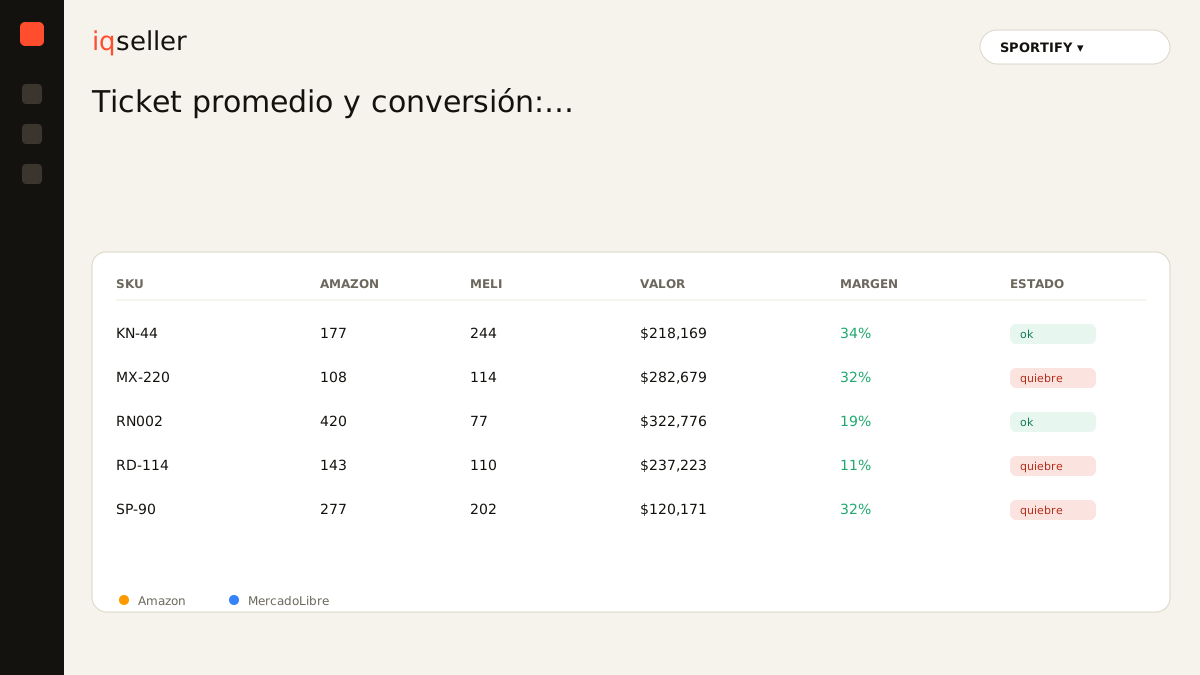
Think of a seller like SPORTIFY, moving the same product line across two marketplaces. Instead of exporting two panels and reconciling them in Excel, it sees at a glance that its conversion on MercadoLibre is high but its ticket low, while on Amazon it is the reverse. That reading —impossible to do quickly with the native panels— tells it where to raise price and where to improve the listing, without touching a single formula.
The goal is not for you to watch more metrics, but to read the right ones, together and on time. Average ticket and conversion are honest signals only when they share a screen with margin and inventory. Everything else is consolation statistics: a pretty average that does not tell you whether you made or lost money this week.