
Anatomy of a multichannel SKU: a case study
February 13, 2026
Let’s take a single product and open it up channel by channel. Not an abstract product, but a concrete one that SPORTIFY sells every day: a compression knee brace, size M, color black. One box, one code, something that fits in the palm of your hand. In your head it’s “the black medium knee brace” and that’s that. But if you chase it through the places where it actually lives, you discover that this knee brace isn’t one thing: it’s half a dozen things that look alike, each with its own number, its own price, and its own version of the truth.
The multichannel seller’s pain isn’t selling. It’s that the same product fragments the moment it leaves your warehouse. In Amazon Seller Central it’s an ASIN with its title, its Buy Box, and its FBA fees. In MercadoLibre it’s a listing with its MLM, its category commission, and its Full shipping cost. In your 3PL panel it’s an inventory line with an internal code nobody else recognizes. And at the end of the day, to pull it all together, you end up opening three tabs, copying figures into an Excel sheet, and deciding tomorrow’s pricing with yesterday’s numbers. The uncertainty doesn’t come from missing information; it comes from information that’s split apart and never lines up at the same second.
This article is a dissection. We’ll take that knee brace apart layer by layer —identity, cost, price, inventory, profitability— so you can see exactly where the math breaks when you do it by hand, and why having a single master SKU that gathers every layer in real time completely changes how fast and how confidently you decide.
layer 1: identity, or how many names one box has
Let’s start with the most basic problem, the one that looks trivial and ruins everything else: what is this knee brace called? The answer depends on who you ask. Your internal SKU says ROD-NEG-M. The Amazon ASIN is B0XXXXXXXX. The MercadoLibre listing is MLM-1234567890. The 3PL registered it as SP-00482. The supplier invoiced it with an EAN that, when you check, has one zero too many compared to the one you captured in Meli eight months ago.
Each of those codes is correct in its own context and none of them can talk to the others. When you sell 30 units on Amazon, that movement happens under the ASIN; your 3PL knows it as SP-00482; your Excel has it as ROD-NEG-M. To answer “how many black medium knee braces do I have in total” you have to mentally recognize that those four codes are the same box. You do it once, no problem. You do it across 300 SKUs and it eats your day, and a single typo is enough to add the stock of two different products as if they were one.
Identity is layer zero because everything else hangs from it. If you don’t first establish that those codes point to the same real product, no later metric makes sense: you’d be adding one channel’s apples to another channel’s oranges.
layer 2: cost, which is almost never a single number
Simple question: how much does this knee brace cost you? If you answer “what the supplier invoiced me,” you’ve only touched the first of several layers. Cost of goods is the floor. On top of it comes import freight prorated per unit, the 3PL’s storage cost for the time the box sat there, and shrinkage from damaged units you find at receiving.
And here’s the uncomfortable part: that total cost isn’t the same depending on the channel the knee brace ships through. If it goes via FBA, you carry Amazon’s fulfillment fee plus the monthly warehousing of the fulfillment center. If it goes via MercadoLibre Full, you carry the shipping cost Meli deducts based on weight and zone. Same box, same purchase cost, two different exit costs. When you do this in Excel, the usual move is to use an average cost and pray; the average hides the fact that one channel leaves you almost no margin while the other does.
layer 3: price, which moves on its own in each marketplace
Price is the layer that moves the most and ages the worst in your spreadsheet. On Amazon, the price that matters isn’t the one you set, it’s the one that lets you win the Buy Box; a competitor drops two pesos and suddenly your knee brace stops showing even though your “official” price is still there. On MercadoLibre the price carries the category commission on top, plus the decision to offer interest-free installments or not, which also costs you. The effective price —what actually reaches your pocket after everything— is different from the sticker price in each channel.
Keeping this up by hand is exhausting. You change the price in one channel, forget the other, and for a week you’re selling cheap where you didn’t mean to. That’s why it pays to treat price as something you plan and sync, not a number you tweak in a hurry; we develop this in the automatic price calendar, where each channel’s price stops depending on you remembering it.
Dictionary: the real net margin is what remains from a sale after subtracting cost of goods, channel fees, shipping, and taxes; it’s the only figure that tells you whether that SKU makes you money.layer 4: inventory, where the math becomes money
Here the anatomy stops being theoretical. SPORTIFY has 40 black medium knee braces in the 3PL warehouse. How many does it offer in each channel? The naive answer is 40 on Amazon and 40 on MercadoLibre, and that’s exactly how you oversell: you sell 30 on Amazon, you have 10 left for real, but Meli still shows 40 because it never heard about the sale on the other side. When order number 35 comes in from Meli, you have nothing to fulfill it with, and you eat a cancellation that hurts your reputation on that marketplace.
Inventory is the layer where the multichannel SKU proves why it needs a single source of truth. If those 40 units are one shared pool that gets deducted in real time wherever the sale comes from, the problem disappears. The hard part of doing it by hand is speed: by the time you’ve copied the number into your Excel, you’ve already sold three more.
layer 5: coverage, or how long this knee brace lasts you
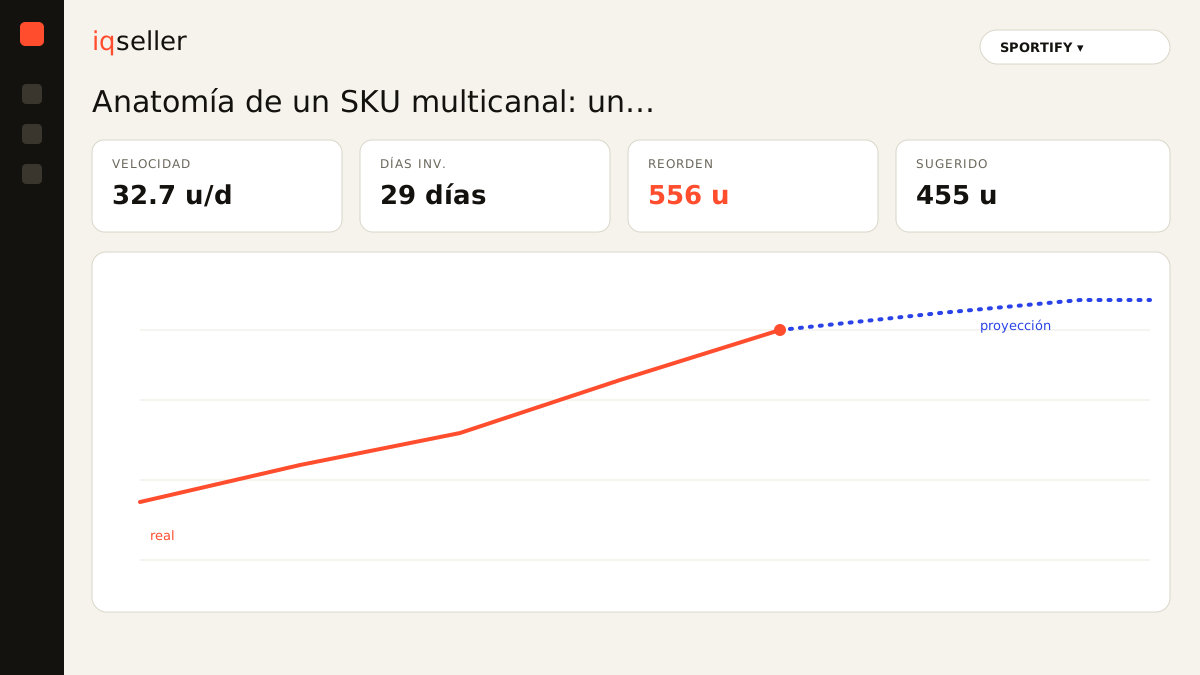
Knowing you have 10 units tells you nothing useful on its own. What you need to know is how many days they last at your current sales pace. If you sell 5 a day across both channels, those 10 units are two days of coverage: an emergency. If you sell one every three days, that’s a calm month. The raw stock number lies; days of coverage is what tells you whether you have to reorder today or can wait.
Dictionary: days of inventory measure how long your available stock lasts at the recent sales pace; they turn a unit count into a stockout date.And coverage is also multichannel: maybe you sell fast on Amazon and slow on Meli, so the same 10 units last differently depending on where they flow. A single source of truth lets you see combined coverage and per-channel coverage at the same time, without estimating it from memory.
putting the layers together: the complete knee brace
When you stack the five layers onto the same knee brace, only then can you answer the question that really matters: does this SKU make me money, and through which channel? Maybe the black medium knee brace is a star on MercadoLibre thanks to its moderate commission and a mediocre product on Amazon because FBA fees eat the margin. That conclusion is invisible if you look at the channels separately; it only appears when the SKU is one and the layers are aligned at the same instant.
That’s the deeper shift. You stop reasoning “listing by listing” and start reasoning “this product and its channels.” Decisions you used to make with yesterday’s data —raise price, move stock between channels, reorder from the supplier, pause a listing that’s losing— become today’s decisions, with the math already done. To go deeper on which numbers to look at each morning, check out the metrics a multichannel seller checks daily; this knee brace case is exactly the kind of object those metrics come alive on.
The anatomy of a multichannel SKU isn’t hard to understand. It’s hard to maintain by hand, because each layer lives in a different dashboard and changes at a different speed. Gathering them into a single real product, updated in real time, is what turns a forever-outdated spreadsheet into a decision you can defend.