
The metrics a multichannel seller checks daily
March 16, 2026
There is a routine almost every multichannel seller repeats each morning without noticing how expensive it is. You open Amazon Seller Central and look at yesterday’s sales. You switch tabs to MercadoLibre and check the numbers there. You log into your 3PL portal to see whether the restock arrived. Three dashboards, three different ways of counting the same thing, and a spreadsheet open in a fourth tab where you paste numbers by hand just to get a rough sense of how the business is doing. By the time that ritual is over, half an hour has passed and the only thing that is clear is that everything you just looked at is from yesterday.
The problem is not a lack of metrics. There are too many. Every marketplace hands you dozens of charts, panels, and reports. The problem is that none of them gives you the full picture, because none of them knows about the others. Amazon does not know how much you sold on MercadoLibre, MercadoLibre does not know what stock sits in your 3PL, and your 3PL does not know what fees each channel charged you. So the work of stitching it all together, the work that actually matters, lands on you, every morning, by hand.
This article is about the few metrics a multichannel seller really does check daily, why each one earns that attention, and why seeing them scattered across dashboards makes them nearly useless. The underlying idea is simple: you do not need more numbers, you need the same numbers gathered into a single source of truth, live and comparable across channels.
sales for the day, but summed across channels
The first metric everyone looks at is the obvious one: how much did I sell today. The catch is that “today” on Amazon and “today” on MercadoLibre rarely line up on the first try. Time zones, day cutoffs, and the way each channel counts cancelled orders all differ. Adding both channels’ sales by hand seems trivial until a refunded order inflates the figure or a time-zone gap shifts your cutoff by an hour.
What you actually need is not each channel’s total separately, but the consolidated sales of the day under the same definition for all of them. Once that number is unified, it stops being a vanity figure and becomes a signal: it tells you immediately whether the day is running above or below your average, without making you open three tabs to deduce it. Daily sales are only useful when you can compare them against your own history, and that requires the figure to be clean and joined.
real margin, not the sale price
Selling a lot is not the same as earning a lot, and that is the most common trap for the seller who only watches sales. A record day in units can leave you with less profit than a quiet one, if those sales concentrated in high-fee products, with expensive shipping or frequent returns. That is why real margin, what actually stays with you after commissions, shipping, ads, and returns, is the metric that separates the seller who survives from the one who only grows in revenue.
The obstacle is that each channel charges differently. Amazon has its FBA fee table, MercadoLibre has its category commission and shipping costs, and neither shows you the net margin of a product with everything combined. Computing it in a spreadsheet is possible, but it goes stale the same day you change a price. As we argued in data that does not drive a decision is noise, a margin calculated once a month is worthless: either you see it live, or you do not see it.
Dictionary: real net margin is what actually stays with you after fees, shipping, commissions, and returns, not price minus product cost.real availability, so you do not sell what you do not have
The second check of the morning is usually stock, and here the risk is selling air. The number each marketplace shows is not always what you can really ship: there are units reserved by orders in progress, units in transit that have not reached the 3PL yet, and units one channel has already committed while the other still counts them as available. If your stock lives duplicated across Amazon, MercadoLibre, and 3PL, sooner or later you sell a piece that does not exist and eat the cancellation, the refund, and the hit to your reputation.
Checking real availability daily means looking at one trustworthy figure per product, already net of everything committed, valid for all channels at once. That is exactly the problem solved by real-time inventory: when a sale on one channel decrements stock on all of them instantly, the metric stops lying to you. Without that join, checking inventory every morning is an exercise in faith, not control.
Dictionary: real availability is the stock you can truly sell today, already net of reservations and pending orders, the figure that keeps you from selling what you do not have.days of inventory, the metric that looks ahead
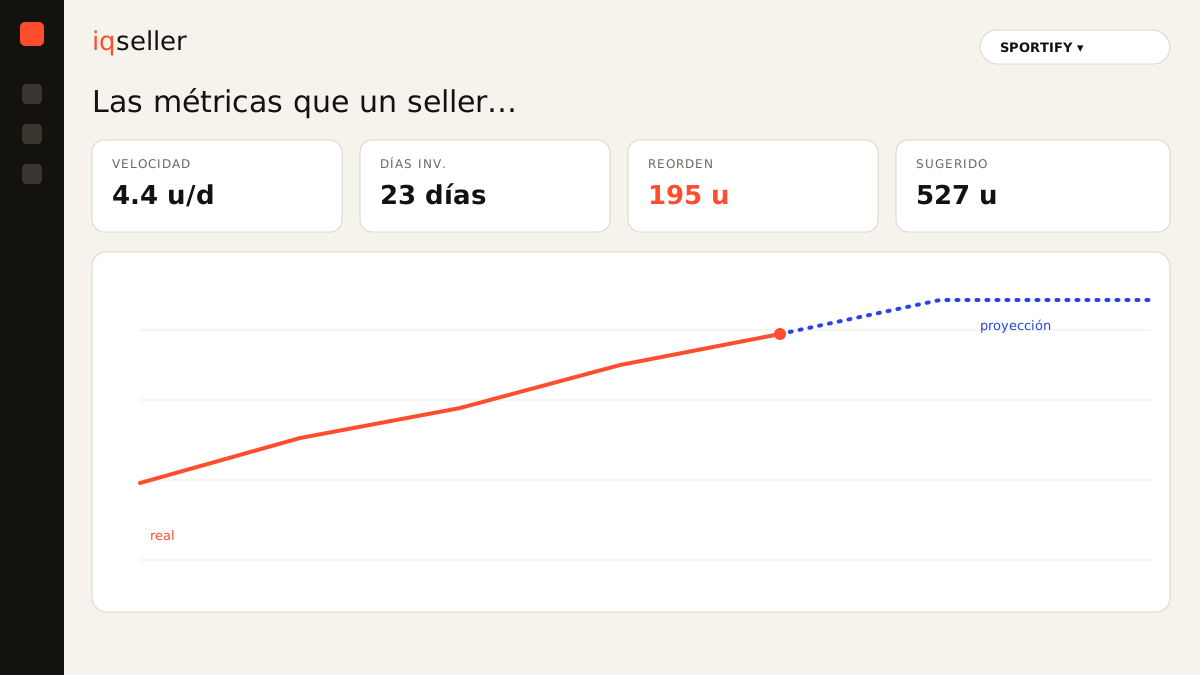
Knowing how many units you have left is half the story; the other half is how long they will last. Days of inventory crosses your available stock with your recent sales velocity and tells you, in a single figure, how many days remain before you run out. That is the metric that truly triggers a purchasing decision, because it translates the warehouse into time.
The calculation gets harder when you sell the same product across several channels at different rhythms. A SKU might last twenty days at Amazon’s pace but only eight once you add what goes out through MercadoLibre. Looking at it per channel deceives you; looking at it consolidated gives you the number that matters. For SPORTIFY, for example, telling the difference between “I have two hundred pieces left” and “I have six days left at the combined sales rate” is the difference between reordering on time or running out of its star product mid-peak.
Dictionary: days of inventory estimates how long your stock lasts at the current sales rate, the signal that tells you when to reorder before you stock out.pricing and buy box, because they change while you sleep
Price is not a static metric you set once: it is a battlefield that moves on its own. A competitor lowers their price overnight, you lose the buy box on Amazon, and your sales for that product collapse without you touching a thing. That is why checking your price position against the competition and your buy box status daily is part of any serious seller’s ritual.
The multichannel problem is that the same product can carry a different price on each marketplace, and a change in one should alert you on all of them. Without a unified view, you find out about the problem when sales have already dropped, not when the price moved. The pricing metric is only actionable if you see it in time and next to margin: dropping price to recover the buy box is pointless if it leaves you selling at a loss.
advertising and the cost of acquiring each sale
The last daily stop is advertising. Each channel has its own campaign console, its own spend report, and its own way of measuring return. Looking at Amazon’s ACOS in one tab and MercadoLibre’s in another, with no way to sum them against total margin, makes it nearly impossible to know whether your ad spend is building the business or burning it.
Checking daily how much you spent on advertising and how much you sold thanks to it only makes sense if you cross it with the real margin of the product you are pushing. A campaign with apparently good return can be losing money if the promoted product carries high fees. That cross, spend, attributed sales, and margin, all three together and per channel, is what turns advertising from a blind expense into a measured lever.
the difference is not the metrics, it is where they live
If you read carefully, none of these metrics is exotic. Sales, margin, stock, days of inventory, price, and advertising: every seller knows them. The difference between checking them with anxiety each morning and checking them with control is not which ones you watch, but where they live. Split across Amazon Seller Central, MercadoLibre, the 3PL portal, and a spreadsheet, each one tells you half a truth and forces you to join the rest by hand, with yesterday’s data.
Gathered into a single source of truth, live and comparable across channels, those same six metrics stop being a morning chore and become a thirty-second read. The goal is not to give you yet another dashboard, but to take away the three you already have and the spreadsheet that glues them together. When the numbers are clean, joined, and up to date, the question changes: it is no longer “will I manage to gather the information in time?”, but “what do I decide with what I am seeing?”. And that, in the end, is the only reason to look at a metric at all.