
Clearing season leftovers without giving away margin
November 9, 2026
There is always product left over after a season. However good your forecast is, you ordered to cover a peak, the peak behaved differently than projected, and by the second week of January you are holding boxes of something nobody is hunting for with the urgency they had two weeks ago.
The question that follows almost never gets asked properly. It gets asked as: “what do I dump this at?” It should be asked as: “does it cost me more to hold this for a year than to sell it cheap today?” Those are two different questions, and the second one has a numerical answer. The first only has an emotional answer, and post-season emotion always points the same way: get the problem off the shelf fast.
The cost of being wrong runs in both directions. Clear too much and you give away margin you had already earned, while training both the buyer and the algorithm to wait for your low price. Hold too much and you freeze capital for twelve months, pay storage all year, and risk the product reaching next December discontinued, in dated packaging, or simply out of fashion.
On top of that sits the usual information mess. The real cost of holding a unit lives in the fulfillment center’s rate card, the discount needed lives in your per-channel net margin, and turnover lives in your sales history. Three separate screens, normally, and one decision that needs all three together.
not all leftovers are the same problem
Before talking about price, classify. Treating all remaining stock the same way is the original mistake, because there are three kinds of leftover and each one has a different answer.
The first is the perishable seasonal leftover: product whose demand dies with the date and does not come back the same way next year. A dated themed item, a collaboration that already ran, a calendar. Holding almost never makes sense here, because the value drops on its own with time.
The second is the recurring seasonal leftover: the product sells mainly in season, but next year it sells exactly the same. A classic toy, a generic ornament, an undated gift item. Here holding is a legitimate financial option, and the decision is purely arithmetic.
The third is the continuous-turnover leftover that piled up because you overbought for the peak. That product keeps selling all year, just slower. It rarely needs clearing: stop replenishing it for a while and it stops being a problem.
Sorting your leftovers into those three buckets takes an afternoon and eliminates half the decisions up front. The second group is what actually needs deciding.
the calculation that decides: holding for a year costs this
For recurring seasonal leftovers there is a direct comparison. On one side, the carrying cost of the unit for twelve months. On the other, the discount you would need today to move it. If the required discount is smaller than the carrying cost, you clear. If it is larger, you hold.
Carrying cost has four components, and the typical mistake is counting only the first:
- Storage. The monthly fulfillment center or 3PL rate for the volume that unit occupies, multiplied by the months.
- Aged inventory surcharges. Amazon charges an additional surcharge once inventory reaches a certain age, on top of normal storage. The threshold and the rates change and vary by country, so confirm them in Seller Central before using them on your account; we already wrote about whether FBA storage is expensive in Mexico.
- Cost of capital. The money you paid for that unit is not available to buy one that actually turns. If you finance inventory, it is explicit interest; if not, it is the profit from the purchase you did not make.
- Shrinkage and obsolescence. Packaging that gets banged up, product that expires or gets discontinued, newer versions that make yours look old.
An example with invented figures, purely to see the mechanics. Suppose a SKU with a cost of 180 pesos, a list price of 399, and a full-price net margin of 72 pesos per unit. You have 400 units left. Storage for that volume runs 6 pesos per unit per month; twelve months is 72. Add 15 of expected aging surcharge and 20 of estimated cost of capital, and assume 3% shrinkage, another 5 pesos. Carrying that unit for a year costs roughly 112 pesos.
Now the other half. If moving the inventory today requires dropping to 299 — a hundred pesos of discount — clearing costs you 100 and holding costs you 112. You clear. If 40 pesos of discount moves it, holding would be worse still. But if moving it today would mean dropping to 229, that 170-peso discount is more expensive than the 112 of carrying it: holding is the right call, as long as the product is still sellable next year.
The value of the calculation is not this example’s result. It is that it turns a nervous debate into a subtraction. And it forces you to estimate something almost nobody estimates: how much discount that product actually needs to move, which is not the same as how much discount scares you.
Glossary: laddered offers, stepping down instead of dumping all at once →the limit the calculation cannot see: your profitability floor
The arithmetic above tells you what is worth doing. Your minimum profitable price tells you what you are allowed to do. They are different things and both deserve respect.
The floor is the price below which the unit no longer covers cost, commission, fulfillment, shipping and its share of advertising. Selling below that number is not clearing: it is paying to get rid of the product. Sometimes that is justified — when carrying cost is brutal or the product is going to die — but it has to be a conscious decision with the number in view, not a discovery at month-end close.
One detail slips past a lot of sellers: that floor is not the same in every channel. Amazon and MercadoLibre commissions differ, FBA and Full fees differ, and the weight of shipping changes. The same clearance price can leave you 4% margin in one channel and −7% in the other. Clearing at one flat price is the fastest way to find that out too late.
There is also a floor that is strategic rather than financial: the price at which you are willing for your product to be seen. If your January clearance becomes the reference point, getting back to normal price in March will cost you. It is the same logic as recovering price after the peak, just running in reverse.
clear in steps, not in one jump
The reflex is to set an aggressive dump price and hope it flies. That is an expensive way to clear, for two reasons. First: you do not know how much discount was actually needed, so you probably gave more than necessary. Second: an abrupt price drop is a strong signal to both the algorithm and the repeat buyer.
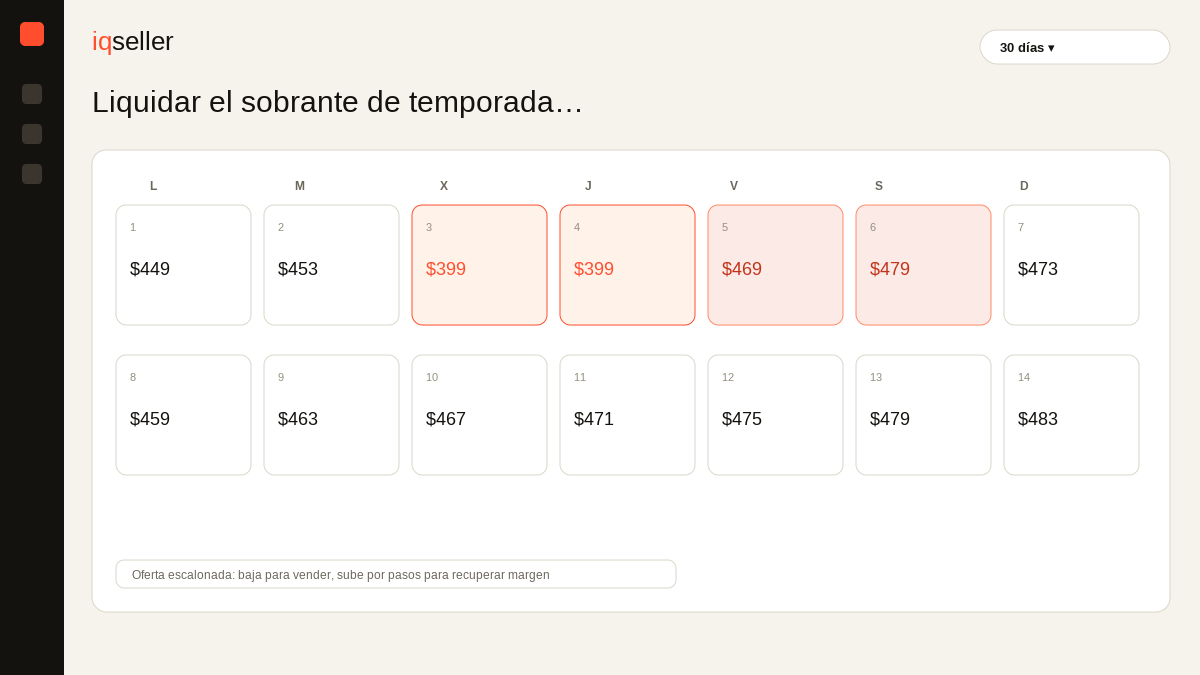
The cheaper path is to step down and measure each step. A modest first step, a week of watching units sold; if it moved enough to empty the lot within the window you set, you stay there; if not, next step. What you are hunting for is not “the lowest price,” it is the first price that achieves the turnover you need.
For that you need an explicit deadline before you start. “I want to clear 400 units in eight weeks” translates into 50 units a week, and that is a measuring stick: every step gets judged against that pace, not against the feeling that “it’s moving now.” Without a deadline, clearance stretches out until storage eats the discount you saved.
when holding is clearly the better option
Some scenarios tilt the calculation unambiguously toward holding, and it is worth spotting them quickly:
- The product is recurring seasonal and non-perishable, and last year’s demand for that date was solid.
- The leftover is small relative to your season sales. If three weeks of peak demand is what is left over, you will probably place it next year at full price.
- Storage cost is low by volume: small, light product, or inventory you can pull out of the fulfillment center into your own warehouse or a cheaper 3PL.
- The discount needed to move it today would take you below the floor or very close to it.
In that case, what matters is holding it well. Pull the inventory out of the expensive warehouse if that makes sense, document what it is and which date it is for, and put it into next cycle’s forecast as opening stock — not as zero. Held-back leftovers that nobody records are the ones that reappear next December, already carrying aging surcharges, after you bought the same thing again.
Watch it inside the channel too: inventory that sits for months can end up as stranded inventory on Amazon, with no active listing, accruing storage with no way to sell.
Glossary: real net margin, with everything deducted, which is what defines your floor →how iqseller helps with this decision
In the end this decision is the intersection of three data points: how much you have left and where, how fast it moves, and what it leaves you at each price. That is exactly what iqseller puts on one screen.
The Inventory module gives you real availability and valuation per warehouse, including FBA, Full and 3PL. Valuation is what tells you how much capital is parked in leftovers, which is the number that turns “I have product left” into a figure you can compare against carrying cost.
Profitability computes net margin per SKU and per channel with the COGS you load, the commissions from Amazon’s settlement and MercadoLibre’s orders, FBA and Full fees, shipping, advertising, and the VAT and withholding breakdown. That is where your per-channel floor comes from, and it is what keeps you from clearing below cost without noticing.
Pricing supports the laddered clearance per channel, and Analytics with its comparison views lets you see whether a step actually moved units or just lowered margin. Alerts flags it if the sell-through pace collapses mid-clearance.
What iqseller does not do: it does not compute each marketplace’s aged inventory surcharge or its current threshold for you — those rates change and get confirmed in Seller Central and MercadoLibre’s help center — it does not execute FBA removals, and it does not decide for you. It gives you the three numbers so the decision is a subtraction rather than a hunch.
the clearance that is not a fire sale
The real shift is to stop thinking of clearance as punishment for a bad forecast and start thinking of it as a capital allocation decision. You have money sitting in boxes; the question is whether that money returns more leaving today at a discount or waiting twelve months at full price. Framed that way, there are cases where the right answer is to hold without discounting a single peso, and others where clearing early and aggressively is correct. What there is not, is a general rule.
What you can have is the process: sort leftovers into the three buckets, calculate carrying cost per unit, know your floor per channel, set a deadline, and step the price down while measuring each step. Done that way, clearance stops being the moment the season’s margin evaporates and becomes the last profitable decision of the cycle.