
Minimum profitable price: your floor before competing
March 6, 2026
Every multichannel seller knows the moment. A competitor drops the price on a product you also sell, and the question turns urgent: do you match it or let it go? The temptation is to answer fast, match with one click, and move on with your day. The problem is that you rarely know, in that instant, how far you can actually go down before you start selling at a loss. You are competing blind, and the person who competes blind almost always gives up too much.
The minimum profitable price is the number that answers that question before it ever shows up. It is your floor: the lowest price at which you can sell a product, in a specific channel, and still cover every cost plus the minimum margin you decided to accept. Below that floor, every unit you sell makes you poorer. It is not an opinion or an aspirational target; it is a hard line that your real cost imposes on you.
It sounds obvious when you put it that way. The hard part is calculating it correctly and having it on hand at the exact moment you need it. Because that number is not a single value: it changes by product, it changes by channel, and it shifts every time a fee, a shipping cost, or your supplier’s exchange rate moves. The seller carrying it in a three-week-old spreadsheet does not have a floor; he has a memory of his floor.
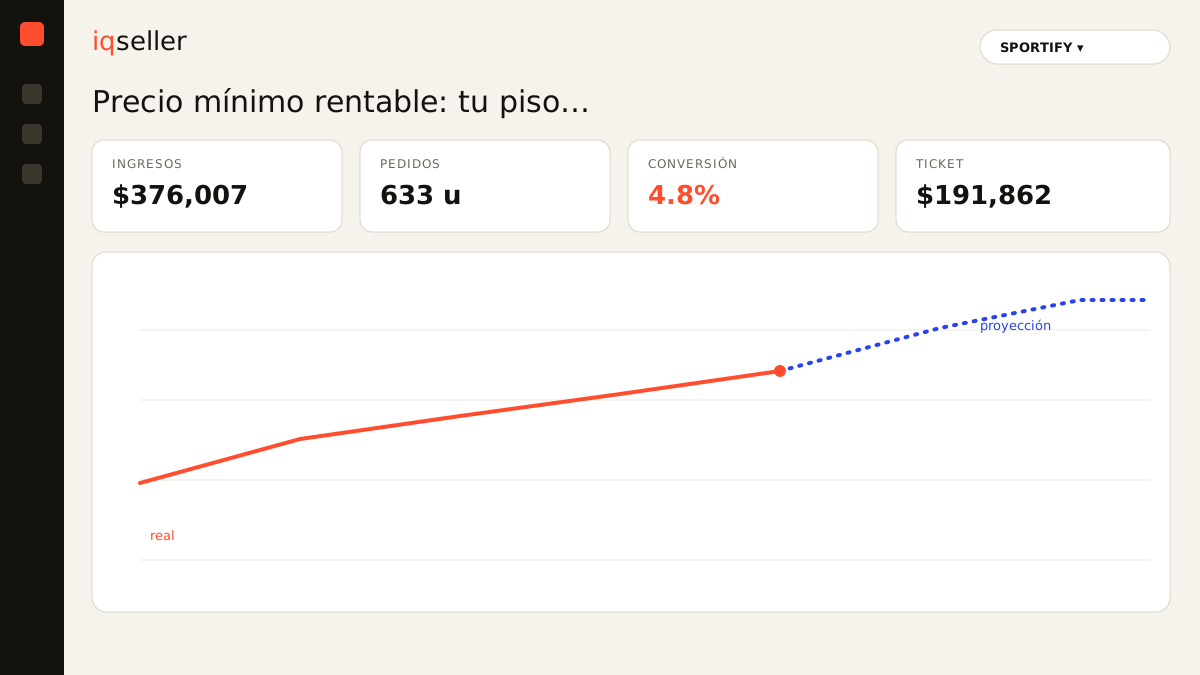
why your floor is not your purchase cost
The most common mistake is confusing the cost of the product with the price floor. You bought something for $180, so you assume any price above $180 leaves you a profit. That is not true, not even close. Between what you paid for the product and what actually lands in your account sits a layer of costs that eats a huge slice of the selling price.
On Amazon, the category referral fee, the FBA fee, storage, and, depending on the case, advertising. On MercadoLibre, the channel commission, the Full or shipping cost, and the installment charges you absorb. Add VAT, last-mile cost where it applies, and the proportional share of returns you know will happen. That $180 product may need to sell at $310 just to break even, and at $345 to leave you the minimum margin you decided was worth it. That $345 is your floor, not the $180.
Dictionary: what real net margin is and why it is the only thing that counts when setting your floor →the floor is different in each channel
Here is the trap that ruins the most pricing decisions: thinking you have a single floor for the product. You do not. You have a floor per channel, because Amazon’s fee structure and MercadoLibre’s do not look alike.
Picture SPORTIFY, a store selling a sports backpack on both marketplaces. Amazon’s referral fee in its category is a certain percentage, and the FBA fee depends on weight and volume. On MercadoLibre, the commission is different and Full shipping is calculated another way. The same product, with the same purchase cost, ends up with two different floors that can be tens of pesos apart. If SPORTIFY uses one number for both channels, it will give away margin on one and price itself out of contention on the other.
That is why the floor has to be calculated against each channel’s real net margin, not against a comfortable average. A price that keeps you healthy on Amazon can put you in the red on MercadoLibre, and the other way around. The floor is channel-specific or it is useless.
the pain of calculating it by hand
In theory, any seller can sit down and calculate their floors. In practice, almost nobody keeps them current, and the reason is pure operational fatigue. To build the real number you have to open Amazon Seller Central and write down the current fees, log into MercadoLibre and check the commissions on each listing, ask your 3PL for the month’s storage and fulfillment cost, and then paste it all into a spreadsheet you built yourself and only you understand.
By the time you finish, the data is already days old. And costs do not sit still: Amazon adjusts fees, the supplier raises the price, the exchange rate moves, MercadoLibre changes an interest-free installment promotion. Each of those shifts moves your floor, and your spreadsheet never finds out. You decide with yesterday’s numbers, which is only slightly better than deciding with no numbers at all.
You know how it ends: when the price war arrives, you do not check your sheet because you know it is stale. You match on instinct, and sometimes instinct takes you below the floor without you noticing until the month closes.
a single source of truth, in real time
The alternative is to stop rebuilding the number by hand and have a system that calculates it for you, with today’s real costs, for every product and every channel. That is what changes when your Amazon, MercadoLibre, and 3PL data live in one place instead of in three tabs and a spreadsheet.
When a channel’s commission changes, the floor recalculates. When the supplier raises the cost, the floor rises with it. When your 3PL reports a new storage rate, it is reflected. You are not maintaining a calculation; you are consulting a number that is always current. The difference between these two ways of working is the difference between competing with uncertainty and competing with firm ground under your feet.
And because the floor lives next to your inventory, another layer of judgment appears. Dropping to the floor to move a product with a lot of idle stock and high days of inventory can be a sensible move; dropping to the floor on something that is nearly out of stock is giving away margin for no reason.
Dictionary: how days of inventory change whether it makes sense to approach your floor →the floor turns a price war into a decision
Having the floor in view completely changes the dynamic of competing. When a rival drops, you no longer ask “how far can I go?” because you already know. The question becomes far more useful: is the price they are selling at above or below my floor?
If it is above your floor, you can choose to match, knowing exactly how much margin you are sacrificing. If it is below your floor, the decision is just as clear: you do not enter. That competitor is selling at a loss or has a cost structure you do not have, and following them to the bottom only means you both lose, but you lose first. The floor gives you permission not to fight battles you cannot win.
This connects to a broader idea of multichannel pricing worth mastering. If you want the full vocabulary, the seventeen terms every multichannel seller must master place the price floor in context alongside margin, contribution, and sell-through.
from the floor to a pricing strategy
The minimum profitable price is not the price you should sell at. It is the price you should not drop below. That distinction matters, because the floor does not tell you how to win; it tells you how not to lose. Everything else is built on that foundation: the laddered offer, the promotion calendar, the decision to match or hold.
A seller who knows their floors can be aggressive when it makes sense and firm when it is needed, because they always know where in the range they are moving. And one more thing: the floor must also respect your real available stock, because promising an aggressive price on inventory that is actually already committed is the recipe for selling cheap something you could not even deliver.
Dictionary: why your real available stock conditions how low you can go →The deeper shift is to stop improvising. The floor turns the most stressful moment in the business —the price war— into a calm decision with a number behind it. You do not sell more units by knowing your floor, but you stop selling units that cost you money. In a multichannel business where each channel pulls its own way, that clarity is what separates the seller who survives a price war from the one who starts it by accident.