
Product SEO: titles and bullets on Amazon and MercadoLibre
October 1, 2026
There is an uncomfortable moment nearly every seller runs into sooner or later. You search for your own product on Amazon using the term you assume shoppers type, and your listing is nowhere on the first two screens. You search for the same product on MercadoLibre and it does show up, but below three cheaper listings that got there first. Same product, similar price, healthy stock. What changed is what each search engine understood from your page.
The usual reflex is to stuff the title until it reads like a customs telegram: brand, model, color, size, material, use case, compatibility, two synonyms, a “free shipping” and a “best in Mexico”. Sometimes it works for a couple of weeks. It almost always ends in a title no human reads all the way through, a weak click-through rate and a conversion rate that erodes month after month. And on marketplaces, conversion is not just lost sales: it feeds the same algorithm that decides whether to keep showing you.
The deeper problem is that “product SEO” gets treated as one subject when it is really two disciplines running over the same catalog. Amazon’s search engine and MercadoLibre’s do not weigh the same things, do not read the same fields, and do not even share the same notion of what a listing is. Writing once and copy-pasting across channels is the fastest way to land mid-table on both.
This article is a practical map: which field matters on each side, what the current limits are — and why you should verify them before touching anything — how the two ranking systems differ, and how to actually measure whether a content change moved the needle or only moved your mood.
what each search engine is really trying to solve
Before talking about character counts, it helps to understand the job each platform is doing. Both engines share the same commercial goal — surface whatever is most likely to sell — but they get there differently.
Amazon organizes its world around the product, not the seller. One detail page, identified by its ASIN, can have several sellers competing for the Buy Box, and the content on that page is shared. That has a consequence many sellers learn late: if you sell a product that already exists in the catalog, you are not necessarily the owner of the title or the bullets. Textual SEO carries a lot of weight on Amazon because the engine has to decide, from the text, whether your page is relevant to what somebody typed.
MercadoLibre organizes its world around the listing and the seller. Your reputation, your fulfillment method and that listing’s conversion history enter the ranking equation alongside the text. That is why two listings with identical titles can land in very different positions: one belongs to a green-thermometer seller on Full delivering next day, the other to somebody with open claims and a two-day dispatch window.
That structural difference explains almost everything else. On Amazon you fight to be understood. On MercadoLibre you fight to be understood and to prove you deserve the slot.
Glossary: Buy Box, the purchase box that decides who sells →titles on Amazon: less room than you are used to
There is a big change here that reshaped how titles get written. In June 2026, in its Seller Central forums, Amazon announced an update that started rolling out on 27 July 2026: product titles in every category except media are capped at 75 characters, spaces included. The reasoning the platform gave is that this makes the full title visible on mobile and brings it in line with what other online stores use.
Alongside that cut came a new field, Item Highlights, with 125 additional characters for materials, features or recommended use cases. That content is searchable and appears below the title both in search results and on the detail page. In other words, Amazon did not remove room: it moved it into a different, more structured field.
For listings that stayed above the cap, Amazon said it would rewrite them automatically and gradually, and that brand owners would get a window in Review Listing Changes to review, edit or approve the proposed titles before they went live. If you run a large catalog, that is not a copywriting detail: it is a mass change that will roll straight over you if nobody is watching that queue.
Bullets — the bullet points in the feature block — remain the other indexed field you control. The detail page normally shows five. Amazon’s style guides have historically worked with a per-bullet range that tops out in the low hundreds of characters, and the platform’s practical guidance has trended toward short, scannable bullets that read well on a phone.
And here is the warning to take seriously: the exact limits vary by category and change often. The number that applies to your product lives in your category’s style guide inside Seller Central, not in a blog post. Before you rewrite three hundred titles, open your category guide and confirm the current cap. What we describe here is the general shape of the rules, not a substitute for the official source.
titles on MercadoLibre: sixty characters and an attribute sheet that carries weight
MercadoLibre works with a short title — the reference limit the platform uses is 60 characters — and with a recommended structure that is almost a formula: product, brand, model and then the attributes that genuinely distinguish the variant. No odd punctuation, no shouted capitals, no sales adjectives.
What matters is that on MercadoLibre the title does not carry the whole semantic load by itself. The technical sheet — the block of structured attributes: color, size, material, voltage, capacity, compatibility — is a first-class field. The platform insists, in its own seller guidance, on filling it in as completely as possible, because that is where the search filters come from. A shopper filtering by “material: stainless steel” is using your attribute sheet; if you left that attribute blank, you do not exist for them no matter how good your title is.
That is the most expensive mistake made on Meli: treating the attribute sheet as optional paperwork and dumping all the information into the description. The description is free text, it is useful for answering questions and giving context, but it is not where a filter finds you. Attributes are.
If you sell size and color variants, the logic multiplies. Each variant has its own attributes and the engine uses them to build the results page. A family with incomplete attributes looks, to the search engine, like a worse-defined product than the competitor who filled everything in.
how the two ranking systems actually differ
Summed up, and without pretending to reveal formulas that neither platform publishes:
- Amazon leans more on text and on the page’s own performance. Relevance between the query and your content, plus the click and conversion history of that detail page. The individual seller matters mostly for the Buy Box, less for whether the page surfaces at all.
- MercadoLibre folds the seller into the result. Reputation, shipping compliance, fulfillment type and that listing’s conversion history sit alongside page quality. You can have the best title in the country and still rank low with a yellow thermometer.
- Amazon separates content from stock. The detail page survives when you run out of inventory; you simply stop winning the Buy Box.
- MercadoLibre rewards listing continuity. A listing with clean history and accumulated sales starts ahead of a freshly created one. Deleting and republishing to “start over” is almost always a bad trade.
- Synonyms are handled differently. Amazon has backend search-term fields; MercadoLibre depends far more on the title and attributes matching the buyer’s own language.
None of this is static. Both marketplaces adjust their criteria without notice and frequently. The practical consequence is that no optimization is permanent: what lifts you today may be neutral in six months.
why the title that ranks is not always the one that converts
This is the point that costs the most money and gets discussed the least. Ranking and converting are not the same objective, and sometimes they get in each other’s way.
A keyword-saturated title increases your matching surface: you appear in more searches. But you also appear in searches that are not yours. The shopper who wanted something else sees you, does not click, and the engine records that your page does not resolve that intent. Over time that signal works against you.
Worse: if that shopper does click and then does not buy, the damage doubles. You spent an impression, you spent a click — which cost real money if it came from ads — and you taught the algorithm that your page does not close. Badly qualified traffic is expensive even when it is organic.
There is a third, quieter effect: a badly qualified title attracts the wrong buyer, and the wrong buyer returns the item. A return is not only the logistics cost; on MercadoLibre a claim that reaches mediation touches your reputation, and your reputation touches your position in search. The loop closes against you.
The healthy rule is uncomfortable because it forces you to give something up: the title has to earn the click of the right buyer, not the click of the largest number of buyers. Broad synonyms have their place — in Amazon’s backend search fields, in secondary attributes — but not in the line that decides whether somebody walks in.
Glossary: real net margin, with everything deducted →how to measure a content change without fooling yourself
Changing a listing and staring at the next three days of sales is not measuring: it is reading noise. These are the minimum conditions for the comparison to mean anything.
- Change one thing at a time. If you touch the title, the main image and the price on the same Tuesday, you will not know which one moved the number. And the price almost always takes the credit.
- Respect a full cycle. If your product sells ten units a week, two days tell you nothing. You need at least a couple of comparable weeks, with no Buen Fin, no Hot Sale, no stockout in the middle.
- Compare against the same period on the channel, not against your memory. September seasonality and November seasonality are not the same animal.
- Look at the whole funnel, not only sales. A new title can raise clicks and lower conversion: that is a title that attracts worse. The aggregate “I sold more” hides it.
- Confirm there was no stockout. If the SKU went dry for three days, the experiment broke and there is nothing to interpret.
- Write down the date of the change. It sounds obvious and it is the step nobody takes. Without a change date there is no before and after.
Amazon also offers its own A/B testing tool for content, Manage Your Experiments, available to professional sellers with a brand enrolled in Brand Registry and subject to the product having enough traffic to produce statistically meaningful results. When it applies, it is the cleanest way to compare two versions. When it does not — because the product sells too little, or because you are on MercadoLibre, which has no equivalent — you do it by hand and with discipline.
how this reads in iqseller
Worth saying plainly: iqseller does not edit your listing content and does not write copy. It does not draft titles, it does not generate bullets and it will not suggest keywords. That work stays with you, in Seller Central and in Meli’s listing manager.
What the panel does is the job next door — the one that makes everything else measurable.
In the Catalog module, the Parent → Model → SKU tree ties the real product to all of its listings on every channel. That is what lets you see, side by side, that the same SKU is published with different attributes on Amazon and on MercadoLibre, or that a variant exists on one channel and not the other. Listings that drifted out of alignment across channels stop being an accidental discovery and become something you review.
In Alerts you set up warnings when something moves out of range — including cross-channel discrepancies — so you hear about it the same day instead of at month-end close.
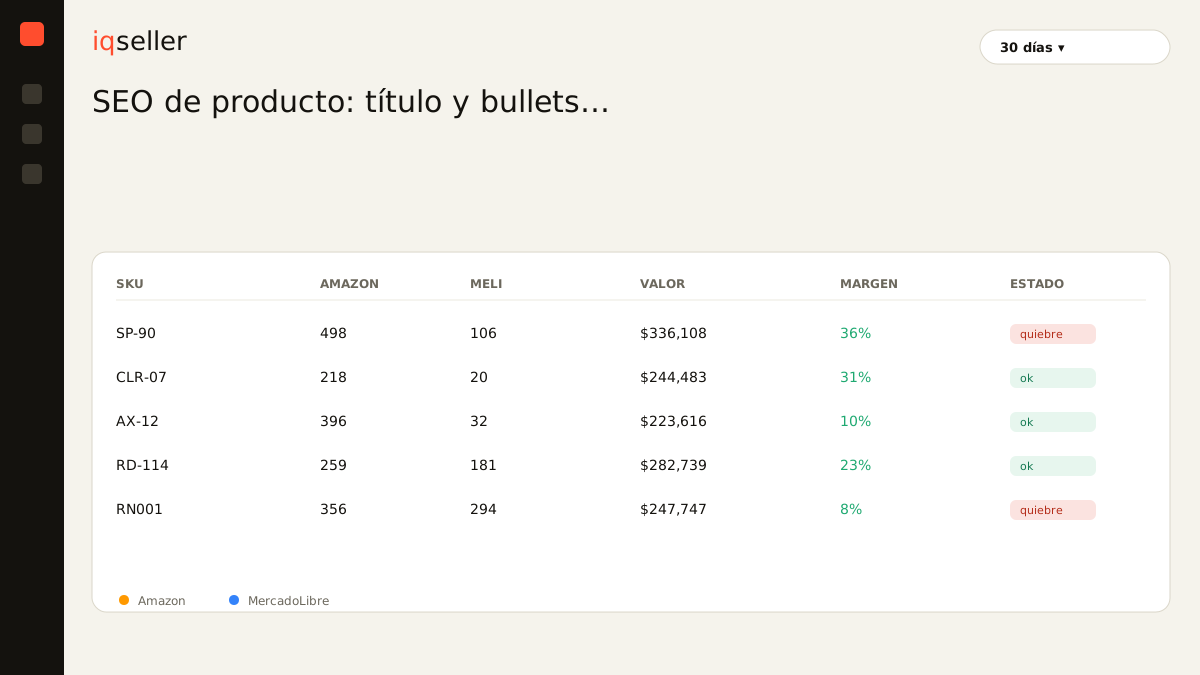
And Profitability is the judge of the experiment. When you change a title and want to know whether it worked, the panel gives you, per SKU, the units, the orders, the average ticket and the real net margin built from the COGS you loaded, the commissions from Amazon’s settlement and from MercadoLibre orders, FBA and Full fees, shipping, advertising and the VAT and withholding breakdown. That is where you see whether the new listing sold more units at a worse margin, which is the most common outcome and the one nobody wants to look at.
Inventory closes the picture with the one data point that invalidates experiments: if the SKU had no real available stock during the period you are comparing, there is no conclusion to draw.
the minimum checklist before touching the catalog
- Open your category’s style guide in Seller Central and MercadoLibre’s seller help, and confirm the current limits. They change often and they vary by category.
- If you sell on Amazon, check the listing-changes queue. Auto-rewritten titles approve themselves when nobody looks.
- Fill MercadoLibre’s attribute sheet to one hundred percent before fighting with the title. It is the field with the best return per minute invested.
- Write for the right buyer and save broad synonyms for the fields nobody reads.
- Change one variable at a time, note the date, and compare at least two clean weeks.
- Close the loop on margin, not only units. A listing that sells more at a worse margin is not an improvement: it is a bigger problem.