
RESICO or Digital Platforms: Which Tax Regime Applies to You
October 13, 2026
“I’ll switch to RESICO and pay 1% instead of all this.” It’s one of the most repeated lines among Mexican sellers, usually right after looking at a fortnightly deposit and discovering how much went to withholdings. It sounds logical: Mexico’s Simplified Trust Regime charges between 1% and 2.5% on income, without the complication of deductions or heavy monthly paperwork. Compared to the general regime, it looks obviously better.
The problem is that, for anyone selling on MercadoLibre or Amazon, that decision isn’t available. It’s not that it isn’t worth it: the law excludes it categorically. And the confusion is expensive, because there are sellers who registered under RESICO believing they were optimizing and ended up in a regime that doesn’t apply to them, with tax authority notices and a correction that costs far more than they thought they were saving.
This article explains why, which regime actually applies, and where a legitimate decision is still left. As with everything tax-related, this is material for arriving prepared to your accountant, not for replacing them.
what RESICO is and why everyone wants it
The Simplified Trust Regime for individuals was designed for small taxpayers, with the promise of being easy and cheap. Two traits make it attractive:
Low, progressive rates, calculated on income collected — not on profit — which for 2026 remain the same as the previous year:
- Up to $25,000 monthly: 1.00%
- Up to $50,000: 1.10%
- Up to $83,333.33: 1.50%
- Up to $208,333.33: 2.00%
- Up to the equivalent of $3,500,000 annually: 2.50%
Simplicity: no deductions to document and a direct calculation on what you collected. The regime’s ceiling is $3,500,000 of annual income; exceed it and you’re out.
Seen that way, a seller billing $2,000,000 a year would assume they’d pay 2.5% and be done. That’s where the enthusiasm comes from.
why it doesn’t apply if you sell on a marketplace
The exclusion is explicit and rests on three legal supports worth knowing by name, because they’re the ones your accountant will cite:
- The final paragraph of article 113-E of the Income Tax Law.
- Rule 3.13.3 of the Miscellaneous Tax Resolution.
- The official tax authority FAQ on RESICO, specifically questions 43 and 59.
The criterion states that the simplified regime is unavailable to anyone earning income “through the Internet, via technological platforms, software applications and similar.” Selling on MercadoLibre or Amazon falls squarely within that definition.
And here’s the detail almost nobody knows, and the most important one in the whole article: the exclusion operates even if only part of your income comes from platforms. You don’t need to sell exclusively on a marketplace to be disqualified. If you have your own store billing well and you also sell on MercadoLibre, that MercadoLibre income takes you out of RESICO entirely — not just for that portion.
It’s an all-or-nothing rule, and it’s why the “I’ll put marketplace income under platforms and everything else under RESICO” strategy doesn’t work.
so which regime applies?
The one that applies is Business Activities with income through Technological Platforms, code 625, governed by articles 113-A through 113-D of the Income Tax Law and article 18-J of the VAT Law.
Under that regime, the platform withholds and remits part of your taxes on every sale. For 2026, with your tax ID properly registered:
- Income tax: 2.5% of gross revenue before VAT
- VAT: 8%, half of the 16% you charged
One irony is worth noting: the 2.5% income tax withholding under the platform regime is exactly RESICO’s top rate. The difference is that under RESICO that 2.5% would apply only to the highest bracket, whereas under the platform regime it’s withheld flat from the first peso. For a small seller, that’s more than they’d pay under the other regime — and that’s precisely the frustration that starts the question. But the comparison is academic: the option doesn’t exist.
Glossary: real net margin, with everything deducted →where there is a decision to make
The regime being determined doesn’t mean there’s nothing to decide. There are three real decisions, and they’re the ones worth the conversation with your accountant.
First: the $300,000 threshold. If your annual platform income is below that figure, you can elect to have the withholdings be your definitive payment and stop there, with no monthly filings for that income and no deductions. If you exceed it, you move to provisional payments, file monthly and can deduct. That election completely changes your administrative burden and, depending on your cost structure, your tax burden.
Second: individual or legal entity. The platform regime’s withholdings are designed for individuals. Operating as a legal entity changes the entire scheme: a different withholding mechanic, different obligations, different bookkeeping and different structural costs. For a business already billing several million a year, that comparison is usually the conversation that genuinely moves the needle.
Third, and the most neglected: documenting your deductions. If you’re above the threshold and entitled to deduct, every expense without an invoice is margin given away. Your cost of goods, marketplace commissions, logistics, advertising, software — all of it is deductible and creditable if properly documented. The seller who never requests tax receipts for their commissions is paying tax on profit they never had.
what if I also sell on my own store?
This is the most frequent follow-up question, and it deserves its own section because the answer surprises almost everyone.
The typical scenario is a business selling on MercadoLibre, on Amazon and on its own Shopify store. Intuition says the direct Shopify sales — where no intermediary withholds, because the site is yours — should be able to file separately under RESICO, while the marketplace income goes under the platform regime.
It doesn’t work that way. The article 113-E exclusion is about the taxpayer, not about each income source. It’s enough for part of what you earn to come from platforms for RESICO to become unavailable for all of your business income. There is no mixed regime.
The practical consequence matters for anyone building their own channel: opening a D2C store is a great business decision for many reasons — customer ownership, margin without commission, a single inventory across channels — but it isn’t a route to changing regimes while you keep selling on a marketplace. The benefit of your own store is commercial and margin-related, not fiscal.
What a direct channel does change is the mix of your income, and that does affect what gets withheld in absolute terms: withholding only applies to what passes through the platforms. If half your sales migrate to your own store, half your sales stop generating withholding — though you still owe the income tax and VAT on that revenue, and now it’s on you to calculate and remit it.
what happens if you registered incorrectly
If you’re already under RESICO and have platform income, the situation isn’t catastrophic but it is urgent. What usually happens is that the tax authority detects the inconsistency — because the platforms report your income — and reclassifies you, with the adjustments and surcharges corresponding to the period you filed where you shouldn’t have.
The practical recommendation is not to wait for the notice: voluntary correction is almost always cheaper. And this is exactly the kind of issue where specific advice pays for itself, because the details of your case — how long, what amounts, what other income you have — change the remedy.
what you do control: knowing your real number
There’s a part of this story that depends on neither the regime nor the tax authority, and it’s the one most often broken: many sellers don’t know their real profit, so they can’t evaluate whether their tax burden is high or whether their margin is simply thin.
It’s an important distinction. If your contribution margin per order is 8% and 10.5% of gross is withheld, your problem isn’t primarily fiscal: it’s price, mix or costs. No regime fixes a catalog that doesn’t make money.
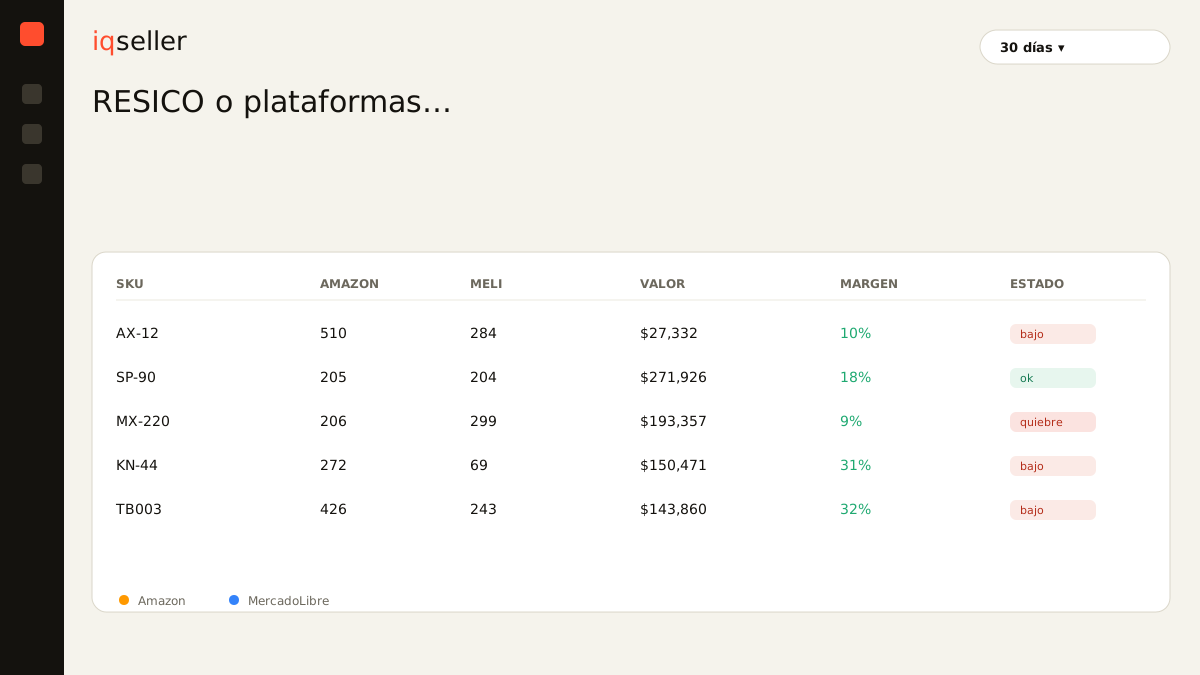
In iqseller that reading lives in the Profitability module. The panel starts from the base excluding VAT, deducts the COGS you uploaded, each channel’s actual commission taken from the settlement, fulfillment fees, shipping and advertising, and delivers net margin per SKU and per model. Next to that sits the tax breakdown: the VAT charged and what each platform withheld, with the figure from each channel’s own report.
Having those two figures separated — what the product earns and what’s being withheld — is what turns the tax conversation into a conversation with numbers. You arrive at your accountant knowing how much you actually make and how much is parked, instead of arriving with a feeling that “something is leaking.”
Glossary: inventory valuation, how much capital is tied up →the summary
For a marketplace seller in Mexico, the map looks like this: RESICO is not an option while you have platform income, even partial. The regime that applies is technological platforms, code 625, with 2.5% income tax and 8% VAT withholding in 2026.
The decisions that are genuinely yours are the treatment of withholdings under the $300,000 threshold, the legal form you operate under, and how disciplined you are about documenting what’s deductible. None of the three gets settled by reading a blog — this one included — but all three go far better when you arrive holding your real margin.
The legal grounds cited here are public and verifiable, and they’re the right starting point for that conversation. The rest belongs to your accountant, who knows your full situation.