
The 72 hours before Buen Fin: a last-minute checklist
November 4, 2026
Buen Fin 2026 is the sixteenth edition and, according to the dates circulated by the organizers and the Mexican press, it runs from Friday November 13 through Tuesday November 17: five days, with Monday the 16th as a public holiday because it falls on the third Monday of November. Which means that by the time you read this, what is left is not a month of preparation. What is left is a few hours of verification.
That is the problem with almost every Buen Fin checklist going around: it asks you for things you can no longer do. “Calculate your margin per SKU.” “Clean up your catalog.” “Define your per-channel pricing strategy.” All of that is correct and all of that gets done in September. Three days out, asking a seller to rebuild their cost structure is asking them to make big changes with little information and less time, which is exactly how expensive mistakes happen.
The last 72 hours work differently. They are not for building. They are for verifying, freezing and staging. Verifying that what you already decided is actually reflected in each channel. Freezing whatever must not move, so nobody moves it by accident under pressure. And staging whatever you will need to look at once traffic is on top of you and there is no time to go hunting for it.
This checklist is ordered that way on purpose. If something on the list fails verification and cannot be fixed in three days, the right answer is not to force it: it is to pull it out of the event. Entering Buen Fin with forty healthy SKUs beats entering with a hundred and twenty when you do not know which ones lose money.
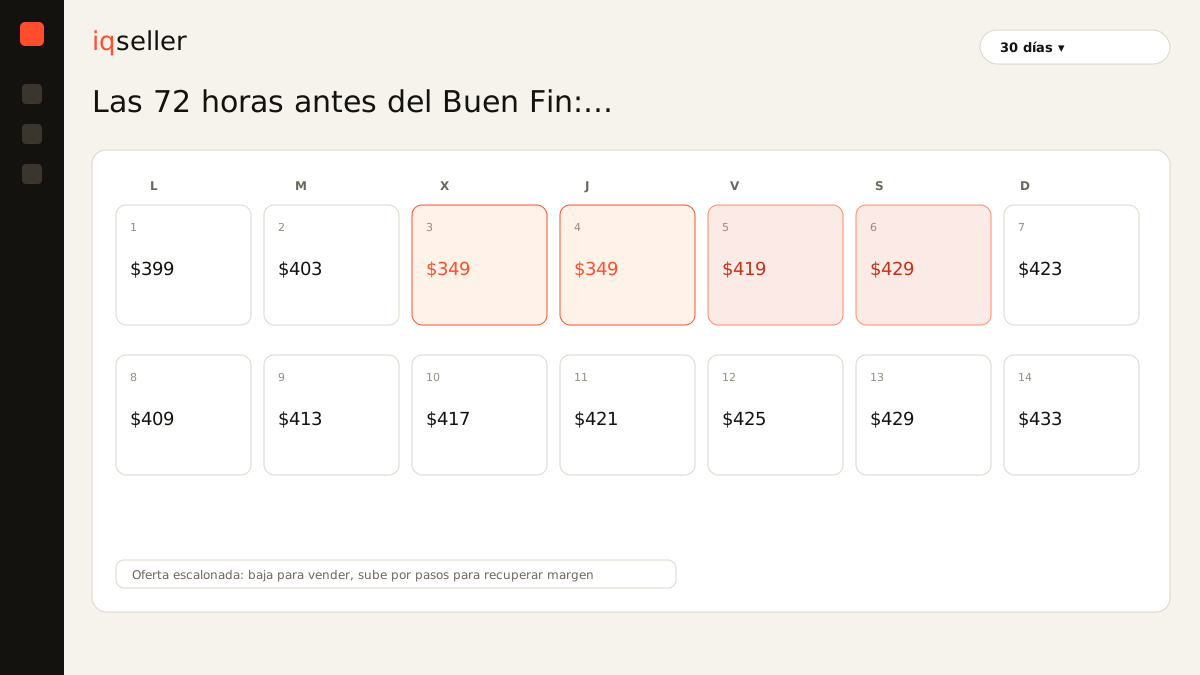
what actually fits in a 72-hour window
Before the list, separate what fits from what does not. What fits is anything that means reading, comparing and correcting a single value: a price loaded wrong, a listing publishing stock that does not exist, an alert with no recipient. Those are minute-level fixes with immediate payoff.
What does not fit is anything that depends on a third party or that changes the structure of your data. Sending new inventory to a fulfillment center and trusting it will be available on Friday does not fit, because receiving has its own clock and you do not control it. Reorganizing the variant tree of a parent product does not fit, because channels take time to reindex and you can end up with orphan listings on the highest-traffic day of the year. Switching a SKU’s fulfillment model does not fit.
If any of that is pending, write it down for December and move on. The goal of these three days is that Friday the 13th starts without surprises, not that you arrive perfect.
There is one administrative item that is genuinely calendar-bound and deserves its own check: registering your business with the Buen Fin organizers has its own cutoff, which in the information published for 2026 fell the day before the event opened. If you also sell offline or invoice under your own brand and you care about appearing in the official listings and the tax raffle, confirm it on the official Buen Fin site before anything else on this list, because it is the only item you cannot fix afterwards.
verify that the stock you publish actually exists
This is item one for a reason: it is the one that costs the most money and the easiest to check. The question is not how much inventory you have. It is whether the number each channel is publishing matches what you can actually ship.
Take your twenty highest-expected-volume SKUs and compare three figures for each: what your warehouse or logistics operator says, what the Amazon panel says, and what the MercadoLibre panel says. If the three disagree, the one that matters is the smallest, and that is the one both channels should be publishing. A SKU with sixty physical units showing sixty on Amazon and sixty on MercadoLibre is publishing a hundred and twenty units that do not exist.
Check the inventory that is counted but not sellable, too: units reserved by orders already placed, units in transit that have not landed, units blocked by a listing issue. Those inflate the total and will not help you sell on Friday.
Glossary: real available stock, what you can genuinely sell right now →freeze the catalog and put it in writing
Freezing the catalog means agreeing that from a specific moment on, nobody touches titles, attributes, codes, variant structure or new product creation until the event ends. This is not bureaucracy: an attribute change on Thursday can take a listing down on Friday, and nobody will understand why it stopped showing exactly when the traffic arrived.
Set the freeze with a date and a time, tell everyone with panel access, and define what is still allowed: adjusting price inside the approved range, adjusting stock, pausing a problem listing. Everything else waits. If somebody spots something worth fixing, it gets logged and done on November 18.
The same logic applies to integrations. If you were planning to connect a new channel or switch tools, this is not the week. Any migration brings a settling period and that period should not land on the peak of the year.
review the price floor, not the discount
Almost everyone arrives at this week with the discount decided and the floor unreviewed. It should be the other way around. The discount is a commercial decision; the floor is an arithmetic constraint, and it is the only thing protecting you from selling at a loss without noticing.
Take a concrete case, as an example. A product listed at 899 pesos with a landed cost of goods of 320. The channel’s referral commission, say 15 percent for its category, is 134.85 pesos, and the fulfillment fee is 65. Costs add up to 519.85 and margin lands at 379.15 pesos, 42.2 percent of price.
Now apply the 25 percent discount you had already decided on: price drops to 674.25. The commission, being percentage-based, drops to 101.14, but cost of goods and the fulfillment fee do not move. Costs add up to 486.14 and margin falls to 188.11 pesos, 27.9 percent. Still healthy. But if that SKU will carry advertising during the event and you expect to spend the equivalent of 10 percent of the selling price, that is another 67.43 pesos and real margin ends at 120.68 pesos, 17.9 percent.
That 17.9 percent is the number you are actually entering Buen Fin with, and it is the one to compare against your floor. The commission percentages in the example are illustrative: real rates vary by category and by channel, and it is worth confirming them in Seller Central and in MercadoLibre’s help center, because they get updated. If a marketplace promotional program charges an extra fee to participate or requires a minimum discount, that goes into the math too, before you approve the price.
stage the alerts before the first click
During the event you will not have time to go looking for problems: you need problems to come looking for you. That is what alerts are for, and the 72-hour window is when you configure them and, above all, when you test them.
Three alerts are worth more than ten. First, critical stock per SKU, with the threshold recalculated for event velocity rather than for an average Tuesday: if a product normally sells six units a day and will sell forty at peak, a fifteen-unit threshold warns you when it is already too late. Second, cross-channel price discrepancy, so you find out when a drop applied on one side and not the other. Third, sync failure, because an integration down for four hours on a Saturday is an overselling incident waiting to happen.
Test that they arrive. An alert wired to an inbox nobody opens on a weekend is not an alert. Decide which phone it reaches and who owns it in each shift.
write the restock plan and the kill plan
Two plans get written in advance and executed without debate. The first is internal restock: what you do when a SKU approaches depletion. Do you have units in another warehouse you can reassign? Can you move stock between channels? Is there an equivalent product you can push instead? Deciding this at noon on Saturday with the phone ringing does not go well.
The second is the kill plan: at what point you pull a SKU out of the event. It can be for stock, but it can also be for margin. If mid-event you discover a product is selling hard and leaving less than you calculated, the plan should already say whether you raise its price, pull it from the promotion or let it run as a loss leader. Writing it beforehand turns an emotional decision into a rule.
Glossary: price calendar, scheduled drops and raises with dates →agree on who decides what
The last item is not about data, it is about operations. Five days with a holiday in the middle means shifts. Define who watches which window, who can authorize a price change outside the approved range, and who an overselling incident escalates to.
Leave a simple log, too: time, what changed, who changed it and why. It is not for auditing anyone. It is so that on November 18, when you analyze results, you can tell the difference between what happened because of demand and what happened because somebody moved a price at eleven on Saturday night.
what this verification looks like in iqseller
In iqseller this list stops being a tour of five panels. The Inventory module shows stock by warehouse, by Amazon fulfillment center, by Full and by 3PL in the same view, with real available already netted out, so comparing the three numbers from item one means reading one row instead of opening three tabs.
The Profitability module computes net margin per SKU with the COGS you load and with what is actually deducted: commissions from the Amazon settlement, commissions on MercadoLibre orders, FBA and Full fees, shipping, advertising, plus the VAT and withholding breakdown. That is the number you use to validate the price floor from the example above, with your figures instead of estimates.
The Pricing module holds the per-channel calendar of drops and raises, and Alerts sends the critical-stock and price-discrepancy notices. The Parent, Model and SKU tree is what lets you see whether the depletion is in one size or in the whole product.
What iqseller does not do is execute the physical restock or negotiate with your logistics operator. It also does not invent a Buen Fin participation policy: the rules of each promotional program are set by the marketplace and have to be read there. What it does is make sure that when you look at a number, it is the same number everywhere and it is current.
the checklist, on one page
To close, the short version, in the order worth doing it. Confirm registration with the organizers if it applies to you, since it is the only item with an external deadline. Verify real available stock for your top twenty SKUs against what each channel publishes, and correct downward. Freeze the catalog with a date and time, and tell everyone with access. Review the price floor of every promoted SKU including advertising, not just the discount. Recalculate critical-stock thresholds for event velocity and test that alerts reach a phone somebody will look at. Write the restock plan and the kill plan. Assign shifts and open the log.
None of this is spectacular, and that is exactly why it works. Buen Fin is not won with a brilliant idea on Friday morning. It is won with the boring list you made on Tuesday that spared you the three things that actually cost money.