
Día de Reyes: the second peak almost nobody plans for
November 8, 2026
Almost every ecommerce playbook assumes a calendar that is not yours. Black Friday, Cyber Monday, Christmas, and then “slow season.” In Mexico that script is incomplete: between El Buen Fin and January 6 there is not one peak, there are two. The second one has its own buying rhythm, its own winning categories and its own logistics, and almost nobody plans it as a separate event.
The outcome repeats every year in the same places. The seller closes December with inventory scraped clean, exhales, and then runs straight into a week where parents buy toys, bikes, tablets and consoles with genuine urgency, because the date does not move and the letter to the Three Kings has already been written. That week finds them out of stock on the right SKUs, with the marketplace warehouse closed for inbound, and the supplier on holiday until mid-January.
The trap is not that Día de Reyes exists. The trap is the distance: there are barely three weeks between the Christmas peak and the Reyes peak, and a normal replenishment cycle does not fit in that gap. If your lead time is four weeks from placing the order to having the unit sellable, the decision about what you will sell on January 5 was already made in November, whether or not you realized you were making it.
And there is a quieter second problem: after Reyes comes the thinnest month of the Mexican calendar. So you are planning a short peak, with replenishment effectively impossible, followed by a drop. Three chained decisions — how much to bring in, when to stop, and what you get stuck with — and each one depends on numbers that rarely live on the same screen.
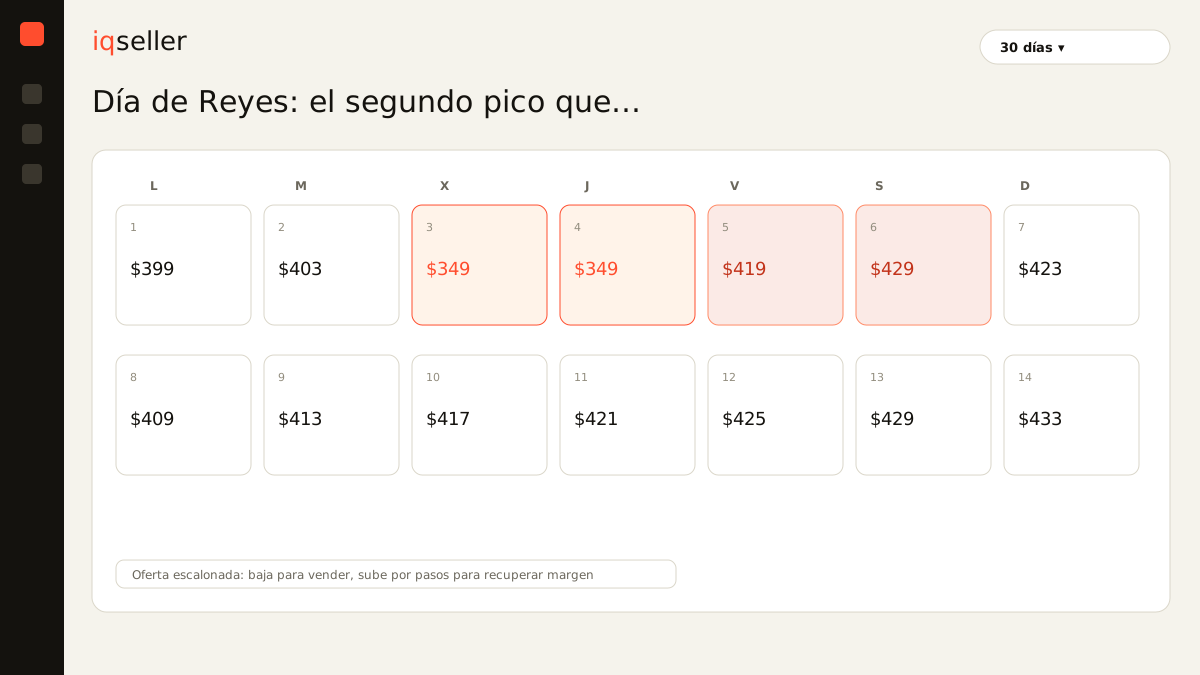
how big January 6 actually is in Mexico
It helps to anchor the size with public figures, even though they cover retail in general rather than the online channel. For Día de Reyes 2026, Mexico’s Concanaco Servytur chamber estimated economic activity of 26,136 million pesos nationally, 8% above the 24,200 million it had estimated for 2025. That is total consumer spending across Mexican commerce — brick-and-mortar included, rosca de reyes bread included — not marketplace sales, so use it to understand the scale of the event, not to project your units.
The categories that same estimate flags as highest demand are quite specific: traditional and educational toys; electronics such as video games, consoles, tablets, phones and computers; and apparel, footwear, perfume and personal care. If you sell in any of those families, Reyes is not a calendar footnote. It can move your entire January.
From the toy industry side there is another figure that explains why the Mexican season feels different. In December 2024, the Mexican toy association AMIJU stated that December generates 65% of the sector’s annual revenue, on annual sales in the order of 2.8 billion US dollars. That is a national industry figure covering all retail, not your channel, but it says something important: in toys, sales concentration into a few weeks is extreme, and an assortment mistake there is paid for with the whole year.
What you will not find is a reliable public series telling you how much a Mexican marketplace seller moves on January 5 versus December 20. That number is not published with the rigor you would need to plan against it. The one that does exist is yours, in last year’s history, and it is worth infinitely more than any industry average.
measuring your own Reyes peak with last year’s data
The exercise is simple and almost nobody does it. Take your units sold per day from December 1 to January 31 of the previous cycle, by channel and by SKU. Not revenue — units, because revenue mixes in the price changes you made during the season. Then chart it, or just list weekly totals. Three things will show up that a monthly average hides completely.
The first is where your Christmas peak actually falls, which is almost never the 24th. On marketplaces, with delivery promises on display, buying pulls forward: the real cutoff usually sits several days earlier, when the buyer stops believing it will arrive. The second is whether there is a valley between Christmas and New Year, and how deep it runs. The third is whether you have a lift in the first days of January and how concentrated it is: it may be a four-day curve or one brutal day.
With that in hand you can compute two ratios worth more than any borrowed benchmark:
- Reyes peak over Christmas peak: units in your best January week divided by units in your best December week, per SKU. It tells you whether Reyes is 20% of Christmas for that product, or 90%.
- Concentration: what share of January units sold in the five days before the 6th. If it is high, your margin for error is hours, not weeks.
Those two numbers, calculated per SKU rather than per account, are the real input to a forecast. And if this is your first cycle and you have no history, the honest path is not to fake precision: start from a conservative assumption, order in two waves, and use this season precisely to build the history that will serve you next year.
Glossary: forecast, what it is and what it needs so it is not guesswork →two peaks, one lead time: the arithmetic that settles everything
Here is the operational knot. January 6, 2027 falls on a Wednesday, and buying concentrates in the days before it. If you want units sellable on January 4 and 5, count backwards using your real lead time — the actual one, not the one your supplier promises — and add the channel’s inbound receiving time, which stretches during peak season.
An example with invented numbers, purely to see the mechanics: suppose 21 days of supplier production and transit, 7 days from your warehouse to the fulfillment center, and 5 days of receiving and check-in during high season. That is 33 days. To sell on January 4, the purchase order had to be placed around December 2. Swap in your own numbers and the date shifts, but the conclusion does not: the Reyes decision gets made in early December or earlier, not in January.
That explains why so many sellers arrive at Reyes with the wrong assortment. It is not lack of effort. The decision was made while they were still fighting El Buen Fin, with their head elsewhere, and nobody wrote down how many units were “for December” and how many were “for January.” Both waves blended into one lot, and the January wave sold out in December.
That is the cheapest fix available this year: label inventory by peak starting at the purchase order. You do not need a new system to begin. You need the discipline to separate “this is for Christmas” from “this is for Reyes,” and to check on December 26 how much of the second wave survived the first peak.
holding back for the second peak without starving the first
The uncomfortable question is whether holding units back is worth it. Lowering December availability to have a floor in January sounds like leaving money on the table, and sometimes it is. The answer depends on a concrete comparison you can actually run: the net margin that unit leaves you sold in December versus sold on January 4.
In December you usually sell with deeper discounts, more ad spend and more competitive pressure. In the Reyes window the buyer’s urgency is higher and the discount needed tends to be smaller. If your net margin per unit in January is better and your Reyes peak for that SKU is high, holding back makes economic sense. If the SKU barely moves on January 6, holding back is just freezing capital for three weeks.
That comparison needs net margin per channel and per date, not an average product margin. The same SKU can leave ten points more in one channel than the other once you subtract commission, fulfillment, shipping and advertising. Without that breakdown, “hold back or not” turns into a debate of opinions.
the logistics cutoffs you have to confirm yourself
Part of this planning cannot be reasoned out, only asked about. Both Amazon and MercadoLibre run inbound cutoff dates during peak season, appointment windows at fulfillment centers, and storage capacity limits that adjust with your performance. Those dates and limits change every year, change by warehouse, and sometimes change mid-season.
Do not take the deadline for getting inventory in on time for Reyes from a blog, this one included. Confirm it in Seller Central and in MercadoLibre’s help center, and confirm it again in mid-December. The same goes for delivery promises: if your promise slips two days because carriers are saturated, your Reyes peak moves two days earlier and you have to sell sooner.
What you can plan without asking anyone is your own buffer. If you know the channel takes five days to check inventory in during peak, your last useful order is not the one arriving January 2 — it is the one arriving December 27. You can do that subtraction yourself.
Glossary: days of inventory, the countdown that says whether you make it to January 6 →what to watch every day of the Reyes window
During the five or six days that genuinely matter, planning ends and operations begin. The short list of what to check daily, not weekly:
- Real available stock per channel, not total stock. Reserved, damaged and in-transit units do not sell.
- Sales velocity over the last 24 hours versus the prior week, to catch which SKU accelerated and which never started.
- Days of inventory at the current pace. A SKU with two days of coverage in a four-day window calls for a different pricing decision than one with ten.
- Net margin on what you are selling today, because the mix gets dirty during peak: volume rises and profit sometimes does not.
- Price discrepancies across channels, which appear during peak because one channel applied a promotion the other did not.
That list is the same as any heavy week, with one difference: at Reyes there is no second chance. A stockout on January 4 is not recovered on January 7, because demand vanishes with the date. A five-minute daily review on fresh data beats a perfect report on January 8.
how iqseller helps with this planning
iqseller will not tell you how many toys Mexico will buy on January 6 — nobody knows that. What it does is take the spreadsheet out of the three things this planning actually needs.
The first is clean, comparable history. The Analytics module and the period-comparison views let you see units per day, per channel and per SKU for the previous December and January, with Amazon and MercadoLibre sales in the same series. That is the input for your peak ratio and your concentration figure, without exporting three reports and stitching them by hand.
The second is Forecast and its restock recommendations, which work from sales velocity, lead time and coverage per channel to say what to order and when. It does not divine Reyes demand for you. It projects from your own behavior and lets you adjust the seasonal assumption, which is how it should be.
The third is Profitability: net margin per SKU with the COGS you load, the commissions that come from Amazon’s settlement and MercadoLibre’s orders, FBA and Full fees, shipping, advertising, and the VAT and withholding breakdown. That is what makes it possible to compare “this unit in December” against “this unit in January” with real numbers instead of intuition.
On top of that, Inventory gives you real availability and valuation per warehouse, including FBA, Full and 3PL, and Alerts warns you when a critical SKU drops below its threshold mid-window. What iqseller does not do is place purchase orders with your supplier or negotiate an inbound appointment with the marketplace. That stays yours, and the cutoff dates you confirm in each channel.
the real shift: a season in two acts
The idea worth keeping is that the Mexican season is not one peak with a long tail. It is two distinct events stuck together. Treating them as one means the second always gets planned with the leftovers of the first, and leftovers are rarely what the Reyes buyer is looking for.
Planning them separately does not cost more money, it costs more order: two waves identified from the purchase order onward, two forecasts, two pricing reviews, and a date in December — not January — when you sit down and decide what will be available on the 4th. If you also measured your own peak from last year, you stop competing against a generic calendar and start planning against your real demand. That is the only benchmark that truly serves you.