
Profitability by channel: the same product does not earn the same everywhere
October 6, 2026
The question shows up sooner or later in every multichannel business: if I have budget to push a product, which channel do I send it to? The default answer is “the one that sells the most”. And the one that sells the most is almost never the one that earns the most.
The problem is that most sellers do not have the figure broken out. They have the margin of the whole business and they have sales by channel, but they do not have margin by channel, and certainly not margin by channel per product. So they decide on sales, which is the number they do have, and end up pouring advertising into the channel where each extra peso leaves the least behind.
The uncomfortable part is that the gap between channels is neither small nor stable. The same SKU, with the same COGS, bought from the same supplier, can leave a healthy margin on one channel and land near zero on another. Not because of one big reason, but because of six or seven small ones stacking in the same direction.
This post takes those reasons apart one at a time, builds the full calculation with an example, and gets to the question that actually matters: not which channel is “better”, but where the next unit of volume should go.
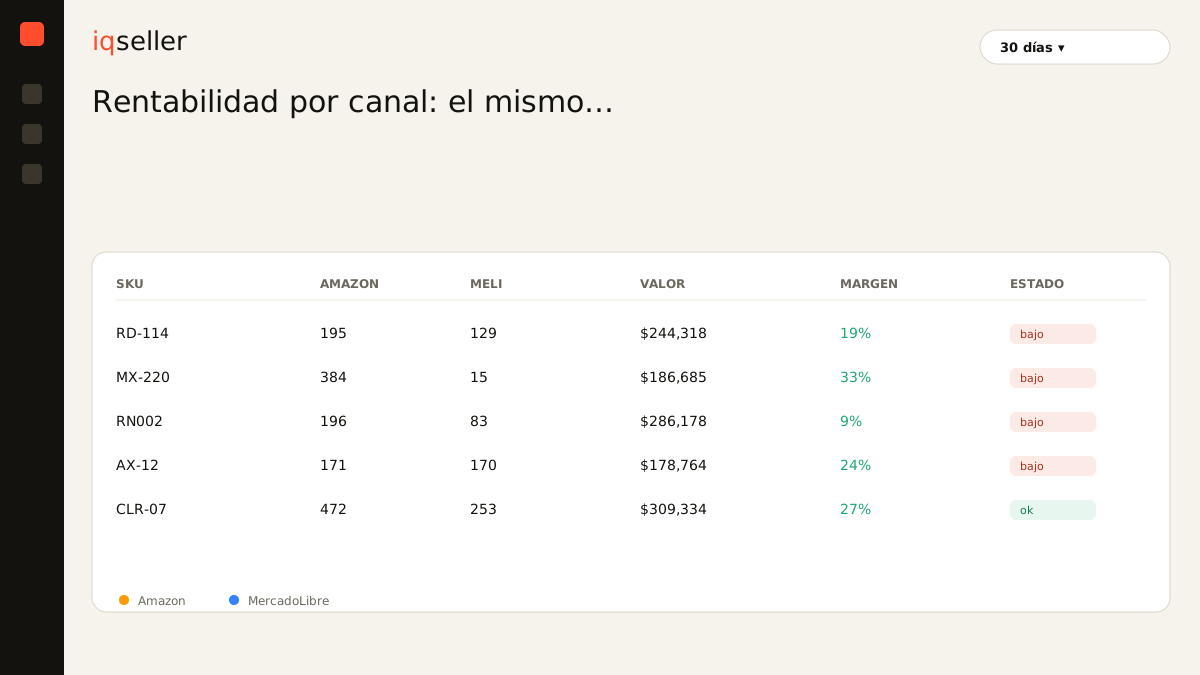
the same product, three different sets of books
When you say “this product leaves me fifteen percent”, you are averaging. And the average of three channels with different cost structures describes none of the three.
Picture one concrete unit you bought for five hundred forty pesos. That unit can leave through three doors. On each one the selling price changes, who charges commission and how much changes, who stores and who packs changes, who pays shipping changes, what it costs to get the buyer changes, and the odds of it coming back change.
Six variables moving at once. None of them swings wildly on its own, but six three-or-four-point differences pointing the same way add up to fifteen points of margin. And fifteen points, in a business that runs on fifteen, is the difference between earning and not.
The practical consequence is that channel profitability is not estimated, it is calculated. There is no shortcut and no general rule of the “Amazon leaves less than Meli” kind. It depends on your category, your weight, your price and your return rate, and it changes when any of the four changes.
the variables that explain the gap
Before the numbers, it is worth having the full list of what moves between one channel and the next:
- The selling price. Rarely identical. Competition, elasticity and each platform’s rules push toward different prices, and that gap is the first margin factor.
- The commission. The percentage varies by channel and category, and the detail of what base it applies to — with or without VAT, on price or on price plus shipping — changes the result more than it looks.
- Fulfillment. FBA, Full, 3PL or self-shipping have completely different structures: some charge per unit and size, others blend storage with handling, and with self-shipping the cost is your own time, which almost nobody books.
- Shipping to the buyer. Who absorbs it and under what price threshold. With free shipping it is you, and on your own store it is you with nobody subsidizing anything.
- The cost of acquiring the buyer. On a marketplace you pay for in-platform advertising and compete against listings; on your own store you buy traffic from scratch. This is the variable with the widest range between channels.
- The return rate. It is not the same everywhere. Policies differ, the buyer profile differs, and the friction of sending something back differs.
- The payment cycle. It does not change the margin of the order, but it does change how much capital you need to sustain the volume. We leave it for later because it deserves its own section.
the full example, channel by channel
The numbers below are invented to show the mechanics. COGS is the same in all three: $540. Everything is computed on a pre-VAT base, because the VAT was never yours.
MercadoLibre with Full. Price $1,160 with VAT, base $1,000.
- COGS: −$540
- Channel commission (14% of base): −$140
- Full fulfillment: −$82
- Attributable advertising: −$60
- Return provision (6% × $300 cost per return): −$18
- Net margin: $160 — 16.0% on base
Amazon with FBA. Price $1,218 with VAT, base $1,050.
- COGS: −$540
- Referral fee (15% of base): −$157.50
- FBA fee: −$95
- Attributable advertising: −$105
- Return provision (8% × $320): −$25.60
- Net margin: $126.90 — 12.1% on base
Your own store. Price $1,102 with VAT, base $950.
- COGS: −$540
- Payment gateway (3.6% + $4): −$38.20
- Shipping to the buyer, absorbed by you: −$110
- In-house picking and packing: −$35
- Traffic acquisition: −$180
- Return provision (4% × $260): −$10.40
- Net margin: $36.40 — 3.8% on base
Same product, same supplier, same week. Sixteen percent, twelve percent and four percent. And notice something counterintuitive: the own store sells cheaper in this example and is still the worst performer, because the commission saved gets eaten by shipping and acquisition. The instinct that “on my own site I pay no commission, so I earn more” is wrong far more often than not; the commission simply changed its name.
why margin per order does not decide on its own
With those three figures the easy conclusion would be to push everything to MercadoLibre. It is the wrong conclusion, because percentage margin does not pay rent: the total does.
Assume the product’s actual quarter looked like this:
- MercadoLibre: 400 orders × $160 = $64,000
- Amazon: 250 orders × $126.90 = $31,725
- Own store: 60 orders × $36.40 = $2,184
Total contributed by the product: $97,909. MercadoLibre brings two thirds, Amazon nearly a third, and the own store brings something that, honestly, would not justify the work of maintaining it if selling that SKU were its only job.
That last sentence deserves an asterisk. The own store also gives you the buyer’s email, the record of who bought, the ability to sell again without paying commission, and a brand that does not depend on anyone’s policy. That value does not show up in order margin and it is real. The honest way to put it: today the own store is an investment, not a profit source, and it should be managed as one.
the marginal cost of the next sale
Here is the part almost nobody does, and the one that changes the decision.
The margin we calculated is an average. The question of where to push volume is not about the average order: it is about the next one. And the next order almost never costs what the average costs, because getting it means raising the bid, widening the audience or dropping the price.
Suppose that to sell twenty more orders a month you need, on each channel:
- MercadoLibre: raise attributable advertising from $60 to $105 on the incremental order. Marginal margin: $160 − $45 = $115.
- Amazon: raise it from $105 to $135. Marginal margin: $126.90 − $30 = $96.90.
- Own store: raise acquisition from $180 to $230. Marginal margin: $36.40 − $50 = −$13.60.
The reading changes tone. On MercadoLibre each extra order still contributes a hundred fifteen pesos. On Amazon, ninety-seven. On the own store the extra order costs you money: growing there, with that acquisition structure, destroys margin.
That is the calculation that decides. Not “which channel is better”, but what the one-thousand-and-first peso of budget leaves on each channel. And it has to be redone, because marginal cost rises as you grow: there is a point where even on MercadoLibre the next order leaves less than the last one.
what you cannot see: capital, timing and risk
Two channels with the same margin are not equivalent if one pays in three days and the other in twenty-five.
The payment cycle determines how much working capital you need to hold a given sales level. If you sell a hundred thousand pesos a month on a fast-releasing channel and a hundred thousand on one that holds funds for three weeks, the second forces you to keep more money permanently immobilized. That cost never shows in order margin, but it very much shows in your ability to place the next purchase order with your supplier.
Two more factors belong next to each channel’s margin:
- Concentration. A channel that contributes eighty percent of your profit is a risk, even if it is the most profitable one. A policy change, a suspension or a new competitor moves the whole business.
- Cost to operate. Every channel consumes someone’s hours: listing, answering questions, handling claims, keeping the catalog clean. Those hours are a real fixed cost and they are not spread evenly.
how this reads in iqseller
The Profitability module computes net margin per SKU and breaks it down by channel, starting from real movements: Amazon settlement commissions, MercadoLibre order commissions, FBA and Full fees, shipping, advertising, and the VAT and withholding breakdown. COGS is loaded by you, and it is what turns a revenue report into a profit report.
The piece that makes the comparison possible is the Catalog, with its Parent → Model → SKU tree. Without that structure, “the same product” on Amazon and on MercadoLibre are two rows nobody links, and there is no way to put their margins side by side. With it, the comparison is direct and drills down to the size or color where the gap originates.
The Pricing module is where what the comparison finds gets corrected. If a channel sits below the floor, the adjustment happens there with margin in view rather than from memory. And Alerts exists so you hear about a channel crossing the threshold you defined instead of discovering it at month-end close.
The Inventory module completes the picture on the capital side: how much stock is committed in FBA, in Full and in your own warehouse, with its valuation. Pushing volume to the most profitable channel means moving inventory there, and that is only plannable with both views together.
how to decide where to push
The procedure fits in five steps and needs nothing exotic:
- Compute net margin by channel for your top twenty products, on a pre-VAT base and with the return provision included. Twenty products usually explain most of the profit.
- Estimate the marginal acquisition cost on each channel: how much you would have to raise advertising to move volume ten percent.
- Subtract and rank. The channel with the highest marginal margin gets the incremental budget. The one that comes out negative is not necessarily closed, but it stops receiving new money.
- Check the payment cycle before confirming. If the winning channel pays very late, growth will hit your cash before it hits demand.
- Measure it again in four weeks. Commissions change, fees get updated, and cost per click rises in peak season. An allocation decision has an expiry date.
None of this is sophisticated. It is arithmetic. The hard part is not the calculation but having clean data, by channel and by SKU, on the day the decision has to be made — not three weeks after the budget is already spent.