
Raising prices in December: how much the season absorbs
November 25, 2026
December comes with a reflex pre-installed: go down. We go down during Buen Fin because everyone does, down in the first week of December because the season started, down mid-month because a competitor did, and we arrive at the 31st with the highest-revenue year on record and a profit that does not resemble the effort.
The curious part is that December is probably the month of the year in which your price has the most room. Not because people have more money, which is a story we tell ourselves. Because the December buyer buys under conditions that change how they decide: there is a hard deadline, they are often not buying for themselves, and the alternatives they would normally consider are out of stock or delivering too late.
That does not mean you can raise whatever you want. It means the question “how much will my price tolerate?” has a different answer in December than in March, and almost nobody measures it. It gets assumed to be zero, and that assumption runs the whole month.
This article will not hand you a percentage. There is no honest general elasticity figure for Mexican marketplaces to cite, and anyone telling you “in December you can raise 12 percent” is either making it up or pulling it from their own catalog, which is not yours. What does exist is a method: how to calculate how much volume you can afford to lose, how to test an increase without burning your position, and when simply not to.
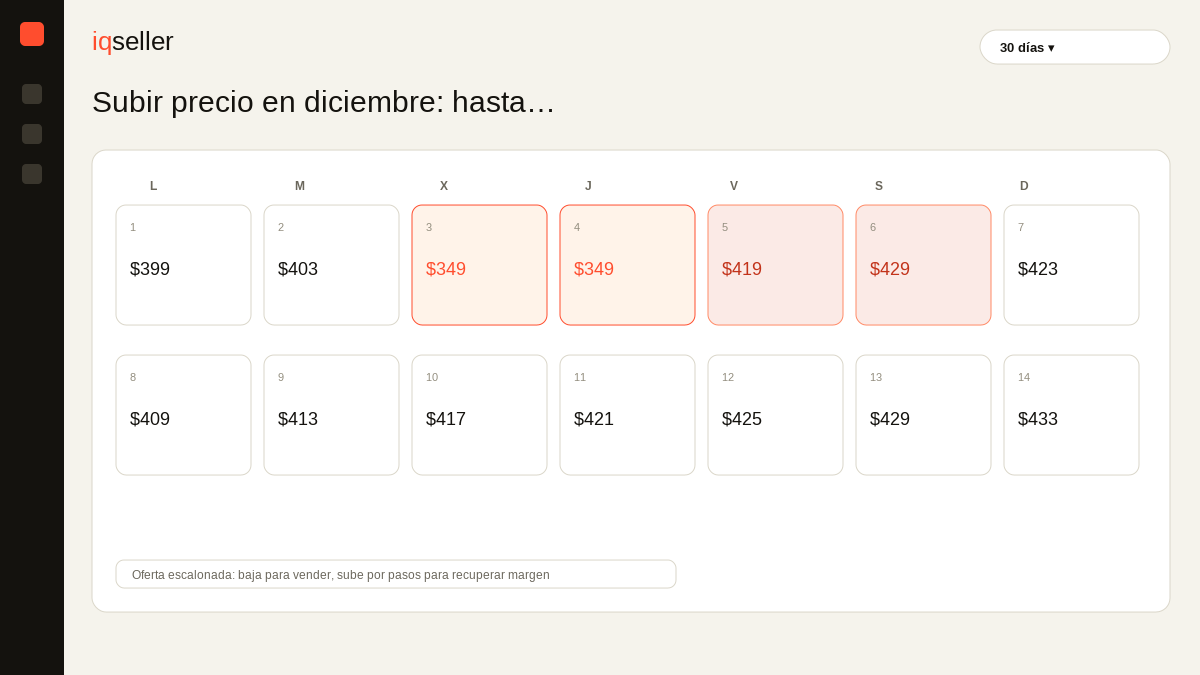
why going down feels safe and is not
Lowering price has a dangerous psychological property: the effect shows up fast and it is positive. You drop, units rise, the counter moves, it feels like it worked. The cost appears weeks later, spread across commissions, fees and a per-unit margin that no longer covers anything, and by the time it appears it can no longer be traced to a specific decision.
Raising has the opposite property. The negative effect shows up fast: units drop, and that hurts immediately. The positive effect — more profit per unit — shows up at the month’s close. So a decision that may well be correct feels wrong for the first three days, which is exactly when most sellers reverse it.
That is why the decision to raise cannot be made on feel. It is made with arithmetic done beforehand, telling you how much volume you are allowed to lose for the change to still be good. Without that arithmetic, on day three you will react to a drop in units with no idea whether the drop matters.
what changes about the December buyer
There are three mechanisms worth understanding, and I present them as mechanisms, not as data: they are reasons to test, not evidence of an outcome.
The first is the deadline. In March, a buyer who finds your price high waits, compares, saves the product. In December they have a delivery date that does not move. The cost of continuing to shop is no longer just time: it is the risk of not having it before the 24th. That reduces comparison shopping, and comparison shopping is the mechanism by which the lowest price wins.
The second is that the buyer is not always the user. A gift gets evaluated differently: the buyer is not optimizing price per unit of their own utility, they are covering a social obligation against an approximate mental budget. Between two products that both do the job, fifty pesos of difference carries less weight than in a purchase for oneself.
The third is scarcity on the supply side. In December your competitors run out too. The product that would normally be the cheap alternative may be out of stock, or delivering on January 7, which for a Christmas gift is the same as not existing. Your price is not competing against the lowest price in the category, it is competing against the lowest price that genuinely arrives in time.
None of the three is universal. In repeat-consumption categories, where the buyer is the user and there is no date pressure, all three weaken. Which is why this gets tested per product and not decreed for the catalog.
the arithmetic that tells you how much volume you can lose
This is the part that makes the decision defensible. Before touching a price, calculate how many units you can stop selling and still earn the same.
An example with the arithmetic closed. You have a SKU you sell at 599 pesos. Your COGS is 310. The channel commission is 15 percent, which is 89.85. Shipping plus the fulfillment fee add up to 109. Total variable cost: 508.85. Margin per unit: 90.15.
Now you raise it to 649. COGS does not change: 310. The commission does, because it is a percentage: 15 percent of 649 is 97.35, nine pesos more than before. Shipping and the fulfillment fee stay at 109. Total variable cost: 516.35. Margin per unit: 132.65.
Margin per unit went from 90.15 to 132.65, a 47 percent increase. The question is how many units you need to break even. If you were selling 100 units, your gross profit was 9,015 pesos. To match that at 649, you need 9,015 divided by 132.65, which is 68 units. Check: 68 × 132.65 = 9,020. Practically identical.
In other words: you can lose 32 of every 100 units and come out even. And if you lose fewer — say you fall to 85 units — you make 85 × 132.65 = 11,275 pesos, 25 percent more profit while selling 15 fewer units. With a bonus almost nobody counts: you consumed 15 fewer units of inventory, which in a month where inventory is the scarce resource is worth something on its own.
Do this arithmetic before raising and write the number down. “I can fall to 68 units a week.” That is your threshold, and it is what you compare against on day three instead of your gut.
Glossary: real net margin, with everything deducted →raising price as an inventory tool
There is a second reason to raise in December that has nothing to do with per-unit profit, and it is the one most often wasted: stretching coverage.
If a SKU will last five days and the month has eighteen days of demand ahead, you have an allocation problem. Lowering the price makes it worse. Raising it eases it in two ways at once: it slows the outflow somewhat, and it makes each remaining unit leave more behind.
With the previous example: at 599 you sell 36 units a day and you have 240, so you have 6.7 days. At 649 you sell 28 a day, and 240 divided by 28 is 8.6 days. Almost two extra days of presence in the most important month of the year, with a per-unit margin 47 percent higher. The total profit from that finite inventory goes from 240 × 90.15 = 21,636 pesos to 240 × 132.65 = 31,836 pesos. Same inventory, sold slower, at a better price.
This logic is the inverse of a laddered offer and applies when the bottleneck is not demand but stock. In December, for many SKUs, the bottleneck is stock. Lowering the price on a product that will run out before the season ends is giving away margin in exchange for nothing: those units were going to sell anyway.
how to test without risking the Buy Box
The test has to be designed so it can be reversed in minutes and so the result is readable. Five practical rules.
- One change at a time. If you raise the price on the same day you raise the ad budget and swap the main image, you will not be able to attribute anything. December already has plenty of variables in motion.
- Small steps. Going from 599 to 649 is 8.3 percent. That is a readable step. Going from 599 to 799 is not a test, it is a change of strategy, and the only thing you will learn is that sales stopped.
- One channel first. Raise in the channel where you have the least direct competition on the same listing and leave the other as a reference. If you sell on your own listing on MercadoLibre and compete for the Buy Box on Amazon, test on Meli first.
- A long enough window. Three days minimum, ideally comparable ones: do not compare a Tuesday against a Saturday in December, because the traffic pattern differs. And never run a test across a platform event.
- An exit metric defined up front. Units per day against your calculated threshold. If you fall below it, you go back to the old price and you have learned something. If you do not, you keep it and test the next step the following week.
The Buy Box part deserves separate care. If you compete for the featured offer on a shared listing, the total price — product plus shipping — is one of the factors determining who wins it, and losing it is not losing a little sales: it is losing most of them. What share you should expect and how it is measured is in Buy Box win percentage.
The practical rule: on shared listings where the Buy Box is your main source of sales, the step has to be small and you have to watch the Buy Box share, not just units. Units take time to react; the Buy Box does not. If your share drops on day one, the price is already out of range and there is no need to wait three days to know it.
the platform rules worth knowing first
There is a limit that is not economic but policy-based, and it is worth knowing before you experiment.
Amazon has a marketplace fair pricing policy that lets it act when it considers a price harms buyer trust, including prices well above recent prices for the same product on or off Amazon. The consequences the company itself has publicly described range from losing the featured offer to listing or account deactivation, and the shipping calculation counts too, because the price evaluated is the total. I will not publish a threshold, because Amazon does not publish a formula, and the figures circulating in tooling blogs are third-party estimates. Confirm it on the policy page in Seller Central before making large moves, since these rules get updated.
For the steps this article talks about — single-digit percentage adjustments on your usual price — this is not usually the relevant risk. It becomes relevant when the temptation is a different one: a product that sold out across the whole market and that you could list at double. That is exactly the zone the policy exists for, and the cost of getting it wrong there is not measured in margin but in account status.
On MercadoLibre the practical limit is different and softer: if you participate in catalog listings, raising the price can push you out of the winning position, and the mechanism is explained in MercadoLibre catalog listings. It is also worth reviewing MercadoLibre’s own help center, because the catalog and reference-price mechanics have changed several times.
when not to raise
The list of cases where this does not apply matters just as much, because raising on the wrong product is a fast way to lose position in the worst month to lose it.
- When you need velocity for ranking. A recently launched product, with few reviews, building its sales history. There, volume is worth more than margin, and December is the month to get it.
- When you already committed to a promotion. If your product shows a struck-through reference price or sits inside a channel campaign, moving the price up can break the promotion mechanics or create a visible discrepancy. You exit the promotion first, then adjust.
- When you have too much inventory. If you have three months of coverage on a seasonal product, the problem is not per-unit margin, it is selling before the season ends. There the December decision runs the other way.
- When you are in an active price war. Raising mid-war can be the right exit, but it is a different move, with different logic and different risks, developed in price war.
- When you do not have the per-unit margin calculated. Without that number you cannot compute the threshold, and without the threshold you are not testing: you are moving prices to see what happens.
how this looks in iqseller
To run the threshold arithmetic you need per-unit margin with everything deducted, and that is what the Profitability module provides: net margin per SKU with your loaded COGS, commissions from the Amazon settlement and from MercadoLibre orders, FBA and Full fees, shipping, advertising and the VAT and withholding breakdown. That is the 90.15 in the example, computed from your numbers instead of estimated.
The Pricing module is where the test lives: published price per channel against the calendar you approved, the change history so you know which price was live on each day of the measurement window, and the profitable floor per SKU so a step never puts you under it. Forecast gives you coverage against recent velocity, which is the other input to the decision: without it you do not know whether the SKU is a candidate for stretching or for accelerating. And Alerts flags when a published price separates from the approved one, which is how you find out the step did not apply where it should have.
What iqseller does not do: it does not move prices on its own. There is no automatic repricer and no rules that raise or lower by themselves. It also does not estimate your product’s elasticity or predict how many units you will lose on a step: you measure that with the test. The panel gives you the correct per-unit margin, the floor, the coverage and a clean history so the test is readable. The decision and the move in the channel are yours.
the operable summary
Pick three or four SKUs with short coverage and a well-calculated per-unit margin. Compute the unit threshold for each. Raise one single-digit percentage step, in one channel, without touching anything else. Measure three comparable days. Compare against the threshold, not against your expectation.
If it holds, keep it and test the next step. If it does not, go back, and you now know something about your catalog you did not know, something that will serve you next December. The only thing that is not worth doing is arriving at the 31st having never tested it, assuming the answer was zero.