
Triaging the SKU that runs out mid-season
November 25, 2026
It is December 12. You open the panel and the SKU carrying 30 percent of your revenue has 180 units. It sold 34 yesterday, 31 the day before and 36 the day before that. The season has sixteen days of demand ahead.
The arithmetic is brutal and takes five seconds: 180 divided by 34 is 5.3 days. You are ten or eleven days of product short in the highest-selling stretch of the year. If the pace holds, you would need 16 × 34 = 544 units and you have 180. The deficit is 364 units that are not going to arrive, because restocking in December is not a real option: your supplier has their own queue, customs has its own and the fulfillment center has its own.
What follows that arithmetic is the most expensive moment of the season, and it is almost always handled badly. Not because people do not know what to do, but because they do the right things in the wrong order. Advertising gets switched off before inventory is reassigned. The listing gets paused before the price goes up. The supplier gets a call before anyone knows the real shortfall. Each of those inversions costs units or costs margin.
This article is a triage protocol: a fixed sequence of five steps, designed to run in an hour, with the reasoning for why each step goes before the next. It is not a list of options. It is an order.
why a mid-season stockout is not a normal stockout
In an ordinary month, running out of a SKU costs you the sales of the days it takes to restock. Annoying, measurable, recoverable. Mid-season the cost changes in nature, for three reasons.
The first is that the sales are not postponed. In February, a customer who cannot find your product may come back in two weeks. On December 20 they do not come back: they buy something else, from someone else, and the purchase disappears from your year.
The second is that the stockout is also paid in position. On both marketplaces, a listing without stock loses accumulated visibility, and recovering it takes longer than the restock does. You go five days without product and drag the consequence for two weeks, by which point the season is over.
The third is that a stockout charges you in account metrics if you handle it badly. Cancelling orders because the published stock did not exist is different from not having published stock: the latter costs sales, the former costs reputation, and in December the latter is clearly preferable. The link between stockouts and account health is in fill rate and account reputation.
So triage is not trying to “avoid running out”, which at this point is already impossible. It is trying to make the remaining 180 units leave the most profit and the least damage.
Glossary: stockout, when you run out of product to sell →step zero: the arithmetic, before any move
Before touching anything, the problem has to become three numbers. It takes ten minutes, and it is what keeps the following steps from being improvisation.
One: real available stock, not total stock. They are not the same. Of those 180 units, 20 may be committed to unfulfilled orders, 15 in transit to a fulfillment center that will not be received before the 18th, and 8 in an unfulfillable state. Real available would be 137, not 180, and triage run on 180 will leave you short right at the end.
Two: velocity per channel, not total. The aggregate 34 a day does not tell you where they are going. If it is 22 in one channel and 12 in the other, the reassignment decisions are completely different from 17 and 17.
Three: the days of season that actually matter. Not calendar days. If you sell gifts, your real demand ends when the delivery promise ends, not on the 24th. If you sell something also bought for Día de Reyes, you have a second stretch. The effective cutoff is discussed in the last date you can promise delivery before Christmas.
With those three numbers you have the real deficit per channel and the horizon. Everything else is allocating a scarce, known resource, which is a solvable problem.
step one: slow the pace before switching anything off
The first move, and the one most people skip, is the cheapest of all: raise the price.
It sounds counterintuitive in the middle of a stock emergency, and that is exactly why it works. A higher price does two things at once. It slows the outflow somewhat, so your units cover more days of season. And it makes each unit that does leave worth more, which offsets part of the sales you will not make.
With the example. Say the SKU sells at 599 with a per-unit margin of 90 after COGS, commission, shipping and fees. The 137 available units, at that pace and price, are four days and 12,330 pesos of profit. If you raise to 659 and the pace drops from 34 to 26 a day, margin per unit rises: 60 pesos more price minus 9 of extra commission is 51 pesos, so margin goes to 141. Now the 137 units are 5.3 days and 137 × 141 = 19,317 pesos.
Same inventory. A day and a half more presence in the key month, and 6,987 pesos more profit. Price is the only triage lever that improves both variables at once, and it is reversible in minutes.
The limit: if your sales depend on winning the featured offer on a shared listing, a large step pushes you out and you lose all the volume instead of slowing it. There the step has to be small and you have to watch the Buy Box share, not just units.
step two: reassign across warehouses and channels
Second move: send the units where they leave the most, not where they sell fastest.
This is the decision that moves the most money and the one taken worst, because instinct says “send the inventory to the channel that sells the most”. The correct criterion is profit per unit, crossed with the cost of running short in the other channel.
An example with numbers. Channel A sells 22 a day and leaves you 118 pesos of margin per unit. Channel B sells 12 a day and leaves 76, because the category commission is higher and you absorb the shipping. You have 137 units.
If you split them the way they have been selling — proportionally, 86 to A and 51 to B — your profit is 86 × 118 + 51 × 76 = 10,148 + 3,876 = 14,024 pesos. If you send them all to A, 137 × 118 = 16,166 pesos, almost 2,150 pesos more from the same inventory. Every unit you place in B instead of A costs you 42 pesos of profit.
But the calculation does not end there, and here is the nuance that matters: leaving channel B at zero has costs that are not in those 42 pesos. It loses accumulated position in that channel, it can hurt your metrics if you have orders you cannot fulfill, and if B is the channel where you are building a twelve-month presence, switching it off for fifteen days is a strategic decision disguised as an operational one.
The practical rule that works: the higher-margin channel gets supplied first and in full up to its own coverage target; the lower-margin channel takes the rest plus the minimum stock it needs to avoid showing zero. Leaving three units in B is not symbolic: it keeps the listing live with real stock and avoids the position damage, at a cost of 126 pesos of profit. That is cheap insurance.
The mechanics of moving physical inventory between warehouses and 3PLs, with their timelines, are in multi-warehouse and 3PL inventory in one view. In December you have to add that transfers take longer than usual: a move that took two days in October can take five, and five days out of sixteen is a third of what is left.
step three: substitute, do not switch off
Third move, and the most neglected: steer the demand toward an equivalent product you do have.
A SKU running out does not switch off demand, it just leaves it without a destination. That demand exists, it is searching, and it will land somewhere. It can be in your catalog or in someone else’s.
In practice it is three concrete actions, in order of effort. Move the ad budget from the SKU that is running out to the substitute, which is the fastest and most effective, and which also stops burning money on clicks toward something you cannot fulfill — the criteria for pausing campaigns mid-event are in when to pause a campaign mid-event. Second, check that the substitute is well positioned: sometimes it is the same product in another variant, and all you need is for the available variant to be the default one shown. And third, if the substitute has a better margin than the original, celebrate: the stockout just did you a favor.
The substitute does not have to be perfect. It has to serve the same function for a gift buyer, which is a more flexible standard than we assume: the exact size and exact color matter less when the recipient is someone else and the date is tight.
step four: decide what gets switched off, and how
Fourth move. When the units are going to run out anyway, you have to decide how they run out, and there are two ways: on purpose or by accident.
Running out by accident means letting published stock reach zero while orders are still coming in, with the risk of selling units that no longer exist and ending up cancelling. That is the worst possible outcome: you lost the sale and the cancellation was charged to your metrics on top.
Running out on purpose means pausing the listing, or dropping published stock to zero, while you still have a cushion. If your sync runs clean, the cushion can be small. If it runs behind, the cushion has to be bigger, and it is worth knowing by how much: a two-hour update window at 34 units a day is roughly three units of exposure, and that is how you compute the floor at which to switch off.
An in-between variant almost nobody uses: leave the listing live with the exact real stock and an adjusted delivery promise. If you have eight units left and you can fulfill them, it is better to sell them with the correct date than to pause the listing. What kills you is promising what you cannot deliver, not selling a little.
why this order and not another
The five steps follow a logic of dependency, not of importance.
Price goes first because it is the only move reversible in minutes and because it changes the numbers you will use for the following steps. If you raise the price and the pace drops from 34 to 26, your deficit went from 364 to 279 units and the reassignment becomes less aggressive. Reassigning before adjusting the price is solving an equation with the wrong input.
Reassignment goes before substitution because you first define how many units each channel gets and then decide where the surplus demand is steered. And substitution goes before switching off because moving the ad budget takes effect immediately while the listing is still live; if you switch it off first, you lose the signal of where demand was going.
Switching off goes last because it is the only irreversible step within the season. Reactivating a paused listing in December does not give you back the position it had.
Glossary: real available stock, what you can actually sell right now →the part that gets solved before, not during
All of the triage above is damage control. The real work is making sure the December 12 arithmetic is not a surprise.
The difference between orderly triage and a fire is how many days of warning you had. With seven days, step two includes physical transfers and step zero includes a supplier call that can still accomplish something. With two days, transfers no longer arrive and triage shrinks to price and substitution.
The warning does not come from checking more often. It comes from a threshold defined per SKU and an alert that fired without anyone opening the panel. And a peak-season threshold is not the same as an October one: if your velocity quadruples, a threshold set in units becomes useless, because those units now represent a quarter of the days they used to. How to set it is in what is critical stock and how to set the threshold for each SKU, and the practical configuration is in critical stock alerts.
It also pays to assume December lead times are not the usual ones: a supplier who delivered in three weeks may be at six, and that changes what is restockable and what is not. It is in when supplier lead time stretches in peak season.
how this triage looks in iqseller
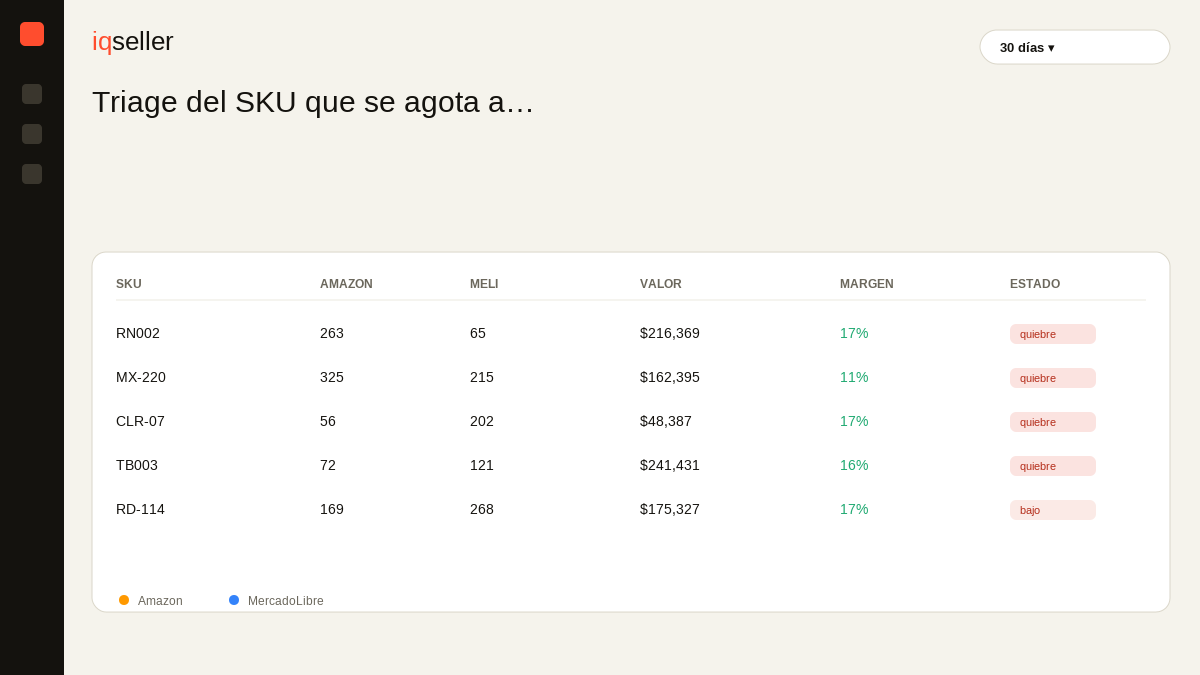
Step zero is the Inventory module: real available stock per SKU, separate from total stock, broken down by your own warehouse, by Amazon fulfillment center, by Full and by 3PL. Over the Parent, Model and SKU tree, so a size running out shows up as what it is instead of hiding in the parent total. Velocity per channel and the resulting coverage come from the Forecast module, which is where the 137-divided-by-26 arithmetic happens.
Step one lives in Pricing: the profitable floor per SKU, so a step never puts you below it, and published price per channel against the approved one, to confirm the step applied where it should have. Step two uses Profitability, which is where the 118 and the 76 in the example come from: net margin per SKU and per channel with your loaded COGS, commissions from the Amazon settlement and from MercadoLibre orders, FBA and Full fees, shipping, advertising and the VAT and withholding breakdown. Without that per-channel number, reassignment is a hunch.
And Alerts is the part that turns triage into something planned: critical-stock notices per SKU and per channel at the threshold you define, plus price-discrepancy and sync-failure notices.
What iqseller does not do: it does not move inventory, pause listings, reassign stock across channels or change prices on its own. It also does not execute physical transfers or talk to your supplier. It gives you real available stock, velocity per channel, coverage and margin per channel; you execute the five steps in each platform.
the triage sheet, in six lines
It is worth having written down before you need it, because the day you need it you will not be in shape to write it.
Compute real available stock, velocity per channel and days of season remaining. Raise one price step and recompute the deficit at the new pace. Supply the higher-margin channel first up to its coverage target and leave a visible minimum in the other. Move the ad budget to the available substitute. Decide the unit floor at which you switch off, computed from your sync window, and switch off on purpose when you reach it. Write down the real deficit so next year’s purchase does not repeat the mistake.
Six lines. One hour well spent on December 12 is worth more than three weeks of analysis in January.